/ Pillar · YouTube niche finder
How to find YouTube niches that are already working — using real channels, not brainstormed lists
A YouTube niche finder surfaces content niches with public proof they're working: real channels with abnormal early traction. The best niche finders rely on public YouTube Data API v3 metadata (channel age, upload count, views per day, first-five-video performance, Shorts ratio), not invented stats or AI guesses. NicheBreakout's free preview is built on thousands of channels we've scanned to date, surfaced from public Data API metadata only.

Ai stories by shano
 45d · 36 uploads
YOU & ME
 45d · 25 uploads
Dootoons TV
 45d · 69 uploads
Mr Pawsome
 42d · 64 uploads
sajkcasqq
 38d · 38 uploads
OP Nigma

FactD
 45d · 31 uploads
Cognexa Talks
 39d · 21 uploads
MapLore
What a YouTube niche finder actually does in 2026
A YouTube niche finder is a research tool that surfaces content niches by analyzing public YouTube metadata for signals of channels currently working inside each niche. The category splits into three flavors. Idea generators, usually LLM-driven, return long lists of "100 niches to start" repackaged from older lists. Keyword tools repackaged as niche tools (vidIQ, Semrush surfaces re-labeled as niche dashboards) return search-volume metrics dressed up as niche analysis. Channel-discovery libraries (TubeLab, OutlierKit, NicheBreakout) index small or recent channels and let you filter them by traction signals like channel age, view velocity, and upload count. Only the third flavor returns evidence that a niche is moving right now. The first two return imagination, dressed up as recommendation. The right framing for a real niche finder: it is a research tool that hands you channel-level evidence, not a fortune cookie that hands you topic names.
vidIQ defines the underlying object cleanly: "A YouTube niche is the specific topic area your channel focuses on, such as gaming, travel, or cooking" (vidIQ). That definition is fine, but it answers "what is a niche," not "is this niche worth running a channel inside." The second question is the one a niche finder is supposed to answer, and the gap between those two questions is the entire reason proof-based tools exist while idea-based tools cycle through the same recycled lists every year.
Proof-based tools work by reading public Data API v3 fields like channel age, video count, view count, and video metadata, then applying deterministic filters that flag channels whose early-traction profile is unusual relative to their size. If a 14-day-old channel with 4 uploads averages 40,000 views per day on its first five videos, that is signal. If a brainstormed list says AI storytelling is hot, that is noise until you can point at a specific small AI-storytelling channel that is currently moving. The methodology NicheBreakout uses to flag candidates is published in full further down this page; the full niche research workflow walks through how to apply these signals end-to-end.
A practical test for any niche finder: ask it to show you five small channels in a niche it just recommended. Tools that can answer instantly are working from real channel data. Tools that pivot to keyword volume or generic "search demand" are not. Most products in the current SERP fall into the second bucket.
Why small-channel proof beats brainstormed niche lists
The fastest way to tell whether a niche-finder list is research or imagination is to look for channel evidence. A list that names AI storytelling without showing a small AI-storytelling channel currently breaking out is recommendation by vibe. A list that says "AI storytelling: here are four channels under 90 days old, three of them faceless, all clearing 50,000 views per day on their first five uploads" is research. The difference matters because a niche that worked in 2023 and is referenced in a 2026 listicle may have already saturated; without channel-level evidence you have no way to tell. Profitability claims sit on the same shaky ground. RPM, CPM, and revenue numbers live behind the YouTube Analytics API and aren't third-party-accessible, so any "$30 RPM in this niche" headline on a generic list is either guess, extrapolation, or marketing pitch.
OutlierKit names this pattern explicitly: "The sweet spot: Topics with clear audience demand but few creators producing high-quality content" (OutlierKit). That sweet spot is only verifiable by looking at the actual channels in the niche, not by reading a list of niche names.
The brainstormed-list problem compounds in three ways. First, lists copy each other. A list published in 2026 is often re-shaping the same 30 niches that appeared in 2022 listicles, which means the niches that were genuinely fresh have aged out. Second, "best niches" lists optimize for click-through, not creator outcomes. They over-index on niches that sound exciting (high-end finance, luxury cars, AI tools) regardless of whether small channels are actually winning there. Third, lists can't tell you about format. A topic might still work, but only if you bring a specific format to it (Shorts-first, faceless TTS, screen-recorded teardowns), and that format-fit information lives in the channel data, not the list.
The YouTube niche validation checklist walks through how to convert a list-derived hunch into a channel-evidence verdict. The short version: every candidate niche needs at least three small channels under 90 days old that show abnormal early traction, or the niche is unproven for new entrants regardless of how it polls.
How to tell if a niche is viable from public data alone
You can't see watch time, audience retention, RPM, or average view duration for any channel you don't own. Those metrics live behind the YouTube Analytics API, which Google explicitly restricts to channel owners and authenticated content partners: "This parameter is intended for YouTube content partners that own and manage many different YouTube channels. It allows content owners to authenticate once and get access to all their video and channel data, without having to provide authentication credentials for each individual channel" (YouTube Data API: channels.list). Anyone selling you "competitor watch time" without that authentication is either guessing or using leaked data. The constraint matters for the rest of this article: every signal NicheBreakout uses is one a third party can read; nothing claimed depends on private channel telemetry.
What you can read for any channel: subscriber count, view count, video count, video metadata, channel age, and recent video performance. Even those have limits. The Data API specifies that "the number of subscribers that the channel has [...] is rounded down to three significant figures" (YouTube Data API: channels), which means a channel showing 14,500 subs might actually have 14,567. Coarse but enough.
The constraint is also a clarifier. Once you accept that competitor watch time is private, the research question stops being "do their viewers stay" and becomes: are small channels in this niche showing abnormal early traction in the metrics that ARE public? That question is fully answerable from Data API fields. A 14-day-old channel posting 4 videos that each clear 30,000 views per day is breaking out, and you can see it in real time. A channel with 100,000 subs that posts a video clearing 5,000 views in a week is below trend, and you can see that too.
Public-data niche research relies on the methodology NicheBreakout publishes in full: deterministic thresholds applied to public Data API v3 fields. No inferred metrics. No AI guesses about why a channel is working. The next section walks through the five specific signals.
The deterministic filter and score that flag a working niche
NicheBreakout flags a channel for the live library when it passes three hard public-metadata gates, then ranks it with a deterministic score that weights two additional signals. The full methodology is published on the methodology page — every threshold below is one a reader can verify against the channel cards we surface.
Channel age
detected within 45 days of channel creationFirst-5 upload views
combined views across the first five public uploads ≥ 10,000Views per day
lifetime channel views ÷ channel age ≥ 1,000Format clarity (bonus)
score weights channels with a clear Shorts-first or long-form-first ratio above mixed-format channelsEarly-traction velocity (bonus)
score boost when channel age ≤ 14 days, first-5 sum ≥ 50,000, or views/day ≥ 5,000
The three hard gates work because each captures a different piece of the early-traction picture. Channel age ≤ 45 days isolates breakouts to creators who haven't yet accumulated subscriber-driven views; recommendation surfaces are doing the work, not the audience. First-five-video sum views ≥ 10,000 filters out channels where the first uploads landed flat — five uploads sharing 10,000 views means a working content vehicle, not a single lucky video. Lifetime views per day ≥ 1,000 is the cleanest velocity check from public metadata alone, because watch time and impressions live behind the YouTube Analytics API and cannot be third-party-verified.
The two score bonuses sharpen ranking inside the filtered set. Format-clarity bonus (Shorts ratio component of the score formula) rewards channels with a consistent format — YouTube's recommendation systems treat Shorts and long-form differently, so format-mixed channels are harder to classify, harder to copy, and slower to compound. The early-traction velocity bonuses (channel age ≤ 14 days, first-5 sum ≥ 50,000, views/day ≥ 5,000) push the freshest, fastest-moving channels to the top of the ranking inside any niche.
The exact score formula and grade thresholds live on the methodology page. The cross-pillar how to find small YouTube channels guide walks through how to apply these signals to channel discovery without using NicheBreakout's library.
Average first-five-video views for every populated grade tier inside our discoveries cohort looks like this (grades with no current members are suppressed until they fill in):
What you'll see for free vs. what's behind the paywall
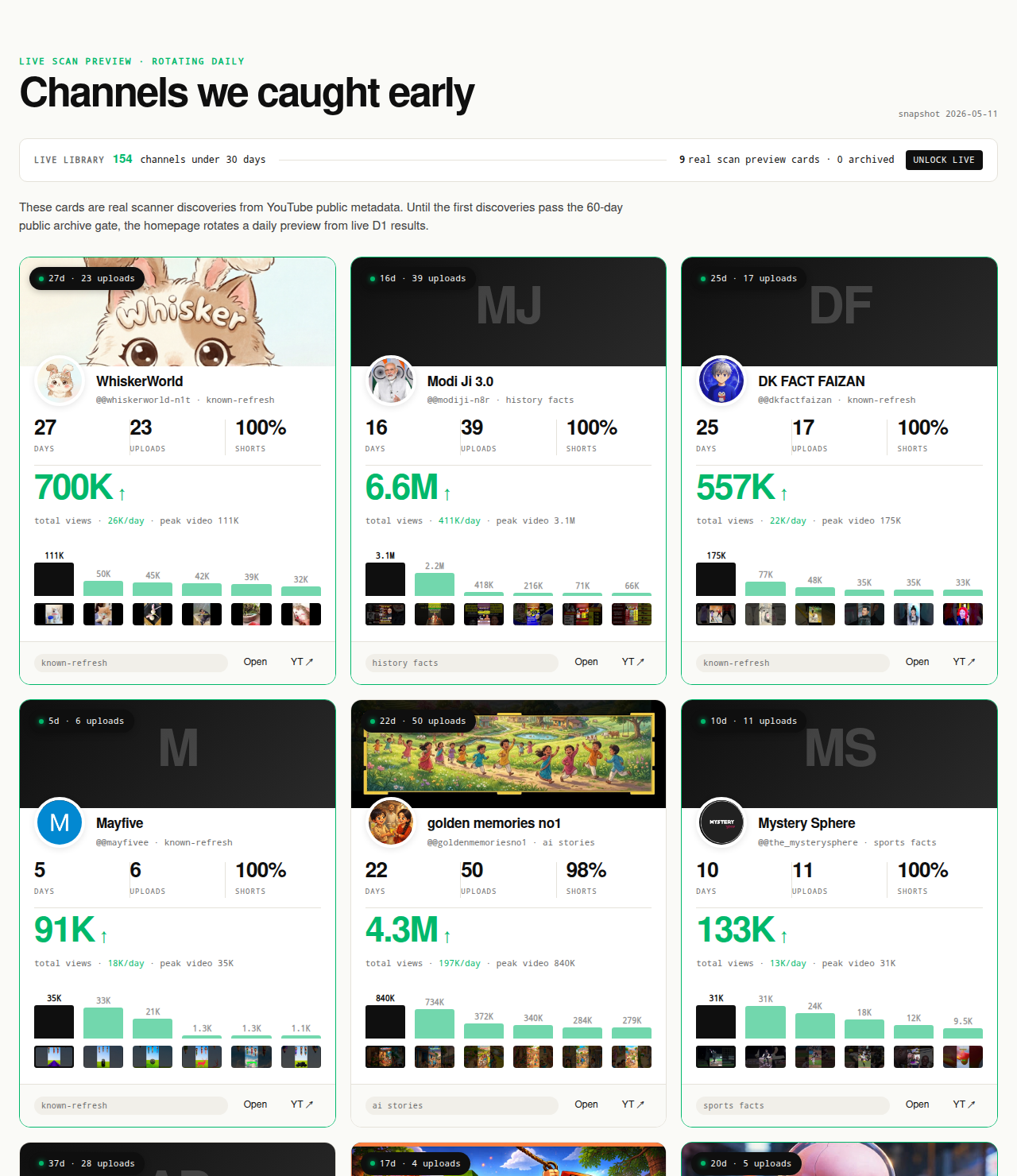
Today the free tier is the Friday digest — three current breakout channels every week with outbound YouTube links so you can verify the public metrics yourself. NicheBreakout also splits its library by freshness, not redaction: the matured public archive holds hundreds of channels that were detected when they were under 30 days old and are now 60+ days post-detection, while the paid live library holds dozens of channels currently inside the 30-day window with daily-refreshed traction signals. Both cohorts use only public Data API v3 metadata, and the thresholds described in the previous section apply identically across both. The freshness gate is the entire product split, not a marketing optimization layered on top of one.
Other tools in this category gate by feature (TubeLab's free tier shows fewer filters; vidIQ's free tier shows fewer keyword tools). NicheBreakout's gate is structural: the Friday digest reveals channels in full for free, the matured public archive will do the same once the first cohort ages out, and the live 30-day window is the paid workflow surface.
The free archive is the deliberate part. Visitors verify the methodology by clicking through to YouTube on any free-archive channel and confirming the metrics match what the page claims. This is how trust is built without requiring a paid trial: the unfakeable proof is right there. The paid library adds filters (channel age, upload count, views per day, first 5 video performance, Shorts ratio, seed niche), sort, save-to-shortlist, and CSV export.
Both halves cite the same data source. Neither uses any private metric. Neither infers strategy or generates AI narrative about channels. See pricing for the current tier; the matured public archive is permanently free.
Are AI-powered niche finders trustworthy?
AI niche finders that generate channel-level narratives ("this channel works because the algorithm rewards X" or "this niche is exploding because of Y demographic shift") run into a structural problem flagged by Google's own quality framework. The Search Quality Rater Guidelines define high-quality information as content that "demonstrates expertise, authoritativeness and trustworthiness on a topic, or E-A-T for short" (Search Quality Rater Guidelines, raterhub.com); Google added "Experience" to the framework in December 2022, making the current shorthand E-E-A-T (Google Search Central, 2022 update). Google's public position is that "while E-E-A-T itself isn't a specific ranking factor, using a mix of factors that can identify content with good E-E-A-T is useful." AI-generated narratives about channels you don't own and can't measure fail the trust signal: the AI is inferring causality from patterns it shouldn't be able to see.
The deterministic alternative is to publish public-data signals and let the reader draw their own causal conclusion. NicheBreakout's design constraint is that no AI-generated narrative ever ships about any channel.
The failure modes are concrete. AI niche finders hallucinate strategy claims (a channel "uses thumbnail psychology" when the channel is just using the same template every video). They attribute audience demographics that aren't measurable from public data. They write confident causal explanations of viral success that are post-hoc storytelling. Each of these is a soft trust failure: nothing the reader can falsify, but nothing they can verify either.
The corrective is to make every claim falsifiable. NicheBreakout's flagging logic is published verbatim. Every channel card outbound-links to YouTube so a researcher can confirm the number. The methodology page walks through edge cases. The result is a tool the reader can audit, which is the long-form definition of trust under Google's own guidelines.
Faceless and Shorts: where small breakouts are concentrating
Most small-channel breakouts in 2026 are not in traditional creator niches. They cluster in faceless and Shorts-first formats: AI storytelling, history shorts, Reddit narration, quiz/trivia, scary stories, finance explainers, faceless storytelling. Across NicheBreakout's matured public archive (the channels that were detected when they were under 30 days old and have since proven format-fit), the densest niche cluster currently meeting our sample-size threshold is:
This is what we've observed in our scans, not a market-wide claim, and it shifts week over week as new format clusters surface and older ones saturate. The Shorts-first vs long-form split inside those top niches looks like this in our dataset:
Format clustering beats topic clustering for new-channel research because format-fit is the actually-replicable variable. A specific topic can become saturated within weeks; a working format generalizes across topics. AI storytelling worked in romance, then horror, then "based on a true story": same format, different topics. The format-cluster perspective is the entire reason NicheBreakout's topic-page library is organized by format rather than by topic theme.
Separately from the live cluster snapshot above, we maintain dedicated programmatic topic pages for five recurring format clusters that surface repeatedly in our scans:
- AI story channels: TTS narration plus AI imagery, recurring story types, Shorts-first publishing.
- Reddit story channels: TTS reading r/AmITheAsshole, r/ProRevenge, r/MaliciousCompliance threads with stock visuals.
- History shorts channels: fact-stacking with cinematic visuals, vertical and horizontal variants.
- Faceless storytelling channels: broader narrative format spanning fiction and non-fiction.
- Quiz channels: interactive Q&A format, often Shorts-first with text overlays.
If you're researching faceless production specifically, the faceless YouTube niches pillar covers the production-style angle and links into the AI-tooling discussion. If Shorts is the dominant publishing surface for the niches you care about, the YouTube Shorts trends pillar covers the trend and format crossover. These are the two highest-converging segments observable from our scans; most format-cluster pages live downstream of one or both pillars.
Niching down: when it matters and when it doesn't
Niching down still matters because YouTube's discovery surfaces (Browse, Suggested, Search, Shorts feed) all reward channels with consistent topic and format fingerprints. But "niche" in 2026 has shifted, in NicheBreakout's framing, from topic-niching to format-niching. A "history channel" that publishes 8-minute documentaries is one niche; a "history channel" that publishes 60-second vertical fact-stacks is a completely different niche from YouTube's recommender's perspective, even with overlapping subject matter. Channels that confuse the two often picked the wrong narrowness. The split shows up in our scans: format-consistent channels accumulate early traction faster than format-mixed channels covering the same topic, which is the empirical reason we filter on format-clarity in the methodology described above.
The academic literature on creator-economy decision-making frames this dynamic as algorithm sensemaking. Researchers writing in journals like Convergence and Sage's algorithmic-culture literature describe creators as in a constant state of interpreting and second-guessing the platform's preferences (a representative entry point into this literature is the algorithmic sensemaking research published in Sage Journals). The ambiguity is structural, not solvable by reading a list.
The practical move is to think about niching at two layers simultaneously. The topic layer (history, finance, gaming, fitness, language learning) is the conventional one. The format layer (Shorts-first vs long-form-first, faceless vs face-on-camera, AI-assisted vs hand-produced, single-host vs multi-host) is the layer most "niching down" advice ignores. A channel commits to a specific intersection (for example, "long-form face-on-camera language tutorials") and YouTube starts learning that intersection's audience.
The most common niching mistake is to pick a topic and then alternate formats in the first 10 uploads. The recommender treats the channel as ambiguous and the early-traction signal flatlines. Researching small channels with proven early traction tells you not just which topics are working but which format-topic intersections are. The faceless YouTube niches for beginners page narrows this further for creators who are picking their first format-topic combination.
Saturated vs. working niches
Saturated doesn't mean unworkable. TubeLab's definition is the right starting point: "Saturated niches on YouTube occur when the volume of videos in a specific topic has been maximized relative to audience demand" (TubeLab). What that definition doesn't say: small channels can still break out inside saturated niches when they bring a fresh format. The saturation question is the wrong question for niche research. The right question is: are any small channels in this niche breaking out right now, and if so, what format are they using? That reframing changes what you're shopping for. A "saturated" label across a topic tells you nothing about whether a fresh sub-format inside it is working; saturation lives at the topic level while breakouts often live at the format level. The two cannot be settled with the same data.
Two examples of how this plays out. AI storytelling has thousands of active channels by mid-2026 and is widely described as crowded; despite that, specific sub-formats inside it keep producing breakouts in our scans: AI-generated horror anthologies, AI-generated fictional history, AI-generated true-crime narration. Each refresh cycle within a crowded topic can create a new wave of breakouts. The crowdedness of the parent topic doesn't predict the breakout potential of a fresh sub-format inside it.
The same dynamic shows up across the most profitable YouTube niches listicle SERP. Most of those listicles report niche-level saturation without disaggregating sub-format saturation. NicheBreakout's archive shows the disaggregated picture: the parent topic might be old, but specific format clusters inside it are still surfacing breakouts month over month.
Common mistakes new creators make with niche-finder lists
Five mistakes show up repeatedly when new creators pick a niche from a generic list. First, they pick by income claim ("$30 RPM!") without realizing that monetization data is private and any third-party RPM number is either guess or extrapolation. Second, they treat lists as up-to-date when those lists are recycled from 2-year-old lists with the dates swapped. Third, they confuse topic with format and then wonder why the recommender stays cold. Fourth, they ignore the channel-age signal and copy mature creators instead of mid-breakout small ones, which means they're learning from the people who already won rather than the ones currently winning. Fifth, they trust AI-generated niche analyses without verifying any of the claims against actual channel data. Each of these is a research-discipline failure rather than a YouTube-knowledge failure, which means each is correctable with a checklist rather than a course.
Each of these mistakes shares a root cause: the creator is treating niche selection as a pure abstract decision instead of an evidence-driven research task. The remedy is to demand evidence at every step. Income claims need to come from monetization data, which is private, so they're not usable evidence; treat any income figure on a niche list as decoration. Topic-vs-format confusion gets resolved by looking at the format the small breakout channels are actually using, not at the topic name. The maturity gap gets resolved by deliberately filtering for channels under 30 days old when researching, not for channels with a million subscribers.
The YouTube niche validation checklist operationalizes the evidence-demanding habit into a workflow. For creators who are picking a faceless format specifically, how to start a faceless YouTube channel covers the channel-launch decisions downstream of niche selection.
What we deliberately don't claim
NicheBreakout doesn't claim access to private YouTube Analytics API metrics. Watch time, audience retention, RPM, average view duration, traffic sources, and subscriber demographics live behind authenticated endpoints. None of those metrics ship in the live library, the Friday digest, the future matured public archive, or anywhere else on the page. The product also doesn't generate AI narratives describing why channels are working: no synthesized "the algorithm rewards this because…" prose. It doesn't promise income outcomes or guarantee niche profitability. Every claim on every page is defensible from public Data API v3 fields, and every channel surfaced is one a reader can click through to verify on YouTube. The "verifiable on YouTube" property is non-negotiable; if a claim can't survive that audit, the claim doesn't go on the page.
The boundary statement is structural, not defensive. The constraints define the product. Public-data-only is what makes every channel card verifiable on YouTube; readers can click through and confirm. No-AI-narratives is what keeps the methodology auditable. No-income-claims is what aligns the product with public metadata reality. The full constraint set lives in methodology. Channel-by-channel verification is the trust contract.
FAQ
Is there a free YouTube niche finder?
Yes. The free tier today is the Friday digest — three current breakout channels every week, each one outbound-linking to YouTube so you can verify the public metrics in one click. NicheBreakout's live 30-day library is the paid surface; a matured public archive of 60+ day discoveries will open as a second free surface in summer 2026 as the first cohort ages out of the live window. Other free niche finders include TubeLab and ChannelCrawler with different framings.
Can a YouTube niche finder show me trending topics?
Some can. NicheBreakout inverts the framing: instead of trending topics, it surfaces small channels currently breaking out. Topics are signals; channels are evidence. If you want raw topic trends, Google Trends and YouTube's Trending page are the official sources for that data; niche-finder tools with "trends" features usually pull from those same sources.
How do I know if a niche is profitable?
You can't determine profitability from public data. RPM, CPM, and revenue live behind the YouTube Analytics API and aren't third-party-accessible. What you can see: subscriber count, view count, video count, channel age, upload cadence. NicheBreakout treats "is this niche working" as the public-data question; "is it profitable for me" is downstream and depends on the creator's specific monetization mix.
Will a niche finder help me rank higher on YouTube?
Indirectly. Niche selection is upstream of ranking; you can't rank in a niche where small channels aren't breaking out. NicheBreakout focuses on niche evidence, not on-page YouTube SEO. If you want SEO-specific tools, vidIQ and TubeBuddy lead that category and are complementary, not substitutes.
Can I change my YouTube niche later?
Yes, though you'll lose recommendation momentum during the transition. The niche-finder question matters most when you're starting fresh or considering a second channel. Once a channel has trained YouTube on its format, drift is costly. Many creators run a separate channel rather than rebrand an existing one.
How does NicheBreakout differ from vidIQ or TubeBuddy?
vidIQ and TubeBuddy are creator-tool optimizers built around your existing channel: keywords, tags, thumbnail tests. NicheBreakout is a research library built around channels you don't own: finding new small channels with abnormal early traction. The product categories are adjacent, not substitutes. Most operators end up using both at different decision layers.
Do I still need keyword research if I use NicheBreakout?
For ranking individual videos, yes. Keyword research is downstream from niche selection. NicheBreakout helps you pick a niche with public proof; once you're in, vidIQ-class keyword tools are still useful for video-level optimization, thumbnail tests, and tag research. Different layers of the same problem.
Methodology / About this analysis
NicheBreakout's research relies entirely on YouTube Data API v3 public fields: channel age, subscriber count, video count, view count, video metadata, video publish dates, and recent video performance. No private metrics (watch time, RPM, retention, audience demographics) appear in the live library, the Friday digest, or anywhere else on the page. No browser scraping, no InnerTube calls, no AI-generated narratives describing why channels are working. Detection thresholds are tuned quarterly against the live discoveries cohort and published in full on the methodology page.
Original-research artifacts in this article: the deterministic detection formula in the filter-and-score section above, the live niche-cluster snapshot in the format-clusters section, and the revealed channel cards above the fold. Niche distribution reflects what we've scanned, not all of YouTube. Author: Nicholas Major (Founder, NicheBreakout · Software engineer since 2011). Article last revised 2026-09-21.
Live scan freshness:
Related research
- Most profitable YouTube niches: listicle of niches backed by examples from the live discoveries cohort.
- How to do YouTube niche research: the full process guide downstream of this pillar.
- YouTube niche validation checklist: the deterministic checklist version of the methodology.
- Why we are not a keyword research tool: positioning piece on the keyword-tool category we don't compete in.
- Faceless YouTube niches: sister pillar covering the faceless production angle.
- YouTube Shorts trends: sister pillar covering the Shorts-first publishing angle.
- YouTube outlier finder: sister pillar covering the breakout-discovery framing.
- YouTube channel research: sister pillar covering the broader channel-discovery category.
The Friday digest sends three current breakout channels every week with format fingerprints and outbound YouTube links — free, present-tense. The full live library refreshes daily and surfaces channels currently inside the 30-day window. See pricing for the current tier; subscribe to the digest free.
End of pillar
Find your next breakout channel today
Every channel card outbound-links to YouTube so you can audit the public metadata yourself. The live under-30-day library is the paid workflow; the Friday digest is free.