
/ Pillar · Faceless YouTube niches
Faceless YouTube niches: the working formats backed by real small-channel breakouts in 2026
A faceless YouTube niche is a content format that does not depend on a creator appearing on camera — TTS narration over stock footage, AI imagery with scripted voiceover, screen-recorded explainers, or B-roll-driven storytelling. The working faceless niches in 2026 are the ones where small channels are currently breaking out under public Data API v3 signals: channel age, first-five-video views, lifetime views per day, format clarity. NicheBreakout's research base is thousands of channels scanned to date, surfaced from public YouTube metadata only — no watch-time inferences, no revenue claims.

Ai stories by shano
 45d · 36 uploads
YOU & ME
 45d · 25 uploads
Dootoons TV
 45d · 69 uploads
Mr Pawsome
 42d · 64 uploads
sajkcasqq
 38d · 38 uploads
OP Nigma

FactD
 45d · 31 uploads
Cognexa Talks
 39d · 21 uploads
MapLore
What "faceless YouTube niche" actually means in 2026
Faceless YouTube is a production-style label, not a topical one. A faceless channel is any channel where the creator's face never appears, replaced by some combination of text-to-speech narration, stock footage, AI-generated imagery, screen recordings, or voiceover-over-B-roll. The label has spread because production cost per upload dropped through the floor: a single operator with a script, a TTS voice, and a stock-footage library can publish a finished video in an afternoon. The category split that actually predicts how a faceless channel performs is the production mode, not the topic — the same history-fact script reads very differently as a TTS-Shorts upload versus a long-form voiceover documentary.
Four production modes cover most of the working faceless cohort. TTS plus stock-or-AI imagery is the lowest-cost mode: ElevenLabs or Azure-class voices reading a script over Pexels footage or Midjourney stills. AI-narrated plus AI-imagery pushes further into automation, with the script itself sometimes drafted by an LLM and the visuals generated end-to-end. Screen-recorded explainers are faceless by accident: tutorials, software walkthroughs, and gameplay analysis where the screen is the subject. Voiceover plus B-roll is the most editorial mode: human-recorded narration over curated footage, no AI synthesis, the closest faceless mode to traditional documentary editing.
The label is fuzzy at the edges. A channel with a faceless host and a single recurring animated mascot is borderline faceless; a tutorial channel where hands appear on a keyboard is borderline faceless; a podcast with static cover art is technically faceless even though it isn't usually called that. Treat "faceless" as a production-cost descriptor, not a binary tag. The useful research question is not "is this channel faceless" but "which production mode are the breakout small channels in this niche using right now."
The four-mode taxonomy matters because each mode has a different ceiling. AI-narrated plus AI-imagery hits YouTube's synthetic-content disclosure requirements (see the disclosure section below). Screen-recorded explainers have the lowest visual variety and the strongest editorial-skill floor. Voiceover plus B-roll is the most editorially defensible but the slowest to scale. The mode you pick is downstream of the niche, not upstream — start with the small breakout channels and read off their production mode, then plan around it.
Why faceless dominates new-channel breakouts right now
Faceless production wins on time-to-publish, which compounds inside the 45-day early-traction window NicheBreakout's flagging methodology uses. A creator who can publish five uploads in twenty days has five public datapoints for the recommender to evaluate; a creator on a face-on-camera weekly cadence has fewer. The recommender doesn't reward faceless production directly — it rewards the publish-cadence and format-consistency that faceless production enables. Reading the cause as the format itself misses the real mechanism.
Replicability across topics is the second structural advantage. A working faceless format — say, vertical fact-stacks with TTS narration over historical photography — generalizes from history into mythology into true crime into pop science without re-tooling production. Face-on-camera formats don't generalize that cleanly because the host's persona is the differentiator. A single operator running a faceless format can therefore validate three niche-topic combinations in the time a face-on-camera creator validates one. That validation speed is why faceless dominates the early-traction cohort even when individual face-on-camera channels in mature niches reach higher peak views.
Recommender behavior reinforces the pattern. YouTube's Shorts feed surfaces format-consistent channels faster than mixed-format channels — once it learns a channel publishes 45-second vertical TTS shorts, it can match those shorts to the audience that watches that exact format. Faceless production locks in format consistency by default because the production rig itself is the constraint. A face-on-camera creator can drift between vlog, talking-head, sketch, and pure-info formats; a faceless TTS rig produces TTS shorts.
Across the channels currently inside our live 30-day window — a subset of the broader thousands of-channel scan — the densest niche cluster currently meeting our sample-size threshold is:
The presence of faceless-leaning clusters near the top of that list is consistent with the time-to-publish argument above, not proof of it; the cluster mix shifts week over week as new formats surface and older ones saturate. Read it as a current snapshot, not a market-wide claim. The format split inside those clusters is in the section on Shorts-first versus long-form below.
The methodology that flags a working faceless niche
NicheBreakout applies the same three hard gates to faceless and face-on-camera channels. The full methodology lives on the methodology page; the version on this pillar is the abbreviated readout. A channel enters the live library when it passes all three gates, then ranks inside the library on a deterministic score that adds two bonuses.
Channel age
detected within 45 days of channel creationFirst-5 upload views
combined views across the first five public uploads ≥ 10,000Views per day
lifetime channel views ÷ channel age ≥ 1,000Format clarity (bonus)
score weights channels with a clear Shorts-first or long-form-first ratio above mixed-format channelsEarly-traction velocity (bonus)
score boost when channel age ≤ 14 days, first-5 sum ≥ 50,000, or views/day ≥ 5,000
The three gates each isolate a piece of the early-traction picture. Channel age ≤ 45 days catches the window where recommendation surfaces, not subscribers, are doing the audience-finding work — relevant for faceless because most faceless channels do not have an existing audience migrating in from a host's other platforms. First-five-video sum views ≥ 10,000 filters out channels whose first uploads landed flat; five uploads sharing 10,000 views means a working content vehicle, not one viral first upload. Lifetime views per day ≥ 1,000 is the cleanest velocity check available from public metadata, because watch time, impressions, and click-through rate live behind the YouTube Analytics API and cannot be third-party-verified for a channel you don't own.
The format-clarity bonus matters more for faceless than for face-on-camera channels because faceless production scales horizontally — once a rig works, a creator is tempted to publish vertical TTS shorts on Monday and long-form voiceover documentaries on Friday from the same rig. The recommender treats that as ambiguous. Format-mixed faceless channels accumulate early traction more slowly in our scans than format-consistent faceless channels publishing the same number of uploads. The bonus pushes the consistent ones up the ranking.
The early-traction velocity bonus (age ≤ 14 days, first-5 sum ≥ 50,000, or views/day ≥ 5,000) handles the cases where a faceless format reaches the recommender's audience inside the first two weeks. Those are the channels worth surfacing first, because the format-topic fit is unambiguous. A 14-day-old TTS history-shorts channel clearing 5,000 views per day with five uploads is signal you can act on; a 40-day-old channel scraping the 1,000 views/day floor is signal but weaker.
Average first-five-video views for every populated grade tier inside our discoveries cohort looks like this (grades with no current members are suppressed until they fill in):
Shorts-first vs long-form faceless: when each wins
Shorts-first faceless channels win on early traction. Vertical TTS shorts have the lowest production cost per upload, the highest publish cadence, and the most forgiving recommender surface — the Shorts feed evaluates each video on watch-through inside seconds, which a 45-second clip can survive even if the topic doesn't compound. Long-form faceless channels win on per-viewer monetization and on topic depth. A 12-minute voiceover documentary builds session time, which the Browse and Suggested surfaces reward, and qualifies for mid-roll ad inventory that Shorts does not. The trade is clean: Shorts-first reaches the recommender's audience faster, long-form holds it longer.
Recommender mechanics make the split sharper than creators expect. The Shorts feed and the main Browse feed are different surfaces with different ranking signals; YouTube has been explicit that Shorts watch time and long-form watch time count differently inside the same channel. A channel that publishes both formats teaches the recommender two contradicting profiles for the same channel ID, which dilutes the signal each format contributes. The channels currently winning at faceless production lock in one format and stay there until the format saturates, then spin up a separate channel for the second format rather than mix.
The format split across the top niche clusters in our live window looks like this in our dataset:
Mixing formats inside a single faceless channel is the most common faceless mistake in our scans. The mechanism is recommender confusion. A new channel that publishes three Shorts and one long-form in week one is asking the recommender to evaluate it on both surfaces simultaneously, which it can do, but does badly. The same operator publishing only Shorts for the first ten uploads, then evaluating whether to branch into long-form from a position of established format-fit, accumulates traction faster in our data. The format-clarity bonus in the score formula is the methodology's way of putting that pattern into a number.
The choice between Shorts-first and long-form is not permanent. A channel that wins on Shorts can publish a long-form follow-up to a viral short and have its existing audience carry the recommender signal across. The mistake is starting unsure — picking the format after the first few uploads rather than before — which guarantees the format-mixed signal the recommender penalizes.
The faceless formats with the most working small-channel breakouts right now
The faceless cohort in our scans is not a ranked listicle, and any pillar that ranks faceless niches by claimed RPM is either guessing or repackaging older lists. What we can publish is the format-cluster observation: the faceless formats that keep producing small-channel breakouts inside the 45-day window, in no particular order, with internal links to the dedicated programmatic topic pages where each format has its own scanner-backed evidence.
AI storytelling channels are the highest-volume faceless cluster in our 2026 scans. The format is TTS narration plus AI-generated imagery, recurring story templates (often horror, fictional history, or true-crime adjacent), Shorts-first publishing. The AI story channels programmatic page lists currently-breaking-out channels in this cluster with the same outbound-link verification as the main library. The cluster is crowded at the topic level but specific sub-formats inside it (AI-generated medieval-history shorts, AI-generated cosmic-horror anthologies, AI-generated true-crime explainers) keep producing breakouts.
Reddit narration channels read TTS over r/AmITheAsshole, r/ProRevenge, r/MaliciousCompliance, and similar story threads with stock visuals or simple animation. The Reddit story channels programmatic page tracks the cluster. The 2024 monetization tightening around mass-produced content hit lazy implementations of this format hardest; the channels still breaking out are the ones adding original commentary, character voicing, or editorial selection over the raw thread.
History shorts channels stack fact-density inside 45-to-75-second vertical videos with cinematic visuals (sometimes archival, sometimes AI-generated, sometimes both). The history shorts channels programmatic page indexes the cluster. The format works because history compounds — once the recommender knows a channel publishes history shorts, it pulls from the entire long-tail of historical topics, which keeps audience-side novelty high without per-video research scaling problems.
Faceless storytelling channels are a broader cluster spanning fiction and non-fiction narration, faceless documentaries, and faceless explainer formats. The faceless storytelling channels programmatic page covers the cluster. The defining feature is editorial voice in the script — these are not template channels — and the production mode is usually voiceover plus B-roll rather than pure TTS.
Quiz and trivia channels use interactive Q&A formats, often Shorts-first with text overlays and a count-down timer. The quiz channels programmatic page tracks the cluster. Production is the lowest-cost of the five listed here because the visuals are template-driven; the editorial work is the question selection.
Other faceless clusters surface periodically in our scans without yet having a dedicated programmatic page: finance explainers (faceless screen-recorded chart breakdowns, faceless TTS-over-graphs), scary-story narration (TTS or human voiceover over original or licensed atmospheric footage), list-of-X channels (top-10 vertical shorts with TTS), and faceless gaming highlight reels (no facecam, no commentary, pure gameplay edits). Each is a working format with current small-channel breakouts; none is "the most profitable" in any meaningful sense — they are the formats where the public-data signal currently fires.
Faceless production end-to-end: what the workflow actually looks like
This pillar does not recommend specific tools. The category moves quarterly; any tool list dated 2024 is partially obsolete by 2026, and channel performance is not bottlenecked on which TTS engine an operator uses. What stays constant is the workflow shape: script, narration, visual layer, edit, thumbnail, upload. The decisions inside each step are where channel-level differentiation actually lives.
Scripting is the editorial layer that AI assistance can support but cannot replace. A 60-second history-fact short needs about 130-160 spoken words; a 12-minute voiceover documentary needs roughly 1,800-2,200. The script decisions that compound are the opening hook (first three seconds), the information density per second, and whether the closing 5 seconds set up a next-video click or end flat. LLM-drafted scripts work as a first pass; the editorial pass that follows is what differentiates breakout faceless channels from template channels.
Narration splits into three options: human voiceover, AI TTS, or AI voice cloning. Human voiceover has the highest editorial control and the lowest synthetic-content disclosure overhead but the slowest cadence. AI TTS engines (ElevenLabs, Azure Neural, Play.ht, and others; the specific market leader shifts quarterly) carry no disclosure requirement when they are generic synthetic voices reading a generic script. AI voice cloning of a real person triggers YouTube's synthetic-content disclosure rule and is the highest-risk option.
Visuals divide into stock footage (Pexels, Pixabay, Storyblocks), AI-generated imagery (Midjourney, DALL-E, Stable Diffusion derivatives, and platform-specific tools), archival material in the public domain or appropriately licensed, screen recordings, or a hybrid. The faceless channels currently breaking out tend to use a consistent visual style — a single source library, a single AI imagery aesthetic, a single screen-capture template — because visual consistency is the format signal the recommender reads.
Editing is where most faceless template channels get caught by the mass-production heuristic. Cuts on the beat, motion on every clip, captions on every shot, and a thumbnail-quality first frame are the table stakes. Editors who scale to multiple channels per operator typically standardize the edit template — same intro card, same transition pacing, same caption font — which is good for production speed and good for channel-level format consistency, but a tell if it's identical across multiple channels owned by the same operator.
Thumbnails and titles remain the variable with the largest measurable effect on click-through inside the recommender's evaluation. A breakout faceless channel typically iterates thumbnails for the first 10-20 uploads. The methodology section above does not include thumbnail data because thumbnails are not exposed as a queryable field in the public Data API, but they affect every downstream metric this article does cite.
AI-content disclosure and YouTube's monetization rules
YouTube requires creators to disclose meaningfully altered or synthetic content. The Creator Studio toggle for "altered or synthetic content" must be enabled when a video uses content that could mislead a viewer into thinking it depicts a real person, place, or event when it does not. YouTube's Help Center publishes the canonical version of this rule (YouTube Help: Disclosing use of altered or synthetic content); the page is the authoritative source any faceless creator using AI imagery or AI narration should read before their first upload.
The disclosure rule is narrower than the panic about it suggests. Generic AI imagery in a clearly fictional story does not require disclosure. AI voice generation of a generic synthetic narrator does not require disclosure. What does require disclosure: AI imagery depicting a real person, AI voice cloning of an identifiable person, AI imagery of real events presented as documentary footage, and AI-generated content that could be mistaken for authentic depictions. A faceless channel narrating a fictional horror story with AI imagery is not in scope. A faceless channel using AI voice cloning of a real public figure is in scope.
Monetization is a separate question. The YouTube Partner Program eligibility thresholds (1,000 subscribers and 4,000 watch hours in 12 months, or 1,000 subscribers and 10 million Shorts views in 90 days) apply to faceless and face-on-camera channels identically. The 2024 update to the YPP rules around "inauthentic content" tightened enforcement against channels that mass-produce videos with no original creative work — TTS over reposted footage, AI-generated content that recycles existing channels' material, template channels published at scale by the same operator. Faceless channels with original scripts, original narration choices, and edited visuals are not the target.
The repost rule is the one that catches most faceless operators by surprise. YouTube's monetization policy disallows uploading content that "isn't yours" — including clips, content from social media, or songs — without significant original commentary or value-add. A Reddit-narration channel that reads the thread verbatim with no editorial framing is at higher risk than the same channel reading the same thread with character voices, original commentary on the situation, or editorial selection across multiple threads.
Disclosure on every AI-generated upload is cheap; failing to disclose is expensive. The cost-benefit is unambiguous. Faceless operators who are unsure whether a specific upload triggers the rule should disclose by default — the disclosure label has minimal effect on watch time and removes the enforcement risk entirely.
What we deliberately don't claim about faceless monetization
NicheBreakout does not publish RPM figures, CPM estimates, revenue per channel, or "most profitable faceless niche" rankings. Those metrics live behind the YouTube Analytics API and authenticated AdSense reporting; they are not third-party-accessible for any channel a researcher does not own. Every listicle that ranks faceless niches by "$X RPM" is either extrapolating from anecdote, repackaging someone else's anecdote, or fabricating the number. The product-side discipline that makes our methodology auditable — every claim must be verifiable from public Data API v3 fields — is the same discipline that keeps RPM claims off this page.
What is publishable from public data: channel age, subscriber count (rounded to three significant figures per the Data API documentation), total view count, video count, video publish dates, video view counts, and aggregate signals derived from those fields. From those fields a researcher can read whether a faceless niche is currently producing small-channel breakouts, which production mode the breakout channels are using, and what the format-split looks like. From those fields a researcher cannot read whether a specific niche pays a specific RPM, whether a channel is sponsored, or what the channel's revenue is.
The boundary applies upstream of the product. Faceless creators evaluating a niche should treat any per-niche RPM claim as decoration. The actionable diagnostic is breakout density at the format-topic intersection the creator is considering. If small channels are currently breaking out at that intersection, the format works; whether the creator can monetize it depends on the creator's own conversion funnel, sponsor fit, and ad-inventory mix — none of which are determined by the niche name.
The boundary is also why the live library and the matured public archive use the same fields. There is no premium tier that exposes private metrics; the paid surface is the workflow (filters, sort, saved channels, export), not the data. The free Friday digest and the future matured public archive cite the same Data API fields as the paid live library. Anyone selling "competitor watch time" or "competitor RPM" for faceless channels is selling something that doesn't exist as a third-party-accessible product.
Common mistakes new faceless creators make
Five mistakes recur in the faceless cohort. Picking a saturated topic without checking the format layer. A creator reads a 2024 listicle naming AI storytelling as a top niche, opens an AI-storytelling channel in 2026, and lands in a topic-saturated category without checking whether any specific sub-format inside it is currently producing breakouts. The corrective is to look at small channels under 45 days old at the format-topic intersection the creator is considering, not at the topic alone.
Mixing formats inside the first 10 uploads. The recommender treats a new channel with three Shorts and one long-form as ambiguous, and the early-traction signal flatlines. Format-clarity is a methodology bonus for this reason. The corrective is to lock one format for the first 10-20 uploads, evaluate, and only then consider a second format on a separate channel.
Choosing a TTS voice with poor emotion control. Generic TTS voices read every line at the same energy level, which is fine for a 30-second fact short and fatal for a 12-minute narrative documentary. Higher-end TTS engines support inflection and pacing controls; lower-end engines do not. The corrective for narrative formats is to test the voice on the longest content the channel plans to publish before committing.
Copying viral channels at the topic layer instead of the format layer. Two channels publishing the same topic with different production modes are different channels for the recommender's purposes. A creator who copies a viral history channel's topic list but films it as a face-on-camera vlog is not running the same channel that went viral. The corrective is to read off the format from the viral channel — production mode, video length, publish cadence, visual style — and copy that, not the topic list.
Expecting AI to substitute for editorial judgment. LLMs can draft scripts; they cannot edit. AI imagery tools can generate visuals; they cannot pick which visual lands. A faceless production stack is a force multiplier on editorial taste, not a replacement for it. The corrective is to spend the production-time savings from AI tooling on editorial iteration — thumbnail tests, hook rewrites, format experiments — rather than on publishing more videos with the same editorial floor.
Ignoring the channel-age signal. New faceless creators routinely study channels with 500,000 subscribers and copy their current strategy, missing that the mature channel's current strategy is downstream of two years of recommender-trained audience momentum. The corrective is to study channels under 90 days old inside the same niche — the channels currently winning, not the channels that won. The YouTube niche validation checklist operationalizes this into a workflow.
FAQ
Is faceless YouTube less profitable than face-on-camera?
Public YouTube Data API metadata doesn't expose revenue, so a blanket profitability comparison isn't verifiable from third-party data. What is observable: faceless channels reach first-five-video traction faster on average in our scans because production time per upload is lower, which compounds during the 45-day early-traction window. Per-video monetization depends on niche, ad inventory, sponsor fit, and the creator's own conversion funnel. Anyone quoting a specific RPM gap between faceless and face-on-camera is extrapolating from private data they don't have.
Does YouTube penalize faceless or AI-generated content?
YouTube's monetization policy does not penalize faceless or AI-assisted content by default. It penalizes content that is mass-produced, repetitious, or reposted without original commentary. Faceless channels with original scripts, original narration choices, and edited visuals are inside policy. The 2024 update to the YouTube Partner Program guidance on "inauthentic content" tightened enforcement against AI-generated channels that simply remix other creators' material. Disclosure of synthetic content via the Creator Studio toggle is required for AI narration plus AI imagery.
Do I have to disclose AI-generated content on YouTube?
Yes, for content that could be mistaken for real people, places, or events. YouTube's Help Center requires creators to mark "altered or synthetic content" in Creator Studio when a video meaningfully alters reality — AI voice cloning of a real person, AI imagery of a real event, AI-generated faces presented as a real person. Generic AI imagery in a fictional story does not trigger the requirement. The disclosure shows up as a label under the video. Failing to disclose can result in content removal or monetization restrictions.
Can faceless channels still get monetized?
Yes. The YouTube Partner Program eligibility thresholds (1,000 subscribers and 4,000 watch hours in 12 months, or 1,000 subscribers and 10 million Shorts views in 90 days) apply identically to faceless and face-on-camera channels. A faceless channel that clears those thresholds with original scripts and original narration is reviewed on the same monetization criteria as any other channel. The disqualifier is mass-production patterns (TTS over reposted footage with no original creative work), not the absence of a face.
What's the most profitable faceless YouTube niche?
We don't publish a profitability ranking because per-niche RPM and revenue live behind the YouTube Analytics API and aren't third-party-accessible. Listicles ranking faceless niches by claimed RPM are extrapolating from anecdotes. What we can show from public data: which faceless format clusters currently have the highest density of breakout channels under 45 days old. That density measures format viability, not creator income, and the two are correlated but not identical. Use breakout density as the leading signal; treat RPM claims as decoration.
Are faceless niches saturated?
Faceless YouTube as a category is crowded; specific format-topic intersections inside it are not. AI storytelling has thousands of active channels, but sub-formats inside it (AI-generated horror anthologies, AI-generated true-crime narration, AI-generated fictional history) keep producing breakouts in our scans. Saturation lives at the topic level; breakout potential lives at the format-topic intersection. A channel that picks a fresh intersection inside a crowded parent topic still has a path. The diagnostic is whether small channels at that specific intersection are breaking out right now.
Can one creator run multiple faceless channels?
Yes, and it's common because faceless production decouples a channel from a specific person on camera. YouTube's terms allow a single Google account to operate multiple channels. The constraint is the creator's actual editorial capacity: scripts, narration choices, thumbnails, and format iteration still need a human making decisions. Operators who try to run more channels than they can edit end up with the mass-production pattern that triggers monetization review. One person running two well-edited faceless channels is fine; one person running ten template channels is the disqualifying case.
How long until a faceless channel knows if it's working?
The first five uploads carry most of the signal. If the combined view count across the first five videos clears 10,000 inside the first 30 days, YouTube's recommendation surfaces are picking up the format. Sub-1,000 views per video across the first five suggests the format-topic fit is off, the thumbnails aren't clicking, or the niche is saturated at the level the channel is operating. NicheBreakout's flagging methodology uses that 5-video sum because it filters out single-video flukes while still being readable inside a working channel's first month.
Methodology / About this analysis
NicheBreakout's research relies entirely on YouTube Data API v3 public fields: channel age, subscriber count, video count, view count, video metadata, video publish dates, and recent video performance. The faceless-cohort observations on this page are derived from the same scan that powers the main live library — no separate dataset, no inferred metrics, no AI-generated narratives describing why channels work. Faceless-vs-face-on-camera labeling is heuristic and based on observable channel metadata; channels straddling the boundary (animated mascots, recurring partial-face creators) are flagged but not double-counted.
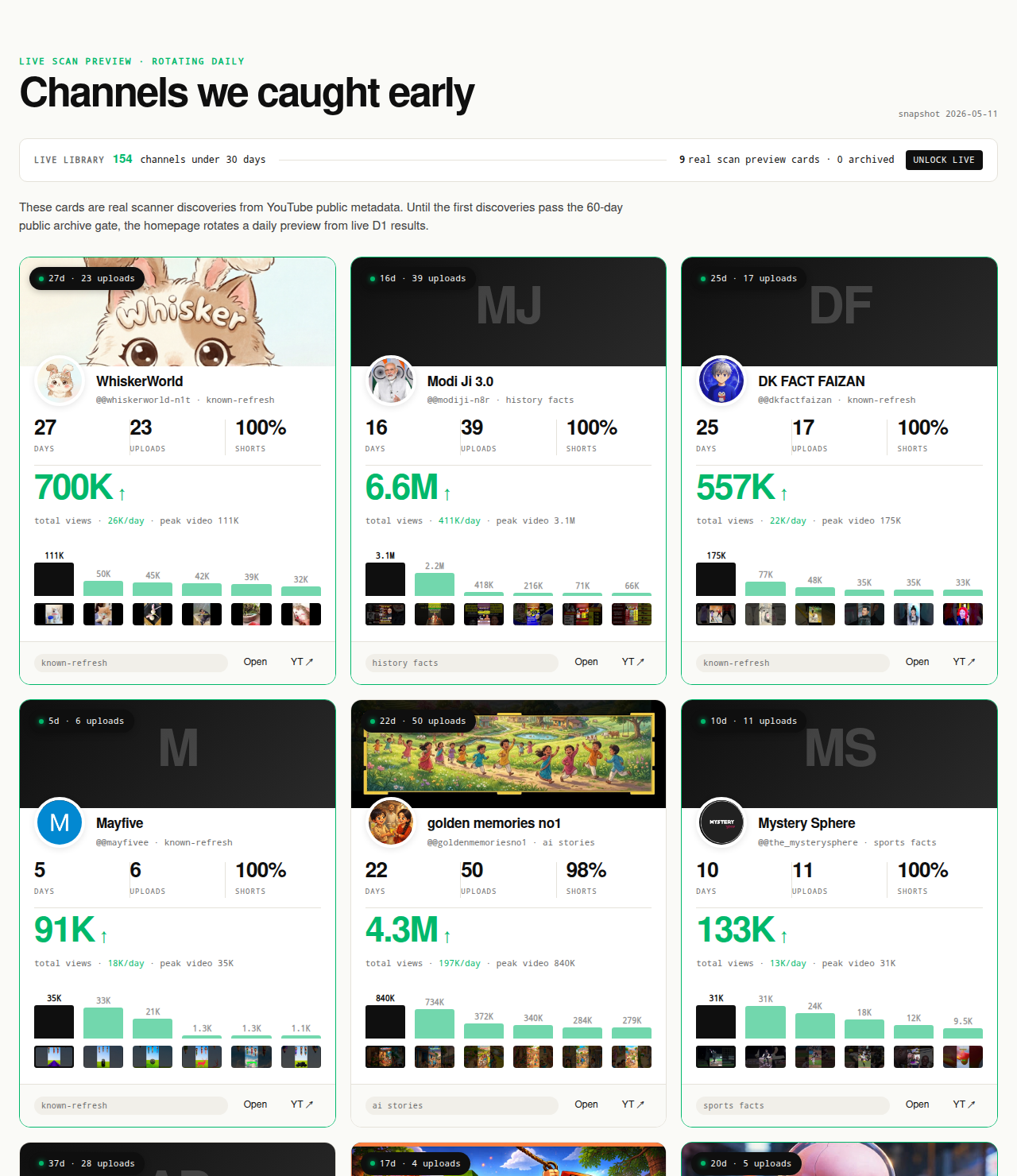
Original-research artifacts in this article: the four-mode production taxonomy in the opening section, the format-split table in the Shorts-vs-long-form section, the deterministic flagging methodology, the live niche-cluster snapshot, and the revealed channel cards above the fold. The faceless format clusters discussed reflect what we've scanned, not all of faceless YouTube. Author: Nicholas Major (Founder, NicheBreakout · Software engineer since 2011). Article last revised 2026-09-21.
Live scan freshness:
Related research
- YouTube niche finder: the parent pillar covering niche research across faceless and face-on-camera channels.
- YouTube Shorts trends: sister pillar covering the Shorts-first publishing angle that dominates faceless production.
- YouTube outlier finder: sister pillar covering the breakout-discovery framing applied to any channel type.
- YouTube channel research: sister pillar covering the broader channel-discovery category.
- How to do YouTube niche research: the full process guide downstream of the niche-finder pillar.
- YouTube niche validation checklist: the deterministic checklist version of the methodology.
- Most profitable YouTube niches: companion listicle backed by examples from the live cohort.
- AI story channels: programmatic topic page tracking the AI-storytelling cluster.
- Reddit story channels: programmatic topic page tracking the Reddit-narration cluster.
- History shorts channels: programmatic topic page tracking the history-shorts cluster.
- Faceless storytelling channels: programmatic topic page tracking the broader storytelling cluster.
- Quiz channels: programmatic topic page tracking the quiz/trivia cluster.
The Friday digest sends three current breakout channels every week — faceless and face-on-camera both — with format fingerprints and outbound YouTube links. Free, present-tense. The live library refreshes daily and surfaces channels currently inside the 30-day window. See pricing for the current tier; subscribe to the digest free.
End of pillar
Find your next faceless format today
Every channel card outbound-links to YouTube so you can audit the public metadata yourself. The live under-30-day library is the paid workflow; the Friday digest is free.