
/ Pillar · YouTube Shorts trends
YouTube Shorts trends: how to tell which trends are real from public channel data
A "YouTube Shorts trend" splits into four observable categories — trending sounds, trending topics, trending formats, and trending shapes or templates — and only two of those are readable from public Data API v3 metadata. The Shorts feed is also a different ranking surface from Browse and Suggested, with its own watch-through, swipe-away, and impression pool, which is why a 1M-view Shorts channel can still have fewer than 1,000 subscribers. NicheBreakout treats Shorts trends as a channel-velocity problem, not a "trending now" feed — built on thousands of channels scanned to date using public YouTube metadata only.

Ai stories by shano
 45d · 36 uploads
YOU & ME
 45d · 25 uploads
Dootoons TV
 45d · 69 uploads
Mr Pawsome
 42d · 64 uploads
sajkcasqq
 38d · 38 uploads
OP Nigma

FactD
 45d · 31 uploads
Cognexa Talks
 39d · 21 uploads
MapLore
What "YouTube Shorts trend" actually means in 2026
"Shorts trend" is four different objects under one label, and conflating them is why most Shorts-trend content fails to predict anything. The four categories are trending sounds (the audio track attached to a Short), trending topics (what the Short is about), trending formats (the vertical structure, pacing, and hook pattern), and trending shapes or templates (a specific reusable scaffold — a transition, a captioned reaction frame, a tier-list template). Each category has a different lifecycle, different replicability, and a different readability from third-party data. A creator deciding what to publish needs to know which category any given "trend" piece is talking about, because the playbook is different for each.
Of the four, only two are observable from public YouTube Data API v3 metadata: trending formats and trending shapes. Format is readable because the Data API exposes video duration, the channel's Shorts ratio, and the publish cadence — enough to identify a vertical-fact-stack or a TTS-narration format as the pattern a channel is repeating across uploads. Shapes and templates are partially readable from the same fields plus title patterns and tag overlap. Topics are weakly readable from titles and descriptions but require text-level inference, which is noisy. Sounds are not readable at all through the public Data API — YouTube does not expose a public trending-sounds endpoint, and Creator Music availability is gated behind the Creator Studio interface, not a third-party API (YouTube Help: Use Creator Music to monetize).
This split matters because the dominant SERP content for "youtube shorts trends" is built around trending sounds — the category that is least readable from third-party data and least durable as a creator strategy. A trending-sounds aggregator that scrapes TikTok and re-publishes the list as "YouTube Shorts trends" is selling cross-platform inference; the sound may not even exist inside YouTube's Creator Music library, and the YouTube Shorts feed doesn't surface content by audio in the same way TikTok's does. Trending formats and trending shapes, on the other hand, are observable, durable, and replicable. A working Shorts format runs for months across rotating topics; a working shape (a transition, a hook frame) gets reused across thousands of uploads before saturation.
The framing that follows treats Shorts trends as a format-velocity question, not a trending-feed question. The product looks for small channels accumulating abnormal view velocity inside a consistent Shorts format, then names the format as the durable signal. That framing rejects the trending-sounds shortcut, accepts the trending-format reality, and stays inside what public Data API metadata can verify.
The Shorts feed is a different ranking surface from Browse and Suggested
YouTube's recommendation system treats the Shorts feed as a separate surface from Browse and Suggested, with its own evaluation signals. The Help Center documents the high-level posture: "The Shorts feed is personalized and ranks each video based on how viewers interact with similar content" (YouTube Help: Shorts overview). What the Shorts surface actually reads is per-view watch-through inside the first seconds, swipe-away rate, and re-watches inside a separate impression pool that does not share state with the main feed. The practical consequence is that a Short ranking in the Shorts feed teaches the recommender almost nothing about how the same channel will rank on Browse, and vice versa.
The clearest empirical tell is the subscribers-vs-Shorts-views gap. A channel can clear several million Shorts views in 90 days and still have fewer than 1,000 subscribers, because the Shorts feed audience is recommender-served, not subscriber-served — viewers swipe through Shorts from creators they don't follow, watch one, and swipe again. The YouTube Partner Program eligibility threshold for Shorts (10 million Shorts views in 90 days) exists exactly to capture this asymmetry, alongside the long-form threshold (4,000 watch hours in 12 months); creators can qualify on either track (YouTube Help: YouTube Partner Program overview).
For trend-research purposes the surface split means a trend on the Shorts feed is a different object from a trend on Browse. A topic spike on Browse — a news event, a meme that breaks into long-form — does not automatically map onto the Shorts feed. Conversely, a Shorts feed pattern (a transition shape, a hook frame, a vertical format) usually does not surface as a Browse-side trend because the audience is being served through a different recommender path. This is why "what's trending on YouTube" lists are usually wrong about Shorts — they read Browse-side signals and project them onto the Shorts surface where the ranking inputs are different.
NicheBreakout reads channels, not topics, which sidesteps the surface-split problem. A Shorts-first channel (Shorts ratio ≥ 0.8 in our data) accumulating abnormal view velocity is signal from the Shorts surface directly; the format that channel is running is the readable trend. Browse-side trends require different research entirely and are mostly covered by the parent YouTube niche finder pillar.
Why trend velocity matters more than trend topic
The topic a Shorts trend is "about" matters less than how fast the trend is moving and how many small channels are getting recommender lift from it. Velocity is the variable that compounds — a 14-day-old Shorts-first channel clearing 50,000 views per day is signal a researcher can act on; a 30-day-old channel on the same topic stuck at 500 views per day is the same topic with no velocity, which means the recommender is not lifting it. Same topic, opposite verdicts.
This reframing fixes the most common error in Shorts-trend research. A creator picks a topic from a "trending list" and discovers six months later that the topic was reported because three large channels covered it once, not because the recommender was currently lifting small channels publishing it. Topic-level reporting averages over channels of every size, which buries the small-channel velocity signal that actually predicts whether a new entrant can break in. Velocity at the channel level (views per day on the first five uploads, Shorts ratio, days since channel creation) is the best public-data proxy for "is the recommender currently lifting this format" that exists without authenticated YouTube Analytics access.
The velocity framing also explains why "evergreen Shorts trends" is mostly a contradiction. Trends, by definition, are velocity events. A format that has been running at a stable lift for two years is no longer a trend, it is a category — and the velocity signal on a 2-year-old channel inside that category has decayed because the recommender has already saturated the audience match. The interesting cohort for a researcher is always the 0-to-45-day channel inside a velocity event, because that is where the recommender is still actively learning the format-audience fit and where a new entrant has a meaningful path. The methodology section below codifies that 45-day window as the upper bound for live-library inclusion.
Velocity is also why aggregating Shorts data from a single point in time is misleading. A snapshot of the top 100 Shorts channels by view count is dominated by channels that broke out 6 to 18 months ago and rode the velocity event to a large subscriber base. The current velocity wave is somewhere else. NicheBreakout's filter on channel age (≤ 45 days) is what isolates the current wave from the historical sediment.
The deterministic filter applied to Shorts-first channels
NicheBreakout applies the same three hard gates to Shorts-first channels as to long-form-first channels, but the qualitative reading inside those gates differs. The full methodology is published on the methodology page; the version below is the abbreviated readout specific to the Shorts-first cohort.
Channel age
detected within 45 days of channel creationFirst-5 upload views
combined views across the first five public uploads ≥ 10,000Views per day
lifetime channel views ÷ channel age ≥ 1,000Format clarity (bonus)
score weights channels with a clear Shorts-first or long-form-first ratio above mixed-format channelsEarly-traction velocity (bonus)
score boost when channel age ≤ 14 days, first-5 sum ≥ 50,000, or views/day ≥ 5,000
The three gates work identically across format types, but the absolute numbers a working Shorts-first channel produces look different. First-5 sum views at the 10,000 floor is the same threshold, but a working Shorts-first channel typically clears that floor several times over — first-5 sums in the 100,000 to 500,000 range are common for Shorts-first breakouts because individual Shorts can clear 50,000 views inside their first 48 hours when the format fits the recommender. The 10,000 floor exists to catch any working channel; the qualitative read is that a Shorts-first channel scraping the floor is a borderline case while a long-form-first channel at the same floor is doing fine. Views per day ≥ 1,000 is the same gate, but Shorts-first channels often clear it by a factor of 10x or 50x inside the first 14 days when the format is hot.
The two score bonuses matter more for Shorts than for long-form. Format clarity — specifically the Shorts ratio component — is the cleanest format-fit signal available from public metadata; a channel with Shorts ratio ≥ 0.8 is unambiguously Shorts-first, and the recommender treats it that way. Format-mixed channels (Shorts ratio in the 0.3 to 0.7 range) accumulate traction more slowly in our scans because the recommender is evaluating them on both the Shorts feed and the main Browse feed and learning a contradicting audience profile from each. The bonus pushes consistent Shorts-first channels up the ranking. Early-traction velocity (age ≤ 14 days, first-5 sum ≥ 50,000, or views/day ≥ 5,000) is the bonus that catches the fastest-moving Shorts-first channels — the ones whose format is unambiguously being lifted by the recommender inside the first two weeks.
Average first-five-video views for every populated grade tier inside our discoveries cohort looks like this (grades with no current members are suppressed until they fill in):
The exact score formula, grade thresholds, and edge cases (channels with one viral Short pulling the average, channels gaming Shorts ratio by deleting long-form uploads) live on the methodology page.
Format trends persist; topic trends evaporate
A working Shorts format generalizes across topics for months; a trending topic inside that format saturates inside weeks. This is the single most useful pattern in our scan history, and it is the reason NicheBreakout indexes by format rather than by trending topic. A specific example: TTS-over-stock-footage history shorts have been a continuously producing format cluster for more than 18 months in our scans, but the topics inside that format have rotated — medieval kings, ancient empires, lesser-known wars, weird scientific history, royal scandals. Each topic peaks and decays. The format does neither.
The mechanism is on the recommender side. Once the Shorts feed learns that a channel publishes 50-second vertical TTS history shorts, it has a stable audience match for that channel — the people who watch 50-second vertical TTS history shorts. The topic the channel runs inside that format can rotate freely and the audience match stays warm, because the audience is matched on format consumption, not topic interest. The opposite is also true: a channel that publishes the same topic across different formats (a vertical Short on a topic, a long-form video on the same topic, a horizontal stream on the topic) has to teach the recommender three different audience profiles for the same topic, and each profile starts cold.
This is why "trending topic" lists are weak research artifacts for a new Shorts-first channel. The list might correctly identify that medieval kings is a hot topic this month, but the durable Shorts research artifact is the format that small channels currently winning at medieval kings are using — TTS narration over stock historical footage, captions on every line, 45 to 75 seconds, recurring template thumbnail style. Six months from now medieval kings will have saturated and the channels still publishing that format will have moved to ancient civilizations or royal scandals. The format carries; the topic doesn't.
Format-cluster persistence also implies a different research workflow than topic-trend tracking. Instead of asking "what topic is hot," ask "what format is the recommender currently lifting at the small-channel layer." The first question is answered (poorly) by trending-feed scrapers; the second is answered by channel-level velocity data filtered to Shorts-first channels under 45 days old. The second answer is durable for months; the first is stale inside weeks.
The Shorts formats with the most working small-channel breakouts right now
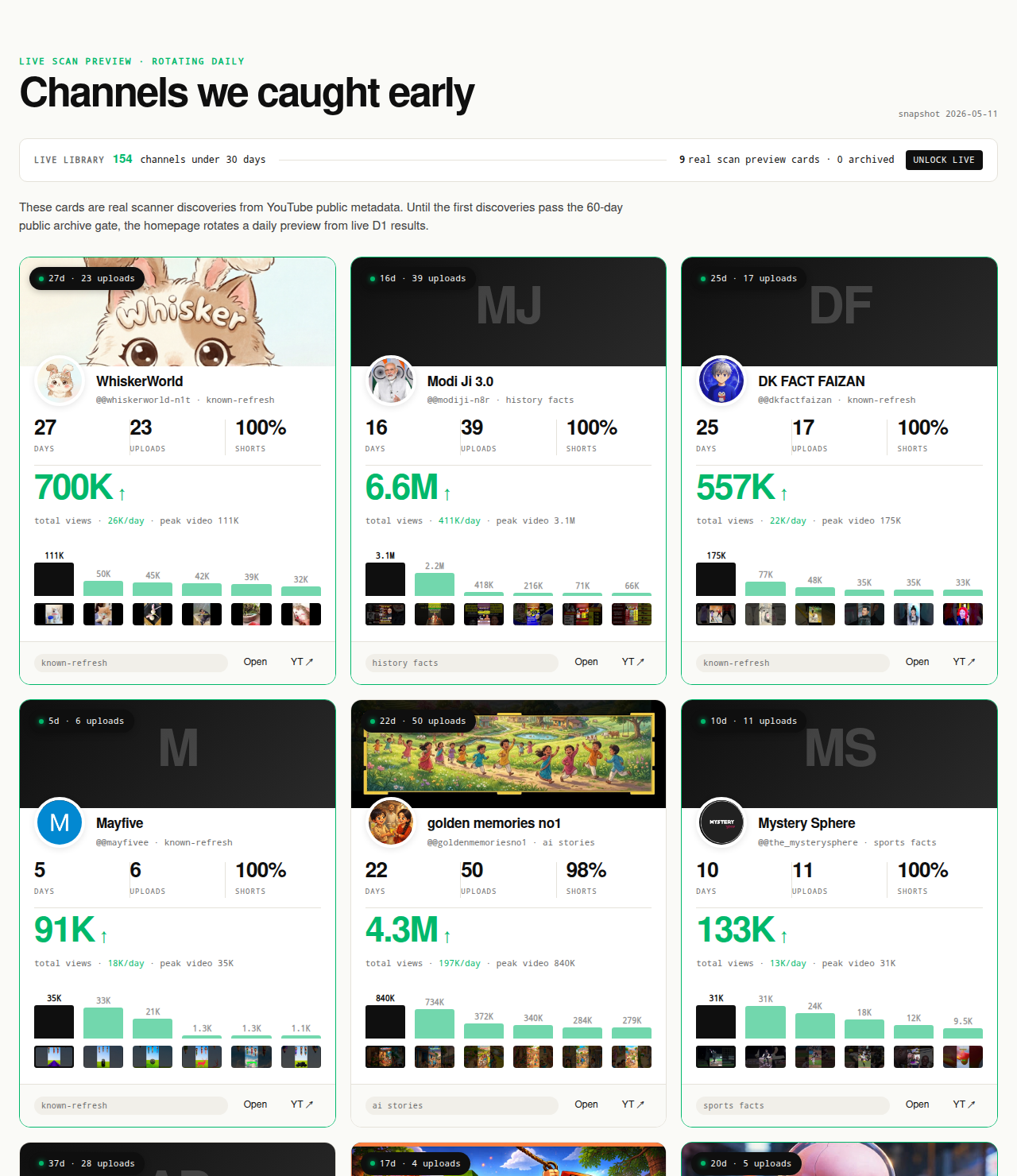
The Shorts-first cohort in our scans clusters into a handful of formats that keep producing small-channel breakouts inside the 45-day window. Read the list as observation, not as a ranking — there is no "best Shorts niche," only formats the recommender is currently lifting at the small-channel layer. Across the channels currently inside our live 30-day window — a subset of the broader thousands of-channel scan — the densest format-leaning niche clusters meeting our sample-size threshold are:
The Shorts-first vs long-form split inside those top clusters looks like this in our dataset:
AI story Shorts are the highest-volume Shorts-first cluster in our 2026 scans. The pattern is TTS narration plus AI-generated imagery in a 45-to-90-second vertical format, with recurring story templates (horror anthologies, AI-generated fictional history, AI-generated true-crime adjacent narratives). The AI story channels programmatic page tracks the cluster with the same outbound-link verification as the main library. The format works on the Shorts feed specifically because the watch-through is high inside a tight vertical container, and the AI imagery layer lets a single operator scale story output without face-on-camera production constraints.
Reddit story Shorts run TTS over r/AmITheAsshole, r/ProRevenge, r/MaliciousCompliance, and adjacent story threads with stock visuals or simple character overlay. The Reddit story channels programmatic page covers the cluster. The format thrives on the Shorts feed because the story has a built-in hook in the first sentence and a payoff inside 60 seconds; the channels still breaking out are the ones adding character voicing or editorial selection over the raw thread, since YouTube's 2024 mass-production enforcement (YouTube Help: monetization policies and channel guidelines) targeted lazy implementations of this format.
History fact-stack Shorts stack three-to-six historical facts inside a 45-to-75-second vertical with cinematic visuals, captioned narration, and a count-up template. The history shorts channels programmatic page indexes the cluster. The format compounds across the entire long-tail of historical topics, which keeps audience-side novelty high without per-video research scaling problems for the operator.
Quiz and trivia Shorts run interactive Q&A formats with text overlays and a count-down timer. The quiz channels programmatic page tracks the cluster. Production is the lowest-cost of the four because the visuals are template-driven; the editorial work is question selection and difficulty calibration.
Other format clusters surface periodically without yet having dedicated programmatic pages: POV cooking Shorts (first-person camera over a cutting board, no face), tier-list Shorts (S-tier through F-tier ranked inside a 60-second template), satisfying process Shorts (manufacturing, restoration, cleaning), and travel-fact Shorts (locations stacked with on-screen captions). Each is a working Shorts format with current small-channel breakouts in our scans; none is "the most profitable" in any meaningful sense — they are the formats where the public-data velocity signal currently fires. The faceless YouTube niches sister pillar covers the production-mode angle for the operators picking which of these to run.
What we deliberately don't claim about Shorts trends
NicheBreakout does not claim access to per-video swipe-away rate, per-trend RPM, audio-side trending data, total Shorts impressions, or "trending now" feed surfacing. Those signals live behind authenticated endpoints, internal recommender state, or product surfaces YouTube has not exposed through the public Data API. The official YouTube Data API v3 documentation defines what is exposed, and the Shorts-specific surfaces (the Shorts feed ranking, Creator Music availability, audio-level analytics) are not part of that surface (YouTube Data API v3 reference). Anyone selling third-party "Shorts feed RPM" or "trending sound" data is either inferring from non-API sources or fabricating the number.
What is readable for any Shorts-first channel from public Data API fields: channel age, subscriber count (rounded to three significant figures per the Data API documentation), total view count, video count, video metadata, video publish dates, individual video view counts, and video duration. The Shorts ratio inside a channel is computable from video duration plus video count. The format pattern is inferable from title patterns, duration distribution, and thumbnail style. The velocity signal is computable from view count divided by channel age. Every claim on this pillar is defensible from one of those fields.
What is not readable for any Shorts-first channel: which audio track a Short uses internally, how a specific Short ranked inside the Shorts feed, what swipe-away rate the Short had, what RPM the Short paid out, which traffic source the Short's views came from, and which Shorts the recommender is currently surging on. None of those metrics ship in the live library, the Friday digest, or the future matured public archive, and none would survive the outbound-link verification rule that governs every channel card on the page.
The boundary is structural. Public-data-only is what makes every Shorts-first channel card on this page verifiable on YouTube — readers can click through and confirm the channel age, the upload count, the view count, the format pattern. No-AI-narratives is what keeps the methodology auditable. The product is a SHORTS-CHANNEL discovery tool, not a "next viral sound" predictor. The audio-side trending question is a real question; it is just not one that public Data API fields can answer, so the page declines to answer it.
Why the standard "trending sounds" advice underperforms
The dominant content pattern for "youtube shorts trends" is a list of trending sounds scraped from TikTok and republished as "use this sound on YouTube Shorts." The framing has two structural problems. First, the sound that is trending on TikTok may not exist inside YouTube's Creator Music library at all, which means a YouTube Shorts creator cannot actually use it without licensing it independently. Creator Music is the gated catalogue YouTube exposes to Shorts creators with revenue-share terms, and it does not mirror TikTok's library (YouTube Help: Creator Music for Shorts). Second, the recommender surfaces do not cross-pollinate audio popularity — a viral sound on TikTok does not get a lift on the YouTube Shorts feed because the sound is viral on TikTok. The Shorts feed reads watch-through inside its own pool.
The advice underperforms in a third way that is downstream of the first two: even when the sound is available and the upload is otherwise solid, the lift from "trending sound" inclusion is small relative to format-fit. A Shorts-first channel publishing a clean format with a generic background track outperforms the same channel publishing the same format with a "trending sound" attached, in our scans, because format consistency is what the recommender reads at the channel level. Sounds are a per-video decoration; format is the channel-level signal.
The durable alternative is the velocity-of-small-channels signal: what are small channels publishing AND getting recommender lift from right now, regardless of audio choice. That signal is observable from channel-level Data API metadata, requires no authenticated access, and points at format trends and shape trends rather than audio trends. The parent YouTube niche finder pillar covers the cross-format methodology; this pillar applies the same methodology with a Shorts-first filter. Either way the unit of analysis is the channel, not the sound, because the channel is what public data describes.
The trending-sounds category is not useless — operators publishing music-driven dance Shorts or remix Shorts still benefit from audio awareness. The framing error is treating trending-sounds research as a general Shorts strategy. For the vast majority of working Shorts formats (TTS narration, fact-stacks, story narration, quiz, POV cooking, satisfying process) the audio track is generic and the format does the work. The list of working Shorts formats with current small-channel breakouts is in the section above; none of them are sound-driven.
Common mistakes new Shorts creators make
Six mistakes recur in the Shorts-first cohort. Chasing trending sounds without format consistency. A creator picks a different trending sound for every upload and never lets the recommender learn the channel's format fingerprint. The Shorts feed evaluates channels on format consistency more aggressively than the main feed does because the surface throughput is higher; format-mixed Shorts channels stay cold. The corrective is to lock a format for the first 10 to 20 uploads and treat audio as a per-video decoration, not the format axis.
Copy-pasting trending topics from TikTok. TikTok's recommendation system and YouTube's Shorts feed read different signals; a topic trending on TikTok is not automatically trending on Shorts. The corrective is to read the format from small Shorts-first channels currently getting recommender lift (channel age ≤ 45 days, first-5 sum ≥ 50,000, Shorts ratio ≥ 0.8) and run a topic inside that format, not the reverse.
Ignoring the channel-age signal. New creators study channels with 500,000 subscribers running Shorts and copy their current strategy, missing that the mature channel's current strategy is downstream of two years of recommender-trained audience momentum. The corrective is to study channels under 90 days old inside the same format — the Shorts-first channels currently winning, not the ones that won. The YouTube niche validation checklist operationalizes this into a workflow.
Mixing Shorts and long-form on a single channel. The recommender treats a channel with three Shorts and one long-form upload as ambiguous, and the early-traction signal flatlines on both surfaces. The faceless pillar covers the same mistake in its mixed-format section; the same logic applies to Shorts-first creators considering "branching into long-form." The corrective is to run two separate channels — one Shorts-first, one long-form-first — rather than blending the formats on a single channel ID. See the faceless YouTube niches pillar's section on Shorts-vs-long-form for the recommender-side mechanism.
Thinking Shorts views map to subscriber growth. They usually don't. Shorts views are recommender-served from the swipe feed, which means viewers are watching one Short and moving on rather than visiting the channel page. A Shorts-first channel can clear 5 million views with 800 subscribers because the audience is feed-served, not channel-served. The corrective is to set Shorts goals on view velocity and Shorts-monetization thresholds (10 million views in 90 days for Partner Program eligibility), not on subscribers. If subscribers are the goal, long-form is the better channel surface for it.
Publishing at the wrong cadence. The Shorts feed rewards format consistency and rewards channels publishing inside a tight cadence — daily or every other day for the first 30 uploads is the pattern in our scans. Creators who publish three Shorts in a week and then nothing for two weeks teach the recommender an unstable channel profile and the format-fit signal cools. The corrective is to batch-produce a backlog before launching and publish on a fixed cadence the recommender can learn.
FAQ
What's trending on YouTube Shorts right now?
Honest answer: no third-party tool publishes a real-time Shorts trending feed, because YouTube doesn't expose one through the public Data API. What is readable from public metadata is the next-best signal — which small Shorts-first channels are accumulating abnormal view velocity right now, and what format they're publishing. NicheBreakout surfaces those channels via the live 30-day library. The format the breakouts share is the durable Shorts-trend signal; specific topics rotate inside that format every few weeks.
How do I find trending YouTube Shorts ideas?
Read off the format from small channels currently breaking out under the Shorts-first filter, then pick a topic inside that format. A working format (TTS-over-stock-history shorts, first-person POV shorts, fact-stack shorts with captions) generalizes across topics for months. Idea lists that name a topic without showing the channels currently winning at it are guesswork. The format-first approach is how the channels in our scans actually scale — they pick one Shorts format and run multiple topic variations inside it.
Are YouTube Shorts profitable?
Public Data API metadata doesn't expose revenue, so a blanket profitability comparison is unverifiable. The YouTube Partner Program does monetize Shorts via the Shorts ad revenue pool, with payouts based on each creator's share of total Shorts views from monetizing viewers. The headline pattern: Shorts CPM/RPM is meaningfully lower than long-form for most channels, which is why creators who monetize seriously typically use Shorts to recruit subscribers into a long-form channel rather than as the primary revenue surface.
Why do my YouTube Shorts get no views?
The most common reason in our scans is format inconsistency — the Shorts feed evaluates each channel on a tight format fingerprint, and uploads that drift between formats teach the recommender contradicting profiles. Other recurring causes: weak first-second hook (the Shorts feed reads swipe-away rate inside seconds), mixing Shorts and long-form on a single channel, or a topic the format works for elsewhere but the recommender hasn't matched to a Shorts audience yet. Format-clarity is the variable with the largest measurable effect.
How long should a YouTube Short be?
YouTube extended the Shorts ceiling to 3 minutes in October 2024, but the channels currently breaking out in our scans cluster at 30 to 75 seconds. Shorter Shorts have higher watch-through inside the feed, which is the primary ranking signal on the Shorts surface. Longer Shorts can work for narrative formats (Reddit reads, story shorts) where the watch-through can survive the length. The default for a new Shorts-first channel is 45 to 60 seconds with a hook in the first second.
Can I copy trending TikTok Shorts on YouTube?
You can repost the same vertical format, but copying a trending TikTok sound onto YouTube Shorts is structurally weak. YouTube's Creator Music library is separate from TikTok's library; the sound that's trending on TikTok may not be available for use inside YouTube Shorts at all, and the recommendation surfaces don't cross-pollinate. What does transfer: the format itself (vertical, fast cuts, hook in second one, captions on every line). The audio side is a per-platform decision.
Do Shorts hurt my channel?
Not by themselves. What hurts a channel is publishing Shorts and long-form on the same channel without a deliberate format strategy — the recommender treats the channel as ambiguous and the early-traction signal flatlines on both surfaces. Channels that pick Shorts-first and stay there for the first 10 to 20 uploads accumulate cleaner format-fit signal than mixed-format channels. If long-form is the eventual goal, run two separate channels rather than blending them on one channel ID.
What's the best niche for YouTube Shorts?
There is no single best Shorts niche — there are working format-topic intersections, and they rotate. The current cluster in our scans skews toward AI-narrated stories, history fact-stacks, Reddit narration, quiz/trivia, and POV cooking, all running as Shorts-first formats. The shortcut is to pick a format the recommender is currently lifting and run a topic inside it. The live library lists the channels currently winning at each format with outbound links so the public metadata is verifiable.
Methodology / About this analysis
NicheBreakout's research relies entirely on YouTube Data API v3 public fields: channel age, subscriber count, video count, view count, video metadata, video publish dates, video duration, and recent video performance. The Shorts-first observations on this page are derived from the same scan that powers the main live library — no separate dataset, no authenticated Analytics access, no inferred audio-side data, no AI-generated narratives describing why specific channels work. Shorts-first labeling uses the Shorts ratio computed from video duration; the cutoff is 0.8.
Original-research artifacts in this article: the four-category Shorts-trend taxonomy in the opening section, the Shorts-feed-vs-Browse surface argument, the velocity-over-topic framing, the deterministic flagging methodology, the live niche-cluster snapshot, and the revealed channel cards above the fold. The Shorts-first format clusters discussed reflect what we've scanned, not all of Shorts YouTube. Author: Nicholas Major (Founder, NicheBreakout · Software engineer since 2011). Article last revised 2026-09-21.
Live scan freshness:
Related research
- YouTube niche finder: the parent pillar covering niche research across Shorts-first and long-form-first channels.
- Faceless YouTube niches: sister pillar covering the production-mode angle that dominates Shorts-first production.
- YouTube outlier finder: sister pillar covering the breakout-discovery framing applied to any channel type.
- YouTube channel research: sister pillar covering the broader channel-discovery category.
- How to do YouTube niche research: the full process guide downstream of the niche-finder pillar.
- YouTube niche validation checklist: the deterministic checklist version of the methodology.
- Most profitable YouTube niches: companion listicle backed by examples from the live cohort.
- AI story channels: programmatic topic page tracking the AI-storytelling Shorts cluster.
- Reddit story channels: programmatic topic page tracking the Reddit-narration Shorts cluster.
- History shorts channels: programmatic topic page tracking the history-shorts cluster.
- Quiz channels: programmatic topic page tracking the quiz/trivia Shorts cluster.
- Faceless storytelling channels: programmatic topic page tracking the broader storytelling cluster.
The Friday digest sends three current breakout channels every week — Shorts-first and long-form-first both — with format fingerprints and outbound YouTube links. Free, present-tense. The live library refreshes daily and surfaces channels currently inside the 30-day window. See pricing for the current tier; subscribe to the digest free.
End of pillar
Find the Shorts format the recommender is lifting today
Every channel card outbound-links to YouTube so you can audit the public metadata yourself. The live under-30-day library is the paid workflow; the Friday digest is free.