
/ Cluster · Faceless YouTube niches for beginners
Faceless YouTube niches for beginners: low production complexity, current breakout evidence, saturation runway
Beginner faceless YouTube niches is a contested category. The standard SERP returns the same broad listicles for the beginner query as it does for the head query, with "beginner-friendly" applied as a marketing label rather than a filter anyone can verify. The defensible reframe: beginner does not mean lower-quality niches, it means niches with low production complexity AND current breakout evidence AND saturation runway. NicheBreakout's research base is thousands of channels scanned, public YouTube Data API v3 metadata only — no income claims, no tool endorsements. This page applies a two-overlay beginner filter on top of the parent pillar's three deterministic gates and walks through which faceless niches clear it.

Ai stories by shano
 45d · 36 uploads
YOU & ME
 45d · 25 uploads
Dootoons TV
 45d · 69 uploads
Mr Pawsome
 42d · 64 uploads
sajkcasqq
 38d · 38 uploads
OP Nigma

FactD
 45d · 31 uploads
Cognexa Talks
 39d · 21 uploads
MapLore
What "for beginners" should actually mean in a faceless niche page
The phrase "faceless YouTube niches for beginners" is doing two jobs at once in most SERP results, and both jobs get done poorly. The first job is to filter for low production complexity — a beginner has not yet built a sustainable per-upload workflow. The second job is to filter for niches where a new entrant has a chance to break out, not just niches that existed two years ago. Listicles dated 2024 rarely do either job explicitly; they restate the parent faceless category with "beginner" added to the title and call it filtered.
This page applies two explicit overlays on top of the parent pillar's three deterministic flagging gates. The first is a production-complexity floor: per-upload time inside the lowest-cost configuration must fit inside a stated ceiling a solo operator can sustain — roughly four hours per upload for a long-form rig, roughly one to two hours per upload for a Shorts-first rig. The ceiling is falsifiable against the operator's own throughput before committing the rig.
The second is an operator-cost floor: the lowest-cost defensible configuration must run on a free or near-free production path — free TTS or simple human narration, free or public-domain visual library, free editing software. Tool pricing shifts quarterly so the floor is not a fixed number; the durable check is whether the format works at all without paid tools.
The third filter — which this page does not relax — is the parent pillar's current breakout evidence requirement: three small channels under 90 days old at the specific format-topic intersection a new entrant would target. Beginner-feasibility without current breakout evidence is a marketing label; with it, an investable observation. The combination is what this page operationalizes on top of the broader format taxonomy in the parent faceless YouTube niches pillar.
Why most "beginner faceless niches" lists are misleading
Open the first page of search results for the beginner-qualified query and the structural pattern is the same as the head-query SERP. The same niches appear, the same listicle structure repeats, and "beginner-friendly" is the only added qualifier. None of the major results explicitly state what makes a niche beginner-friendly. A handful name "low cost" or "no experience required" in passing but do not back the label with channel evidence, production-time estimates, or current-breakout examples.
The pattern is misleading in three falsifiable ways. The lists are recycled. A 2024 beginner-faceless listicle is almost always a re-skin of a 2023 faceless listicle with the word "beginner" inserted into the title. Whether the named niches are currently lifting new entrants in 2026 is not something the listicle answers. The reader takes the list as current evidence when it is a static historical document.
The lists do not assess production complexity. A list that names "documentary-style storytelling" as beginner-friendly treats the topic name as the entire signal. The same topic can run as a 45-second TTS Short or as a 20-minute voiceover documentary; the first is feasible for a solo beginner, the second is the production scope of a small editorial team. Without a per-upload time estimate the listicle conflates two different operating scopes inside the same recommended niche, and the reader who picks the wrong scope ends up with a rig they cannot sustain.
The lists never apply a current-evidence check. A niche that lifted in 2023 and is now post-saturation stays on a 2026 beginner listicle if it was on the 2023 source. The operator who picks the niche, runs the rig, and sees the first-5 sum land flat reads it as personal failure when the actual problem is closed-cohort entry timing. The corrective is a present-tense breakout-evidence step the listicle format does not include because it would shorten the list. The shorter list is the feature.
The deterministic filter for a beginner-friendly faceless niche
NicheBreakout applies three hard public-metadata gates to every channel in the live library. The full methodology lives on the methodology page; the section below restates the gates and adds the two beginner-specific overlays this page applies on top of them.
Channel age
detected within 45 days of channel creationFirst-5 upload views
combined views across the first five public uploads ≥ 10,000Views per day
lifetime channel views ÷ channel age ≥ 1,000Format clarity (bonus)
score weights channels with a clear Shorts-first or long-form-first ratio above mixed-format channelsEarly-traction velocity (bonus)
score boost when channel age ≤ 14 days, first-5 sum ≥ 50,000, or views/day ≥ 5,000
The base gates establish that small channels under 45 days old at the format-topic intersection are clearing public-metadata thresholds the recommender is currently lifting against. First-5 sum filters single-video flukes; views per day filters channels coasting on one viral upload; the 45-day age cap filters mature channels whose numbers reflect years of audience accumulation.
The first beginner-specific overlay is the production-complexity floor. A format clears the overlay when per-upload time inside its lowest-cost configuration fits the stated ceiling for a solo operator — roughly one to two hours per upload for a Shorts-first rig, roughly four hours per upload for a long-form rig, across script, narration, visual layer, edit, and thumbnail combined. A format whose current breakouts run rigs that take a full working day per upload fails the overlay; the corrective for an operator who wants to run it anyway is to recognize they are starting outside the beginner band.
The second overlay is the operator-cost floor. A format clears the overlay when at least one defensible production path inside it runs at free or near-free monthly cost. This does not mean every channel inside the format runs the free path; it means a new operator without a tool budget has a defensible rig they can stand up. Formats where the breakout cohort is dominated by paid-stack rigs with no free-path equivalent fail the overlay.
The overlays combine with the base gates as a conjunction. A beginner-feasible niche clears all five conditions: channel age, first-5 sum, views per day, production-complexity floor, operator-cost floor.
The faceless niches that currently meet the beginner threshold
This section does not rank beginner-feasible niches by claimed monetization. What this page can publish is the cluster observation: which beginner-eligible format-topic intersections are currently producing small-channel breakouts, with links to the programmatic pages where the breakout examples live. The list is intentionally short; the two overlays remove most of the broader faceless category from beginner consideration.
Quiz and trivia Shorts with templated visuals. Production complexity is the lowest of any cluster here, often under an hour once the visual template is built — the editorial work is question selection and difficulty calibration. The quiz channels programmatic page tracks current breakouts. Beginner-fit note: this is the highest copy-density cluster on the list, so the saturation curve is steeper and the breakout window inside a specific sub-format closes faster than for narrative formats.
History Shorts with simple visuals. Vertical 45-to-75-second fact stacks with TTS narration over archival imagery, AI-generated period stills, or a hybrid layer. Production time inside the lowest-cost configuration is roughly one to two hours once the script template is in place; the recurring work is fact selection. The history shorts channels programmatic page indexes the cluster. Beginner-fit note: breakout intersections are typically themed (era, region, profession) rather than generic "history facts."
Reddit narration with editorial selection. TTS or human voiceover reading curated story threads over simple visuals. Production time is roughly two to four hours for a long-form upload because thread selection and the editorial read take time even when the rig is simple. The Reddit story channels programmatic page covers the cluster. Beginner-fit note: the 2024 Partner Program enforcement hit lazy implementations hardest; verbatim reading is the disqualifying pattern. The channels still breaking out add original commentary, character voicing, or editorial selection across threads.
Scary-story and creepypasta narration with atmospheric visuals. TTS or human voiceover reading original or appropriately licensed scary stories over simple atmospheric footage. Production time is the highest on this list (roughly three to four hours for a long-form upload), but the format clears the overlays because a defensible free-or-near-free path exists. Copyright collisions on others' creative writing are a recurring monetization risk; the channels still breaking out are reading original or properly licensed material.
Other faceless clusters fail at least one overlay inside their current breakout cohort: AI-story Shorts usually require a paid imagery stack, finance and investing explainers carry a higher editorial-skill floor, list-of-X channels saturate inside weeks, and broader faceless storytelling runs above the beginner production ceiling once narration and B-roll curation are included. Operators considering those clusters should read the parent faceless YouTube niches pillar and the sibling how to start a faceless YouTube channel cluster.
Why beginner-friendly does NOT mean low-effort
The temptation in any beginner-faceless article is to slide from "low production complexity" into "low effort." The slide is wrong. A beginner-feasible niche has a simpler production rig — fewer paid tools, shorter per-upload time, lower editorial-skill floor for the production craft — but the editorial judgment required to publish a video the recommender will lift is the same as in any other niche.
The visible production craft is what gets simpler. Building a Shorts visual template once and reusing it across thirty uploads is a real time reduction; locking one TTS voice as the channel's recurring narrator is a real time reduction; templating thumbnails is a real time reduction. None of these are editorial reductions. The editorial work — which question to ask, which fact to surface, which Reddit thread to read, which scary story to script — is the same per-upload work the operator would do in any niche, and the quality of those decisions is what the recommender ends up reading off.
Operators who confuse production simplicity with editorial simplicity end up producing template channels at high volume with weak per-upload editorial decisions — the pattern the 2024 Partner Program update on inauthentic content targeted. The time savings from a beginner-feasible rig should go to editorial iteration, not upload volume: thumbnail tests, question selection across multiple seed lists, hook rewrites, and watching the small breakout cohort to read off what the lifted channels are doing differently.
The trade-off: beginner-friendly niches saturate faster
The same property that makes a niche beginner-feasible — low production complexity, low operator cost, simple rig — also makes it cheap to replicate. Cost-to-replicate is the structural variable that determines how fast the breakout window inside a niche closes after a new format starts producing lifts. A niche where a new entrant needs four hours per upload, a paid imagery subscription, and an experienced narrator has a slower replication curve than a niche where a new entrant needs an hour per upload, free tools, and a templated visual layer.
The beginner-feasible clusters above all sit on the steep end of the replication curve. Quiz Shorts replicate fastest because the visual template is reusable across operators and a quiz on one topic is structurally identical to a quiz on another. History Shorts replicate fast for similar reasons. Reddit narration replicates slower because the editorial layer is harder to automate, and scary-story narration replicates slower again because the script editorial pass is hard to template.
The honest reading is that beginner-feasible niches are the easiest entry into faceless YouTube and the hardest to hold past saturation. An operator who clears the three base gates on their first 30 uploads has a real channel; the same operator on uploads 31 through 60 is competing against the next wave who entered with similar or better rigs. The corrective is one of three moves: differentiate at the editorial layer inside the same format, pivot inside the same rig to a less-saturated sub-format, or run a parallel channel inside a different beginner-feasible cluster. The trade-off is not a reason to avoid beginner-feasible niches; it is a reason to plan past the first 30 uploads before committing.
What we deliberately don't claim about beginner monetization
NicheBreakout does not publish income figures, RPM estimates, CPM data, monthly revenue claims, or "highest-earning beginner faceless niche" rankings. Per-channel revenue lives behind YouTube AdSense; per-niche RPM lives behind the YouTube Analytics API. Both are channel-owner-only endpoints, not third-party-accessible. Listicles quoting a monthly income figure for a niche are stacking claims the public data does not support. The boundary applies as strictly as on the cross-pillar most profitable YouTube niches analysis.
The closest defensible substitute for an income claim is the breakout-density observation: which beginner-feasible format-topic intersections are currently producing the most small-channel breakouts under the three base gates. Breakout density measures format viability; it does not measure revenue. Treat per-niche income claims as decoration.
This page also does not claim that any specific beginner-feasible niche is "best for first-time creators." The best niche depends on the operator's actual constraints — script-writing capacity, narration availability, visual-template skill, sustainable weekly hours. The honest answer to "which niche should I start" is "the one inside the four candidate clusters where you can credibly produce 30 consecutive uploads in the format the current breakouts are running."
Following the beginner overlays does not guarantee a working channel. The overlays confirm that the format-topic intersection is currently producing breakouts and that the rig is sustainable for a beginner; execution variables — script craft, thumbnail iteration, cadence discipline, channel-level format consistency — still determine the outcome.
Common beginner mistakes
Five mistakes recur in new beginner-faceless channels failing to clear the 30-day gates. Each is more common in the beginner cohort because the corrective requires workflow discipline or research time a new operator has not yet built.
Picking a niche with no current breakouts. Selecting a niche from a 2024 listicle without checking whether any small channel inside it is currently breaking out under the three base gates. The listicle named the niche as beginner-friendly two years ago; the cohort closed months ago; the operator commits the rig and lands inside a closed cohort. The corrective is to confirm three channels under 90 days old at the format-topic intersection clear the gates before any rig commitment.
Mixing formats in the first 10 uploads. A Shorts-first quiz channel publishes three 45-second vertical quizzes, then on impulse publishes a 10-minute long-form quiz documentary on the fourth upload. The recommender treats the channel as mixed-format and the audience signal flatlines. Lock one format for at least the first 10 to 20 uploads.
Using inconsistent TTS voices across uploads. A new operator with a voice library of dozens of distinct TTS voices rotates voices upload-to-upload. The recommender and the audience read voice consistency as a channel signature; switching voices breaks the recurring-audience signal. Commit to one voice per channel and treat voice selection as a permanent decision.
Copying a viral channel's topic without copying its production mode. A new operator reads about a viral quiz channel running templated Shorts at four uploads per week and produces 15-minute talking-head quiz long-form videos instead. The topic matches; the production mode does not. Copy the production mode, video length, publish cadence, and visual style of the reference channel — not the topic list.
Evaluating after one upload. A new operator publishes the first upload, watches it for three days, sees flat numbers, and pivots or abandons. One upload does not produce enough recommender training signal to support any verdict. The first verdict point is at three uploads, the second is at 30 days. The corrective is the parent how to start a faceless YouTube channel step-seven discipline.
The clusters currently producing the most beginner-fit breakouts
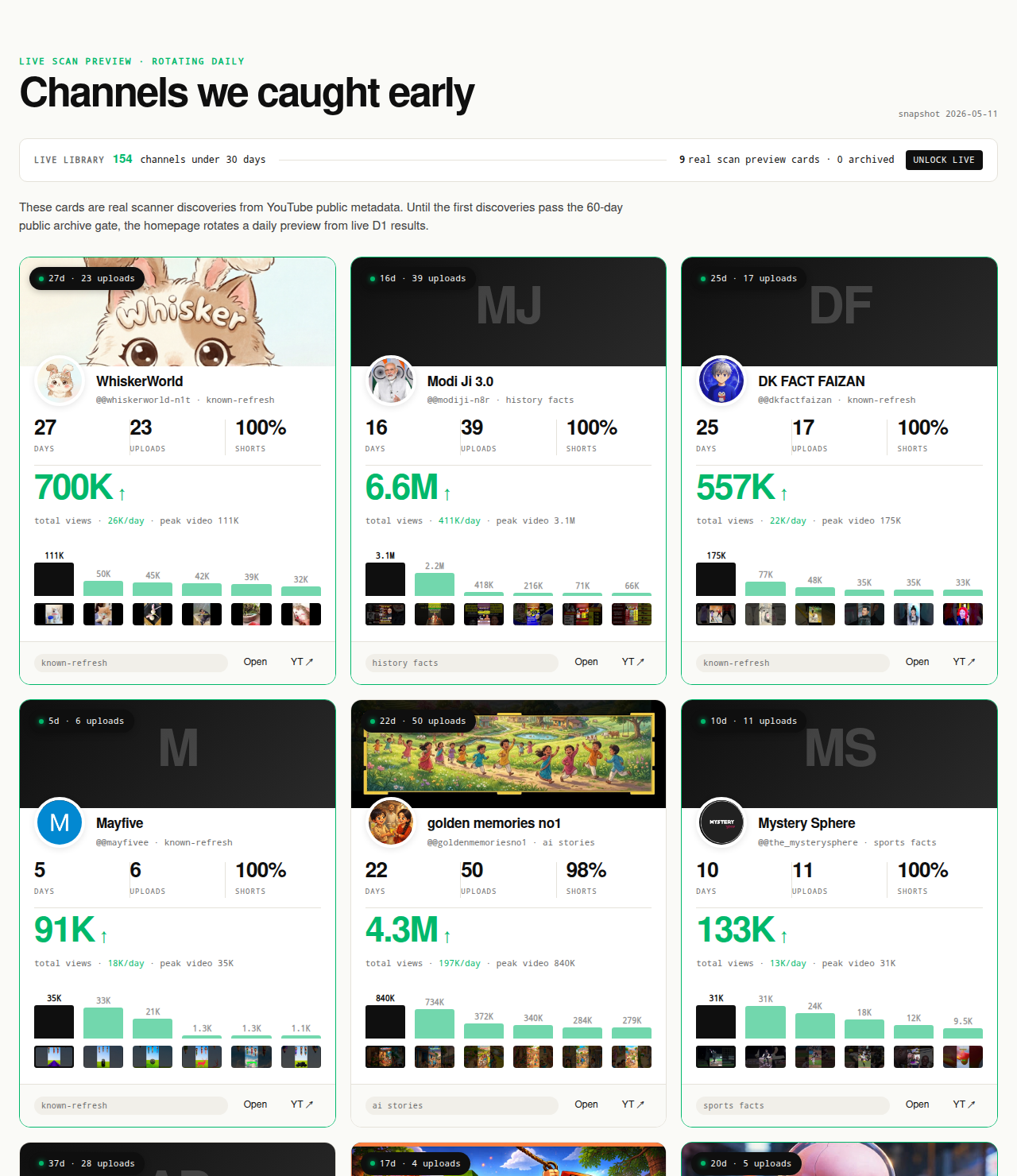
The cluster mix across our recent scans shifts week to week. Static ranking inside the article body would be stale within a month; the right reading is the live snapshot below, re-checked before any rig commitment.
The Shorts-first versus long-form split is the second diagnostic to read alongside the cluster ranking. Beginner-feasible rigs are format-specific by definition, so the operator wants a cluster where the format-fit signal lines up with the production mode they can credibly run:
Operator-fit reading: clusters with a Shorts-first skew favor the lowest-production-complexity rigs (TTS history Shorts, templated quiz Shorts); clusters with a long-form skew favor operators with editorial bandwidth for narrative scripts (Reddit narration, scary-story narration). Mixed-format clusters indicate the recommender is still sorting the cluster.
Average first-five-video views by populated grade tier gives a comparison reference for new operators reading their own first-five sum:
The specific beginner-feasible channels inside each cluster, with outbound YouTube links, live on the relevant programmatic topic pages: quiz channels, history shorts channels, Reddit story channels, faceless storytelling channels.
FAQ
What's the best faceless YouTube niche for beginners?
There is no single best beginner niche; difficulty depends on what the operator can actually produce. The defensible answer is the format-topic intersection where three conditions line up: small channels under 90 days old are currently breaking out under public Data API v3 signals, per-upload production complexity fits a stated ceiling a solo operator can sustain in a few hours per upload, and the cluster has saturation runway left. In our 2026 scans the intersections that most often line up across all three are vertical TTS history Shorts, templated quiz Shorts, scary-story narration with simple visuals, and Reddit narration with editorial selection. None of those is universally easiest; each is easiest for a different operator constraint profile.
What faceless niche is easiest to start?
Easiest is the wrong frame; lower production complexity does not mean lower editorial difficulty. The lowest production-complexity formats in our scans are templated quiz and trivia Shorts, text-overlay fact stacks, and TTS-plus-stock-imagery Shorts under 60 seconds. Each has a current breakout cohort and a production ceiling under a few hours per upload. The trade-off is that the lowest production-complexity formats have the lowest cost-to-replicate, so the saturation curve is steeper. Easiest to start is not easiest to sustain past upload twenty.
How long until a beginner faceless channel can monetize?
The Partner Program thresholds (1,000 subscribers and 4,000 watch hours in 12 months, or 1,000 subscribers and 10 million Shorts views in 90 days) are the same for beginner faceless channels as for any other. The first leading signal is the first-5 sum at 30 days: combined views across the first five uploads clearing 10,000 inside 30 days indicates the recommender is picking up the format. Channels that miss that gate are almost never the channels that hit eligibility a year later.
Do I need expensive tools to start a faceless channel?
No. The platform side is free, and several beginner-feasible formats have a free or near-free production path — screen-recorded explainers with free capture and a free editor, TTS Shorts with a free-tier neural voice and a public-domain footage library, slideshow-style fact stacks in free presentation software. The constraint that matters is sustainability across thirty uploads at format-consistent quality. A free rig that breaks on the eleventh upload because a paid feature was needed is worse than a low-cost rig that runs identically every time.
Can I run multiple beginner faceless channels?
Operationally yes; the constraint for a beginner is editorial capacity, not the platform rule. One channel at four Shorts-first uploads per week is already four script-narrate-edit-thumbnail cycles per week; doubling that almost always degrades quality below the threshold the recommender lifts. Validate one channel to first-5 sum ≥ 10,000 and views/day ≥ 1,000 before spinning up a second. Multi-channel template operators at scale are the pattern the 2024 Partner Program enforcement targets.
Should I pick AI faceless or human-voice faceless as a beginner?
Downstream of which format the operator can actually sustain for thirty uploads. AI-faceless rigs lower per-upload time and enable higher cadence; the trade-off is lower cost-to-replicate and a faster saturation curve. Human-voice faceless rigs hold longer against the copy wave but produce fewer uploads per week and require consistent narration recording. Commit to the rig the operator can run on a sustainable weekly schedule for the format-topic intersection currently producing breakouts. The sibling faceless YouTube channel ideas with AI cluster covers the AI-tooling angle.
What's the worst beginner faceless mistake?
Picking a niche from a 2024 listicle without checking whether any small channel is currently breaking out at that format-topic intersection. The operator commits a rig to a niche that was lifting new entrants two years ago, lands inside a saturated cohort, and concludes that faceless YouTube does not work anymore. The actual problem is entry timing, not the format. Confirm three channels under 90 days old at the intersection are currently clearing the three flagging gates before any rig commitment. The cross-pillar YouTube niche validation checklist operationalizes that corrective.
Are beginner faceless niches saturated?
The beginner-feasible category is the most copy-dense subset of faceless YouTube, because low production-complexity also means low cost-to-replicate. Saturation lives at the format-topic intersection layer, not the topic layer. Specific intersections inside crowded parent topics keep producing breakouts — themed history Shorts, character-voiced Reddit narration, themed quiz formats. The diagnostic is whether any small channels under 45 days old at the specific intersection are currently clearing the three flagging gates.
Methodology / About this analysis
NicheBreakout's research relies entirely on YouTube Data API v3 public fields. No YouTube Analytics API access, no AdSense data, no scraping of authenticated dashboards, no production-stack inference at the tool layer. The beginner-feasibility observations on this page are derived from the same scan that powers the main live library.
Original-research artifacts in this article: the two-overlay beginner filter (production-complexity floor and operator-cost floor) applied on top of the parent pillar's three deterministic flagging gates, a falsifiable per-upload production-time ceiling expressed in operator hours rather than as a marketing label, the saturation-curve argument applied specifically to the beginner band, and the live cluster snapshot. Production-time estimates here are approximate and operator-dependent. Author: Nicholas Major (Founder, NicheBreakout · Software engineer since 2011). Article last revised 2026-09-21. External references: the YouTube Help Center entry on the YouTube Partner Program overview & eligibility covers monetization thresholds; the entry on disclosing use of altered or synthetic content covers the AI-disclosure rule.
Live scan freshness:
Related research
- Faceless YouTube niches: parent pillar covering faceless production modes across all skill levels.
- How to start a faceless YouTube channel: sibling cluster — the seven-step procedural starting sequence.
- Faceless YouTube channel ideas with AI: sibling cluster — the AI-tooling angle and the five-category production stack.
- YouTube automation niches: sibling cluster — operator-workflow angle for agency multi-channel and AI-tooled solo models.
- YouTube Shorts ideas without showing face: lateral cluster — the Shorts-format intersection with faceless production.
- YouTube niche finder: pillar covering niche research across faceless and face-on-camera channels.
- YouTube niche validation checklist: binary scorecard version of the current-evidence step.
- How to do YouTube niche research: process guide upstream of the beginner filter.
- YouTube Shorts trends: pillar covering Shorts-first publishing.
- YouTube channel research: pillar covering broader channel discovery, useful for sourcing breakout examples.
- Most profitable YouTube niches: sibling cluster on why per-niche profitability is not third-party-readable.
- Quiz channels, history shorts channels, Reddit story channels, faceless storytelling channels: programmatic topic pages tracking the beginner-feasible clusters discussed above.
The Friday digest sends three current breakout channels every week with format fingerprints and outbound YouTube links. The live library refreshes daily and surfaces channels currently inside the 30-day window. See pricing for the current tier; subscribe to the digest free.
End of cluster
Find a beginner-feasible faceless intersection currently producing breakouts
Every channel card outbound-links to YouTube so a new operator can read off the format, cadence, and visual style the breakout is running before committing the rig. No income claims, no tool endorsements, no revenue claims — public Data API only. The live under-30-day library is the paid workflow; the Friday digest is free.