
/ Pillar · Most profitable YouTube niches
Most profitable YouTube niches: why no one can tell you, and what to ask instead
"Most profitable YouTube niches" is the wrong question to ask third-party data, because the data needed to answer it is private. Per-channel revenue, RPM, and CPM live behind the YouTube Analytics API and YouTube AdSense — both authenticated, channel-owner-only. Every listicle ranking niches by claimed RPM is extrapolation. What public Data API v3 metadata can tell you: which niches currently have small channels breaking out, with formats consistent enough that a new entrant can replicate. NicheBreakout's research base is thousands of channels scanned to date — public metadata only, no revenue claims, no AdSense inference.

Ai stories by shano
 45d · 36 uploads
YOU & ME
 45d · 25 uploads
Dootoons TV
 45d · 69 uploads
Mr Pawsome
 42d · 64 uploads
sajkcasqq
 38d · 38 uploads
OP Nigma

FactD
 45d · 31 uploads
Cognexa Talks
 39d · 21 uploads
MapLore
Why "most profitable YouTube niches" is the wrong question
The query "most profitable YouTube niches" asks a question that public data cannot answer. Per-channel revenue is gated behind the YouTube Analytics API and YouTube AdSense, both of which authenticate against the channel owner's Google account. A third-party researcher cannot read another channel's revenue. They cannot read its RPM. They cannot read its CPM, its ad-fill rate, its mid-roll density, its sponsorship income, its affiliate conversions, or its YouTube Premium revenue split. Every product, article, and listicle that publishes a "most profitable niche" ranking is doing so without access to the data the ranking would require.
This is not a technicality. It is the structural condition that determines what an honest answer looks like. If the data needed to rank niches by profitability is private, then any public ranking is either an estimate built from non-revenue signals (subscriber count, view count, engagement) presented as a revenue proxy, or it is a guess dressed up in confident copy. Both fail the test of being verifiable. A reader who wants to check a "high-RPM finance niche" claim against a finance channel's actual AdSense report cannot do so, because the AdSense report is private.
The honest reframe is to separate the question into the part public data can answer and the part it cannot. Public Data API v3 metadata exposes channel age, subscriber count (rounded to three significant figures), total view count, video count, individual video performance, and video metadata. From those fields, a researcher can read which niches are currently producing small-channel breakouts inside the first 45 days of a channel's life. That signal answers "is this niche moving right now" — which is the actionable question for someone deciding what kind of channel to start. It does not answer "will I be profitable in this niche," because profitability depends on the creator's monetization mix, not on the niche alone.
This pillar walks through both halves of the split: what is readable from public metadata (and how it is read), and what is not (and why every ranking that claims to know is guessing). The conclusion is not "do not ask about profitability." The conclusion is "ask the question to the data that can answer it, then ask the monetization question separately, to yourself, about your own business model." The niche is upstream of monetization but does not determine it.
Why every "most profitable niches" listicle says the same thing
Open ten "most profitable YouTube niches" articles from the last three years and the same 15 to 20 niche names will recur in roughly the same order: personal finance, technology and product reviews, gaming, beauty and lifestyle, fitness and weight loss, real estate investing, business and entrepreneurship, online education, food and cooking, travel, parenting, pets, automotive, photography, and a recent addition of AI tooling. The numbers attached to each (claimed RPM, claimed CPM, claimed "average earnings") tend to be the same across articles too. The repetition is not because the data has been independently verified at multiple sources. It is because the listicles cite each other, often without sourcing.
The mechanism is straightforward. A 2022 listicle quotes a 2020 ad-buyer survey for a CPM figure. A 2023 listicle quotes the 2022 listicle. A 2024 listicle quotes the 2023 listicle, or quotes a creator self-report that originally cited the 2022 listicle. By 2026 the figure has been recirculated across hundreds of pages without anyone consulting the underlying ad-buyer survey or verifying that the figure still holds — and without acknowledging that the original survey was a benchmark for ad-buyer spend, not for YouTube channel RPM. The same closed loop applies to "average earnings" claims, which are typically calculated by multiplying a niche-level claimed RPM by an unstated assumed view count, producing a figure that looks specific but is two layers of guess removed from any real channel.
The downstream effect on niche choice is concrete. A new creator who reads three 2026 "most profitable niches" lists and sees finance ranked first across all three concludes that finance is the high-RPM consensus choice. The consensus is a citation chain, not evidence. Whether finance is actually paying any specific small finance channel a higher RPM than any specific small storytelling channel cannot be determined from the listicles, because none of them have access to the underlying AdSense data. The reader who acts on the consensus is acting on imagination shared across publishers.
The recycled-list pattern is also why the niche names in listicles drift slowly. New format clusters that surface in our scans — AI-generated horror anthologies, faceless tier-list shorts, quiz channels with count-down timers — typically take 18 to 24 months to appear in listicle copy, by which point the small-channel breakout window inside them has often saturated. Reading current listicles to find current opportunities runs into a freshness gap that the recycled-citation pattern guarantees. The corrective is to read what small channels are publishing right now from channel-level metadata, not what last year's listicle says was profitable two years ago.
What CAN be determined from public YouTube data
The YouTube Data API v3 is the canonical public surface for channel and video metadata. Its reference documentation lists the fields exposed by each endpoint (YouTube Data API v3 reference), and the channel-level fields specifically are documented under the channels.list resource: title, description, custom URL, published-at date, default language, country, view count, subscriber count (rounded to three significant figures), hidden-subscriber flag, and video count (YouTube Data API: channels resource). The videos.list resource exposes per-video title, description, publish date, duration, view count, like count where available, and comment count. The search.list resource exposes the ranked result list for query and filter combinations.
From those fields a researcher can derive a usable set of niche-research signals. Channel age comes from published-at minus today. Video count is direct. Lifetime view count is direct. Lifetime views per day is view count divided by channel age — the cleanest velocity proxy available from public metadata. First-5 upload views is the sum of view counts across the first five public uploads, which filters out single-video flukes while staying readable inside a channel's first month. Shorts ratio is computable from video duration plus video count and identifies format-fit (Shorts-first vs long-form-first vs mixed). Niche taxonomy is inferable from title and description text patterns combined with channel-level metadata.
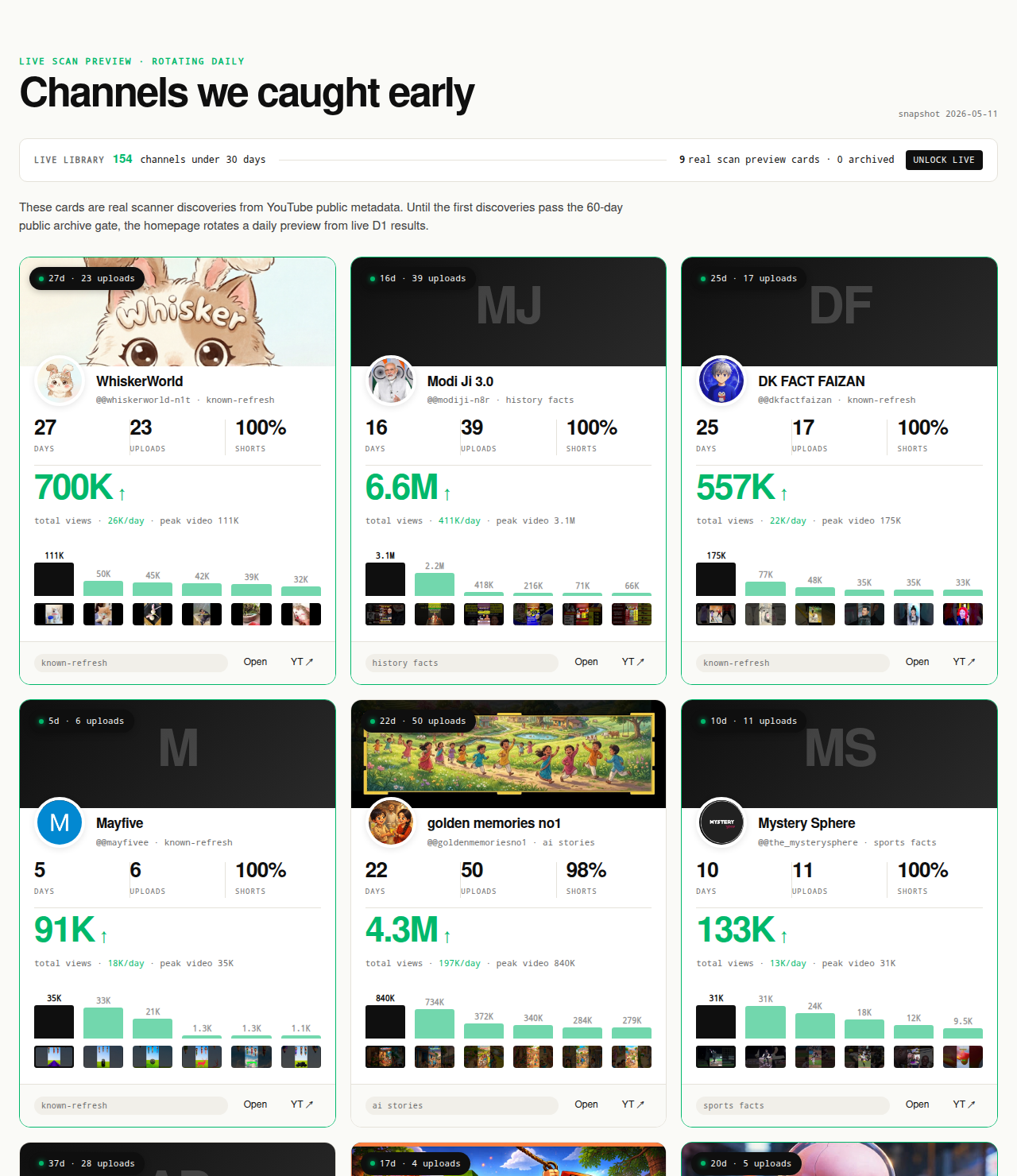
The signals chain into a deterministic flagging methodology. A channel is flagged for the live library when it passes three hard gates: channel age ≤ 45 days, first-5 sum views ≥ 10,000, lifetime views/day ≥ 1,000. The score then weights two bonuses: format clarity (Shorts ratio above 0.8 or below 0.2) and early-traction velocity (age ≤ 14 days, first-5 sum ≥ 50,000, or views/day ≥ 5,000). The full methodology is published on the methodology page. Every channel card NicheBreakout surfaces outbound-links to YouTube so a researcher can verify the public fields directly.
The signals tell you which niches are moving, not which niches are profitable. A 14-day-old channel with five uploads averaging 50,000 views per day is breaking out — public data reveals that unambiguously. Whether that breakout is paying the creator a meaningful net revenue, a token amount, or nothing at all depends on monetization mechanics that public data cannot read. The signals answer the niche-fit question and stop there.
What CANNOT be determined from public YouTube data
The YouTube Analytics API is a separate surface from the Data API, and it is explicitly restricted to authenticated channel owners and content partners. Google's documentation states the constraint directly: the Analytics API "provides multiple reports that channel owners and content owners can use to retrieve YouTube Analytics data" (YouTube Analytics and Reporting APIs overview). The Reporting API doubles down: "This API is intended for YouTube content partners who own and manage many different YouTube channels" with content-owner authentication required. A researcher who does not own the channel and is not authenticated as a content partner for that channel cannot read Analytics data for that channel.
The fields restricted to the Analytics API are the fields that would actually answer "how profitable is this niche." Estimated revenue (channel earnings from ads, YouTube Premium, and other monetization features) is Analytics-only. Estimated ad revenue specifically is Analytics-only. CPM (cost per mille — what advertisers pay per 1,000 impressions) is Analytics-only. RPM (revenue per mille — what the creator receives per 1,000 video views after YouTube's share) is Analytics-only. Monetized playbacks, ad impressions, and playback-based CPM are all Analytics-only.
The non-revenue performance fields are also Analytics-only and matter to the profitability conversation. Watch time (total minutes watched), average view duration, and audience retention are Analytics-only. Click-through rate on impressions, impressions, and traffic source breakdown are Analytics-only. Audience demographics (age, gender, country breakdown) are Analytics-only. Subscriber-vs-non-subscriber view share is Analytics-only. Every metric that would let a third party reason about a channel's actual monetization quality is gated.
The gate is not casual. It is the way YouTube's product is designed. AdSense revenue is the creator's private business outcome; YouTube exposes it only to the creator. Any product that claims to show "competitor RPM," "competitor revenue," or "competitor watch time" for a channel the user does not own is either inferring those metrics from non-Analytics signals (and labeling the inference as data), scraping leaked private dashboards, or fabricating the number. None of those options would survive an outbound-link verification — which is the standard NicheBreakout's product surface holds itself to.
The boundary applies upstream of the listicle SERP. Every "this niche pays the highest RPM" headline is a claim about a metric the publisher does not have access to for the channels they are describing. The honest version of that headline would read "we are guessing about a metric we cannot see." Few publishers write the honest version, because the dishonest version performs better in search.
The right question: which niches currently have small channels breaking out
If profitability is not third-party-readable, the closest public-data proxy a researcher can use to evaluate a niche is channel-velocity at the small-channel layer. The question reframes from "which niche is most profitable" to "which niches currently have small channels breaking out, with formats consistent enough that a new entrant can replicate the pattern." That question is fully answerable from public Data API v3 fields.
The reframe matters because it changes what evidence a researcher should demand. A "most profitable niche" claim should come with revenue evidence — which, as the previous section established, cannot be provided by anyone other than the channel owner. A "this niche is currently producing small-channel breakouts" claim should come with channel evidence: specific small channels under 45 days old with first-5 sum views ≥ 10,000 and lifetime views/day ≥ 1,000, outbound-linked to YouTube so the public metadata is verifiable in one click. The second evidence standard is achievable. The first is not.
The reframe also fits how the recommender actually works. YouTube's discovery surfaces (Browse, Suggested, Search, the Shorts feed) ranking decisions are made on watch-through, click-through, and session-time signals — signals that are private to YouTube. From the creator side, the readable proxy for "the recommender is currently lifting this format" is what small channels in that format are achieving in public metrics. If a 21-day-old channel publishing a specific format clears 60,000 first-5 views and 4,000 views per day, the recommender is lifting that format right now. The format is replicable; the topic inside the format is rotatable. The format-cluster perspective is how NicheBreakout's research is organized.
The reframe is not a downgrade. It is the closer match between what the question is asking and what public data can answer. "Which niches have current small-channel breakouts" is the question that actually maps to a new entrant's decision — because a new entrant's first 45 days will be evaluated by the same recommender that lifted the breakout channels, against the same format-fit signal the breakout channels triggered. The "profitability" framing skips that step and asks about a downstream outcome that the niche only partially determines. The breakout-density framing asks about the upstream condition the niche directly determines: is the format-audience match currently warm for this niche or not.
This reframe is the operating principle that determines what goes on the rest of this page. The niche list in the next section is a list of niches with current breakout density in our scans, not a list of niches ranked by claimed RPM. The methodology that produced the list is the same deterministic filter applied across NicheBreakout's library; the boundary statement on what we do not claim is the same boundary the rest of the product holds to.
The deterministic filter that flags an active niche
NicheBreakout flags a channel for the live library when it passes three hard public-metadata gates, then ranks it inside the library with a deterministic score that weights two additional bonuses. The full methodology is published on the methodology page; the version below is the abbreviated readout.
Channel age
detected within 45 days of channel creationFirst-5 upload views
combined views across the first five public uploads ≥ 10,000Views per day
lifetime channel views ÷ channel age ≥ 1,000Format clarity (bonus)
score weights channels with a clear Shorts-first or long-form-first ratio above mixed-format channelsEarly-traction velocity (bonus)
score boost when channel age ≤ 14 days, first-5 sum ≥ 50,000, or views/day ≥ 5,000
Each gate isolates a different piece of the early-traction picture. Channel age ≤ 45 days catches the window where the recommender is doing the audience-finding work rather than an established subscriber base, which is the relevant window for new entrants. First-5 sum views ≥ 10,000 filters out channels whose first uploads landed flat — five uploads sharing 10,000 views means a working content vehicle, not a single viral first upload. Lifetime views per day ≥ 1,000 is the cleanest velocity check available from public metadata, because watch time and impressions are Analytics-only and cannot be third-party-verified.
The two score bonuses sharpen the ranking inside the filtered set. Format clarity rewards channels with a consistent Shorts-first or long-form-first ratio over format-mixed channels, because the recommender treats the two surfaces differently and a format-consistent channel teaches it a cleaner audience profile. Early-traction velocity (age ≤ 14 days, first-5 sum ≥ 50,000, or views/day ≥ 5,000) pushes the freshest, fastest-moving channels to the top of any niche cluster.
Applied across niches, the methodology produces a niche-cluster ranking by current breakout density rather than by claimed revenue. The niches with the most channels passing the three gates inside a given scan window are the niches where the recommender is currently lifting small channels in formats consistent enough to flag. That density is what the next section reports. Average first-five-video views for every populated grade tier inside our discoveries cohort looks like this (grades with no current members are suppressed until they fill in):
The methodology does not score niches by revenue, RPM, or any private metric. It scores channels by public-data velocity; niches inherit the score density of the channels inside them. The cluster ranking is therefore a "which niches are currently producing breakouts" ranking, not a "which niches are most profitable" ranking — and the difference between those two questions is the entire point of this pillar.
The niches currently surfacing the most small-channel breakouts
The list that follows is not ranked by claimed profitability. It is a list of niche clusters that are currently producing small-channel breakouts in our scans, under the deterministic methodology described above. Read it as a current snapshot of where the recommender is lifting new entrants, not as a "best niches to make money" ranking. The cluster mix shifts week over week as new formats surface and older ones saturate. Across the channels currently inside our live 30-day window — a subset of the broader thousands of-channel scan — the densest niche clusters meeting our sample-size threshold are:
The Shorts-first vs long-form split inside those top clusters looks like this in our dataset:
AI storytelling channels are a high-volume cluster in our 2026 scans. Format: TTS narration plus AI-generated imagery, recurring story templates (horror anthologies, AI-generated fictional history, AI-generated true-crime adjacent narratives), Shorts-first publishing. Public-data signal observed: consistently among the fastest-rising clusters in our weekly scan window by first-5 sum views. The AI story channels programmatic page tracks the cluster with the same outbound-link verification as the main library. Cautionary note: the parent topic is crowded; specific sub-formats inside it (medieval-history shorts, cosmic-horror anthologies, AI-generated true-crime explainers) are where current breakouts cluster, not at the topic level.
Reddit narration channels read TTS over r/AmITheAsshole, r/ProRevenge, r/MaliciousCompliance, and adjacent story threads with stock visuals or simple character overlay. Public-data signal observed: high channel-count concentration under 30 days old. The Reddit story channels programmatic page covers the cluster. Cautionary note: YouTube's 2024 monetization tightening around mass-produced content hit lazy implementations of this format hardest; the channels still breaking out are the ones adding character voicing, editorial selection, or original commentary over the raw thread, not raw thread reads.
History shorts channels stack fact-density inside 45-to-75-second vertical videos with cinematic visuals — archival, AI-generated, or hybrid. Public-data signal observed: persistent breakout density across multiple monthly scan windows, with topic rotation inside the same format. The history shorts channels programmatic page indexes the cluster. Cautionary note: format-mixed history channels (vertical + horizontal on the same channel) underperform format-consistent ones in our scans; the format is the channel-level signal the recommender reads, not the topic.
Faceless storytelling channels span the broader narrative cluster — fiction and non-fiction narration, faceless documentaries, faceless explainer formats. Public-data signal observed: breakout density skews toward voiceover-plus-B-roll production rather than pure TTS, with longer-format uploads accumulating slower but holding viewers longer per video. The faceless storytelling channels programmatic page covers the cluster. Cautionary note: editorial voice in the script is the differentiator — template channels saturate faster than channels with a clear narrative perspective.
Quiz and trivia channels use interactive Q&A formats, often Shorts-first with text overlays and a count-down timer. Public-data signal observed: lowest production cost per upload of the listed clusters, which translates to higher publish cadence and faster first-5 accumulation. The quiz channels programmatic page tracks the cluster. Cautionary note: visual template saturation is real — channels copying the same overlay style at high volume start triggering YouTube's mass-production heuristics; question selection and difficulty calibration are the editorial differentiators.
Other clusters surface periodically in our scans without yet having dedicated programmatic pages. Finance explainer channels (faceless screen-recorded chart breakdowns, faceless TTS-over-graphs) appear in scan windows where macroeconomic news drives audience attention. Public-data signal observed: spikier breakout pattern than the evergreen clusters above, with breakout density correlated to outside-platform news cycles. Cautionary note: this is the cluster most heavily targeted by recycled "highest-RPM" listicle copy, which has driven creator entry without driving recommender lift.
Scary-story narration channels (TTS or human voiceover over original or licensed atmospheric footage) periodically surface as a breakout cluster, often format-adjacent to AI storytelling. Public-data signal observed: durable cluster across multiple quarters with topic-level rotation (Reddit-sourced, original-author, public-domain folklore). Cautionary note: copyright collisions on narration of others' creative writing are a recurring monetization risk; channels with explicit licensing or original-author authorization clear longer.
List-of-X channels (top-10 vertical shorts with TTS, ranked countdown formats) periodically surface as a breakout cluster across topics. Public-data signal observed: very high publish cadence with template-driven production. Cautionary note: list-template saturation is the fastest of any cluster in our scans; channels that rely entirely on the template without editorial selection saturate within months.
Faceless gaming highlight channels (no facecam, no commentary, pure gameplay edits) periodically surface, particularly in scan windows tied to a major game release. Public-data signal observed: spike-and-decay pattern tied to specific titles. Cautionary note: copyright and game-publisher policy on gameplay reuse varies by publisher and changes over time; format-fit signal alone does not address the licensing risk.
None of these clusters is "the most profitable." Each is a cluster where current public-data signal indicates the recommender is currently lifting new entrants. Profitability inside each cluster depends on what the creator builds alongside the channel, which the next section covers.
What "profitability" actually depends on, and why it's not the niche
Niche is upstream of monetization. It is not monetization. Two creators publishing the same format in the same niche routinely have several-multiple-times-different revenue outcomes, and the variance is driven by what each creator sells alongside the channel — not by what each uploads. The niche determines what kind of audience the channel attracts; the creator's business model determines what that audience is worth.
The four monetization levers that determine channel-level revenue are ad revenue share, sponsorships, owned product, and affiliate. Ad revenue share comes through the YouTube Partner Program once the channel meets eligibility (1,000 subscribers and 4,000 watch hours in 12 months, or 1,000 subscribers and 10 million Shorts views in 90 days), with payouts driven by RPM that varies by category, geography, ad inventory, and time of year. Sponsorships are direct creator-brand deals priced per video or per package, with rates that depend on audience match more than on raw view count. Owned product covers anything the creator sells directly (courses, software, services, books, physical product, communities). Affiliate covers any commission-based revenue from products the creator does not own.
The lever that produces the largest revenue dispersion across creators in the same niche is owned product. A finance channel with 50,000 subscribers that sells a mid-priced course to a small percentage of its subscriber base annually is generating revenue that no plausible ad-share or sponsorship combination on a comparable channel without an owned product can match. A storytelling channel with two million subscribers that has no owned product or sponsorship strategy can generate less net revenue than a 50,000-subscriber finance channel with a clear product funnel. The niche affects what kind of product the audience would buy, but the niche itself does not build the product.
This is why "is X the most profitable niche" is the wrong question even before the public-data unavailability is considered. The answer depends on the creator's business model, which is downstream of the channel, not the niche. A creator who has a service business already and is publishing YouTube to feed it has a different profitability function than a creator who is hoping the YouTube channel itself is the business. The niche choice for the first creator should optimize for audience match with the service; the niche choice for the second creator should optimize for ad-share economics, which means optimizing for watch-time-friendly long-form formats in high-CPM categories — both of which are imperfect public-data proxies for the unknowable Analytics-side picture.
The practical reframe for a new creator is two-decision rather than one-decision. Decision one is the niche question, which public data can inform: which niche-format intersection is currently producing breakouts that a new entrant can credibly replicate. Decision two is the monetization question, which the creator answers for themselves: what am I selling to the audience this niche attracts. The two decisions interact (a niche where the audience does not buy anything related is a bad ad-revenue-only bet; a niche where the audience buys specific high-ticket products is a good owned-product bet), but they are separate decisions. Conflating them — picking a niche because a listicle claimed it was "high RPM" — treats the niche as if it determined monetization, which it does not.
What we deliberately don't claim
NicheBreakout does not publish RPM figures, CPM estimates, revenue-per-channel claims, "highest-earning niche" rankings, or "best monetization niche" lists. Those metrics live behind the YouTube Analytics API and YouTube AdSense, which are not third-party-accessible for any channel the researcher does not own. The product-side discipline that makes our methodology auditable — every claim must be verifiable from public Data API v3 fields — is the same discipline that keeps revenue claims off this page and every other page on the site.
What we do publish, with public-data backing on every claim: which niche clusters are currently producing small-channel breakouts inside the 45-day early-traction window, what formats those breakouts share, what their first-5 sum views and lifetime views per day look like, and which specific channels are surfacing inside each cluster. Every channel card surfaced outbound-links to YouTube so a reader can verify the public fields directly. The methodology is published on the methodology page in full, without paywall.
What we will not publish, ever, regardless of search pressure: per-niche RPM, per-niche CPM, per-channel revenue, "average earnings" by niche, or "you can expect to earn this much" claims. The boundary is not a positioning choice — it is the structural condition of the product. The data those claims would require is private. Any product that publishes them is either guessing or selling the appearance of data it does not have. The reader gets to verify our claims on YouTube in one click; that is the standard a competitor RPM claim would have to meet to belong on the page, and a competitor RPM claim cannot meet it.
The boundary also extends to AI-generated narratives about why specific channels are working. We do not publish synthesized prose attributing causality to private metrics ("this channel works because the algorithm rewards X" claims that depend on data we cannot read). Channel cards carry public fields; the methodology page carries the deterministic logic that flags them. A reader who wants a story can write their own from the public fields; a reader who wants verifiable facts gets the facts as they appear in public metadata.
Common mistakes when picking a niche by "profitability"
Five mistakes recur in creators who pick a niche by claimed profitability. Chasing claimed RPM figures. A creator reads three listicles ranking finance first by claimed RPM, starts a finance channel, and discovers six months later that the finance channels currently winning are running a specific faceless screen-recording format the listicles did not describe. The corrective is to read which channels in the niche are currently breaking out, not which niches the listicles currently rank highest. The format-fit signal is recoverable from public data; the RPM signal the listicles claim is not.
Treating listicles as up-to-date. Most "most profitable niches" articles circulate niche names and RPM figures from 2 to 4 years prior, often without citing the original source. A 2026 reader who treats a 2026-dated listicle as current research is reading a citation chain of 2022 content with the date updated. The corrective is to demand channel-level evidence on every claim — specific small channels in the niche with verifiable public metrics — and to discount any niche claim that does not come with current channel proof.
Picking a niche because of one viral case study. Two years ago a finance creator with a specific format went viral and built a large channel; a listicle attributed the success to "the finance niche being high-RPM." The case study is a single sample point, the attribution is a guess about private data, and the listicle generalizes from the single sample as if it represented the niche. The corrective is to look at multiple current small channels in the niche, not at one large channel that broke out a year or two ago. The large channel's current strategy is downstream of momentum that a new entrant cannot reproduce.
Ignoring saturation. A niche that produced breakouts two years ago may have already saturated; current breakout density inside it may be zero or close to zero. Listicles do not update for saturation, because saturation is a current-data signal and listicles are historical. The corrective is the same as above — check current channel-level evidence inside the niche, not the niche's reputation. The YouTube niche validation checklist operationalizes saturation-checking into a workflow.
Conflating format and topic. "Finance" as a topic is different from "finance explainer shorts" as a format-topic intersection. A creator who picks the topic without committing to a format is leaving the most important decision unmade. The recommender ranks at the format-topic intersection layer, not at the topic layer. The corrective is to look at the format the small breakout channels in the niche are using — production mode, video length, publish cadence, visual style — and copy the format, not just the topic. The YouTube niche finder parent pillar covers the format-vs-topic distinction in depth.
The common thread across all five mistakes is taking a listicle's claim as evidence. Each mistake corrects to the same discipline: demand channel-level public-data evidence on every claim, and treat any niche claim without that evidence as decoration. Where the evidence is not third-party-accessible — as in the case of revenue, RPM, and CPM — the honest move is to decline to make the claim, not to make it anyway with a hand-wave.
FAQ
Which YouTube niche makes the most money in 2026?
The honest answer is that no third-party tool can tell you. Per-channel revenue lives behind the YouTube Analytics API and YouTube AdSense, both of which are channel-owner-only endpoints — a researcher who does not own the channel cannot read its RPM, CPM, or revenue. Anyone publishing a 2026 "highest-earning niche" ranking on a niche they do not own is extrapolating from anecdote or repackaging older guesses. What is readable from public Data API v3 fields: which niches currently have small channels breaking out (channel age ≤ 45 days, first-5 sum ≥ 10,000 views, lifetime views/day ≥ 1,000). Channel-level monetization depends on the creator's ad share, sponsorship deals, owned product, and affiliate mix — none of which are determined by the niche name.
What's the highest-paying YouTube niche?
Same answer as above, framed differently. The per-niche RPM averages that circulate online (the kinds of headline numbers paired with finance, luxury, or B2B niche labels) cannot be sourced to YouTube's published documentation, because YouTube does not publish per-niche RPM. The numbers come from creator self-reports, ad-buyer benchmarks reused across contexts, and listicle copy. They are not data. The closest defensible statement from public information: niches dominated by competitive ad inventory (finance, B2B SaaS, legal, insurance) tend to have higher CPMs across ad markets generally, but that does not map cleanly to a specific YouTube channel's revenue because watch-time, ad-fill rate, audience geography, and monetization mix all change the answer. NicheBreakout publishes which niches are currently producing small-channel breakouts; we do not publish per-niche RPM figures.
Is finance the most profitable YouTube niche?
Commonly claimed, but the claim is not backed by third-party-accessible data. The standard story is that finance channels carry higher CPMs because advertisers in the financial-services category bid more per impression. CPM is one input into channel revenue; watch time, ad-fill, mid-roll density, sponsorship rate, and audience geography are other inputs, and none of them are readable for a channel you do not own. What is readable from public data: the finance-explainer cluster (faceless screen-recorded chart breakdowns, faceless TTS-over-graphs) periodically surfaces small-channel breakouts in our scans, alongside other format clusters. Whether any specific finance channel is more profitable than any specific gaming or storytelling channel cannot be determined without authenticated access to both channels' AdSense data.
Can I see what niches earn the most on YouTube?
No. YouTube AdSense revenue is private to each channel owner. The YouTube Analytics API exposes revenue data only to the authenticated channel owner or to content partners that have authenticated access through YouTube's content-owner program. No public endpoint returns per-niche or per-channel revenue. Aggregate "top earning YouTubers" lists published in business media are estimates derived from social-counter data and ad-rate guesses, not from YouTube's revenue data. Any product claiming to show competitor RPM or competitor revenue is selling extrapolation, not data. NicheBreakout's product surface deliberately stops at public Data API v3 fields for this reason.
How do I pick a profitable YouTube niche?
Reframe the question. Niche selection is upstream of monetization but does not determine it. The actionable two-part decision: pick a niche where small channels are currently breaking out under public-data signals (channel age ≤ 45 days, first-5 sum ≥ 10,000, views/day ≥ 1,000), and pick a monetization plan you control (your own product, an affiliate model, a sponsorship-fit niche, a service back-end). Two creators in the same niche routinely have 10× different revenue outcomes based on what they sell alongside their channel, not what they upload. The niche question is "is this format moving right now"; the monetization question is "what am I selling to the audience this format attracts." Both questions matter; only the first is answerable from public data.
Are faceless niches more profitable than face-on-camera niches?
No public-data answer exists. Per-channel revenue is owner-only, so a blanket profitability comparison between faceless and face-on-camera is unverifiable from third-party metadata. What is observable in our scans: faceless channels reach first-five-video traction faster on average because production time per upload is lower, which compounds inside the 45-day early-traction window. Per-video monetization depends on the niche's ad inventory, the creator's sponsorship fit, and the creator's owned-product or affiliate funnel — none of which are determined by whether a face appears on camera. The faceless-vs-face-on-camera decision is a production-mode decision, not a profitability decision. The faceless YouTube niches pillar covers the production angle.
What's the average YouTube RPM?
Unknowable without authenticated channel access. YouTube does not publish a global RPM average, and the per-thousand-view figures that circulate online (with the specific dollar range shifting depending on the source) are aggregated from creator self-reports and ad-buyer benchmarks, not from YouTube data. RPM varies by ad density, ad-fill rate, audience geography, format (Shorts vs long-form), seasonality, and category. A single creator's RPM can move by a factor of three across two consecutive quarters. Anyone quoting a single "average RPM" figure is averaging across a distribution they cannot see. The defensible third-party position is to decline to quote a number.
How long until I know if my niche is making money?
Two separate timelines. The format-fit question (is the niche working) is answerable inside the first 30 to 45 days from public-data signals: first-five-video sum views, lifetime views per day, and recommender lift visible through channel-level metadata. The monetization question (is the niche paying you specifically) requires Partner Program eligibility (1,000 subscribers and 4,000 watch hours in 12 months, or 1,000 subscribers and 10 million Shorts views in 90 days) plus several months of stable performance to read a steady RPM. The two questions resolve on different clocks. If a niche shows no format-fit signal inside 45 days, the monetization question becomes moot.
Methodology / About this analysis
NicheBreakout's research relies entirely on YouTube Data API v3 public fields: channel age, subscriber count, video count, view count, video metadata, video publish dates, video duration, and recent video performance. No YouTube Analytics API access (which is channel-owner-only), no YouTube AdSense data (which is channel-owner-only), no scraping of authenticated dashboards, and no AI-generated narratives about revenue or recommender causality. The niche-cluster observations on this page are derived from the same scan that powers the main live library — no separate dataset, no inferred revenue metrics, no extrapolation from non-revenue signals presented as revenue proxies.
Original-research artifacts in this article: the public-data-vs-private-data split in the opening sections, the four-monetization-lever analysis in the profitability section, the deterministic flagging methodology, the current niche-cluster snapshot, and the revealed channel cards above the fold. The niche cluster list reflects what we have scanned, not the entirety of YouTube. Author: Nicholas Major (Founder, NicheBreakout · Software engineer since 2011). Article last revised 2026-09-21.
Live scan freshness:
Related research
- YouTube niche finder: the parent pillar covering niche research across faceless and face-on-camera channels.
- Faceless YouTube niches: sister pillar covering the faceless production angle for the operators picking which format to run.
- YouTube Shorts trends: sister pillar covering the Shorts-first publishing angle and the Shorts-feed surface split.
- YouTube outlier finder: sister pillar covering the breakout-discovery framing applied to any channel type.
- YouTube channel research: sister pillar covering the broader channel-discovery category.
- How to do YouTube niche research: the full process guide downstream of the niche-finder pillar.
- YouTube niche validation checklist: the deterministic checklist version of the methodology.
- AI story channels: programmatic topic page tracking the AI-storytelling cluster.
- Reddit story channels: programmatic topic page tracking the Reddit-narration cluster.
- History shorts channels: programmatic topic page tracking the history-shorts cluster.
- Faceless storytelling channels: programmatic topic page tracking the broader storytelling cluster.
- Quiz channels: programmatic topic page tracking the quiz/trivia cluster.
The Friday digest sends three current breakout channels every week with format fingerprints and outbound YouTube links — free, present-tense. The live library refreshes daily and surfaces channels currently inside the 30-day window. See pricing for the current tier; subscribe to the digest free.
End of pillar
Find the niches currently producing breakouts today
Every channel card outbound-links to YouTube so you can audit the public metadata yourself. No revenue claims, no RPM figures, no AdSense inference — public Data API only. The live under-30-day library is the paid workflow; the Friday digest is free.