/ Cluster · How to find trending Shorts
How to find trending Shorts: a four-method workflow built on public channel data
Most readers searching "how to find trending Shorts" actually want trending sounds, which third parties cannot read — YouTube does not expose a public trending-sounds endpoint and the Shorts feed ranks on watch-through inside its own impression pool, not on which TikTok sound is currently viral. The readable trend signal from public Data API metadata is channel velocity inside a format cluster: small Shorts-first channels currently accumulating abnormal view counts inside the first 45 days of their existence. This page is the procedural workflow — four methods that operationalize that signal, with an honest cap on what public data cannot answer — built on thousands of channels scanned to date using public YouTube metadata only.

Ai stories by shano
 45d · 36 uploads
YOU & ME
 45d · 25 uploads
Dootoons TV
 45d · 69 uploads
Mr Pawsome
 42d · 64 uploads
sajkcasqq
 38d · 38 uploads
OP Nigma
FactD
 45d · 31 uploads
Cognexa Talks
 39d · 21 uploads
MapLore
Why "find trending Shorts" usually means the wrong thing
"Find trending Shorts" is a noisy query because three different reader intents collapse onto the same string. The first reader wants trending sounds — the audio track attached to a Short — usually after a TikTok strategy video framed audio as the trend signal. The second reader wants trending topics — what to make a Short about — because every listicle on the SERP frames trends as topic spikes. The third reader wants trending formats and channels — what production patterns the recommender is currently lifting at the small-channel layer.
The first two are mostly unanswerable from public data. YouTube does not expose a public trending-sounds endpoint through the Data API v3 (YouTube Data API v3 reference), and Creator Music availability for Shorts is gated behind Creator Studio rather than a third-party surface (YouTube Help: Creator Music for Shorts). Third-party tools selling "trending YouTube Shorts sounds" are typically scraping TikTok and republishing the list under a YouTube label — structurally weak, since a sound viral on TikTok may not exist inside YouTube's Creator Music catalogue, and the surfaces do not cross-pollinate audio popularity. Topic trends fare slightly better, but a hot topic published in a format the recommender is not currently lifting still cools, and a working format usually generalizes across rotating topics inside it for months.
Channel-velocity trends are different. The Shorts feed ranks each Short on per-view watch-through inside its own impression pool (YouTube Help: Shorts overview), and the recommender accumulates a channel-level fingerprint by reading duration, title patterns, and Shorts ratio across uploads. When the recommender starts lifting a small Shorts-first channel inside the first 14 to 45 days, the channel's view velocity climbs in a way observable from public metadata — view count divided by channel age, first-five-video view sum, individual view counts — without authenticated access. The format the channel is publishing is the trend. The channel is the readable instance; the format is the durable artifact.
The reframing changes what the reader does next. A reader chasing trending sounds is waiting for a tool that will not exist; a reader chasing trending topics is reading recycled listicles that drift 18 to 24 months behind the current cluster; a reader chasing trending channels has a deterministic workflow they can run today. The four methods below are the procedural form of that argument. The parent YouTube Shorts trends pillar covers the underlying taxonomy in depth.
The four kinds of Shorts trends visible from public data — and the two that aren't
Before the workflow, name the categories. A "Shorts trend" splits into six possible objects, and a reader who knows which one they are looking at can tell at a glance whether the trend is observable from third-party data. The two unreadable ones come first so the rest of this page can stop apologizing for them.
Audio-side trends. Which sound is attached to the most Shorts right now. Unreadable: gated inside Creator Studio, not exposed through the Data API or any third-party endpoint. A trending-sounds list published by a third party is either inferred from TikTok or fabricated. Skip.
Swipe-away pattern trends. Which Shorts viewers are abandoning fastest. Unreadable: per-video swipe-away rate is not exposed through the Data API, only the channel's own YouTube Analytics. Skip.
Channel-velocity trends. Which small Shorts-first channels are accumulating view counts fastest inside the first 45 days. Readable: channel age, view count, and individual video view counts are Data API fields, and the velocity signal is computable from them. Method 1 operates on this category.
Format-cluster trends. Which Shorts production formats — TTS history fact-stacks, character-voiced Reddit narration, faceless quiz overlays, AI-imagery horror anthologies — are being run by clusters of small channels passing the velocity gate. Readable, because format is inferable from duration distribution, title patterns, thumbnail style, and Shorts ratio. Methods 1 and 3 target this category at different cluster layers.
Upload-cadence trends. Which format clusters are publishing at a faster cadence than the cluster's baseline. Readable: video publish dates are Data API fields, and per-channel cadence is computable as uploads per week. A cluster publishing at double its prior baseline is responding to early-traction signal. Method 2 targets this category.
View-spike timing trends. When inside a Short's lifecycle view count spikes — first 48 hours, first week, weeks later. Partially readable: the Data API does not expose timestamped view counts on its own, so this category requires longitudinal scanning. NicheBreakout's scanner uses repeated daily polling to approximate the curve, which is why the methodology codifies channel-level velocity rather than per-video timing.
The four readable categories are the substrate for the workflow. A workflow that pretends to read audio-side trends or swipe-away patterns is selling a story; one operating on channel-velocity, format-cluster, upload-cadence, and view-spike-timing data is operating on observable fields.
Method 1 — Read channel-velocity inside a format cluster
The primary method. Take a known Shorts format cluster (TTS history fact-stacks, character-voiced Reddit narration, faceless quiz overlays, AI-imagery horror anthologies, faceless POV cooking, scary-story narration). Filter to Shorts-first channels — Shorts ratio ≥ 0.8 — inside that cluster. Apply the three deterministic gates: channel age ≤ 45 days, combined first-five-upload views ≥ 10,000, lifetime views per day ≥ 1,000. The channels passing the filter are the current channel-velocity signal for the cluster; the format pattern shared across them is the durable trend the workflow is surfacing.
The mechanics are mechanical, not interpretive. Channel age is the difference between the channel's creation date and today. First-five-upload views is the sum across the first five public uploads (playlistItems.list and videos.list). Views per day is lifetime view count divided by channel age. Shorts ratio is the proportion of the channel's videos under 60 seconds in duration. Every input is a public field; every gate is a numeric threshold; every output is a list of channels with verifiable public metadata.
The cluster anchor matters because applying the filter without one returns a list of small Shorts-first channels across every format the recommender is lifting at once. A creator deciding whether to launch a faceless history Shorts channel cares about history-cluster channels, not AI-storytelling channels. The cluster filter narrows the output to the format the researcher is investigating.
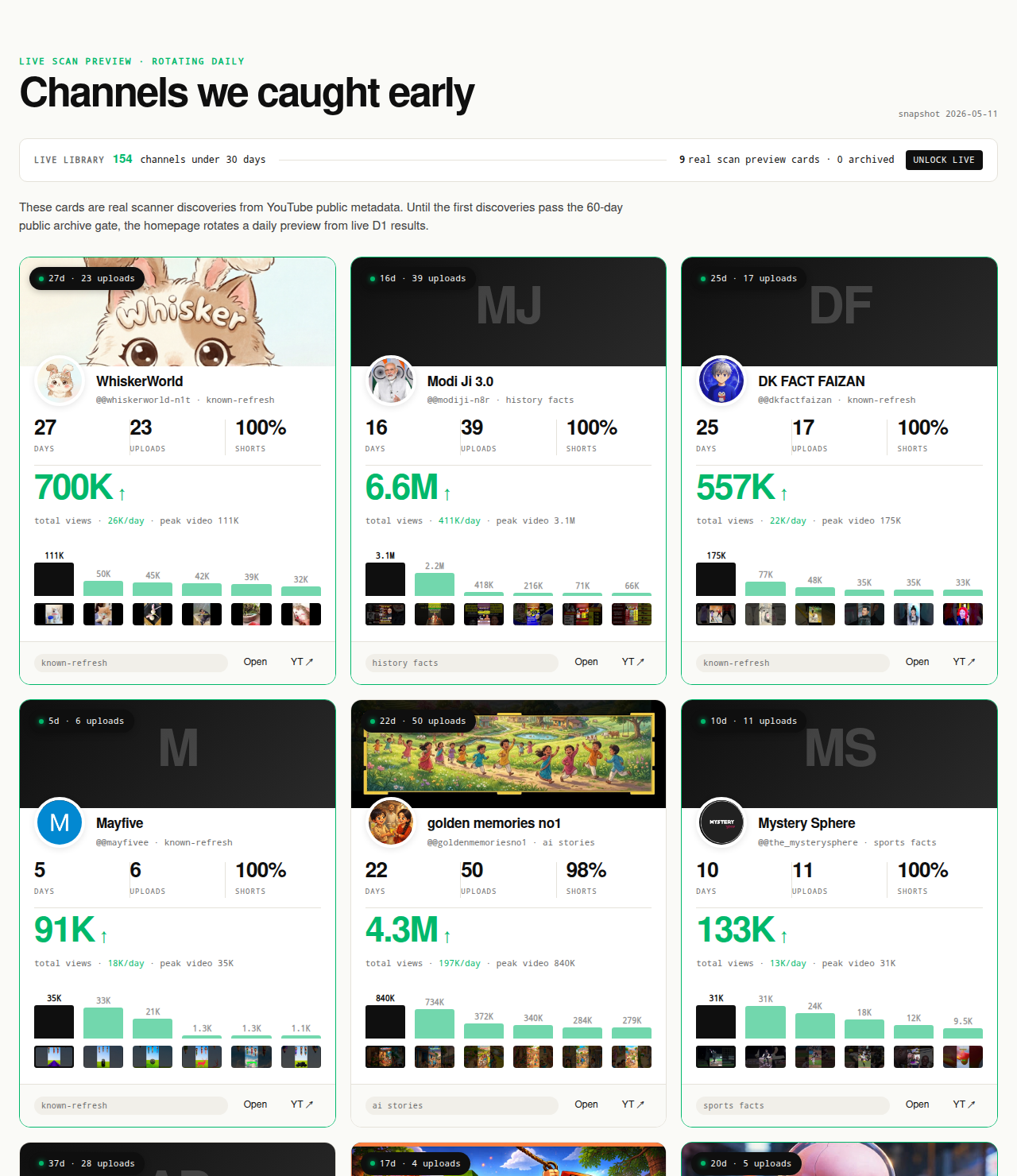
What the output looks like in practice: a list of 5 to 30 channels inside the cluster, each with a verifiable public-metadata trail. The pattern shared across the surviving channels (production mode, duration distribution, hook structure, thumbnail style, title formatting) is the format-cluster trend. The format carries; the specific channels rotate as the cluster ages. Every NicheBreakout channel card on this page is the output of Method 1 applied to the current scan window.
Method 2 — Track upload-cadence shifts inside a cluster
The second method, more sensitive to early-trend movement than Method 1. Compute the average upload cadence for channels inside a format cluster across two consecutive scan windows. When the cluster's average shifts from 3 uploads per week to 6 without any change in member count, operators are responding to early-traction signal by publishing more often. The recommender is lifting the format hard enough that operators inside it are accelerating output.
The mechanism is operator psychology mapped onto a public field. Operators publish faster when the early uploads are working and slower when they are not, because they are reading their own view counts. A cluster-wide cadence acceleration is the leading indicator that the recommender's lift is hitting most channels inside the cluster, usually weeks or months before the cluster appears in a recycled listicle.
The mechanics: pull publish dates from every channel inside the cluster (publishedAt on videos.list), compute uploads per day per channel for the last 30 days vs. the prior 30, average across the cluster, and flag clusters where the new-period cadence is ≥ 1.5x the prior-period cadence. The threshold is heuristic — too tight catches scan-window noise, too loose misses smaller shifts. 1.5x is conservative enough to be signal rather than noise.
Method 2 is most useful with a cluster hypothesis already in hand — "is faceless POV cooking accelerating right now," "is AI-imagery horror anthology cooling off." It is weak as a discovery method on its own; cadence is a derivative signal, and Method 1 supplies the cluster framing it depends on.
Two failure modes. Cadence can accelerate because a single operator runs multiple channels — the cluster looks hot but the diversity-of-operators signal is thin. Weight by unique operator when inferable. Cadence can also accelerate because a template-channel cohort is mass-producing inside the cluster post the 2024 YouTube monetization tightening (YouTube Help: monetization policies and channel guidelines) — hot for operators, not necessarily for viewers. Cross-check Method 2 output against Method 1 channel-velocity output to filter for that pattern.
Method 3 — Watch for new entrants in known clusters
The third method, operationally simple and one of the earliest signals available. Track how many newly created channels enter a known format cluster inside each scan window. When a cluster starts attracting a flood of new sub-30-day channels — operators creating fresh channels specifically to publish in the cluster — the format is being discovered by the creator side, a leading indicator that recommender lift inside the cluster is large enough to draw operator attention.
Operator response to recommender lift is reliably faster than reviewer response or listicle-writer response. A cluster with strong lift sees a wave of new channel creations within weeks; the recycled-listicle SERP catches up months or quarters later. New-channel entry reads the lift before it shows up in the broader content market.
The mechanics: track the count of channels with channel age ≤ 30 days inside the cluster across consecutive scan windows. A cluster whose new-entrant count doubles relative to the prior window is one operators are discovering. Channel creation dates come from channels.list publishedAt; cluster classification uses the same signals Method 1 does. 2x is the conservative threshold; 3x to 5x for two consecutive windows is the clearest discovery signal.
Method 3 composes with Method 1 the same way Method 2 does. Method 1 identifies the current densest clusters; Method 2 flags which are accelerating in cadence; Method 3 flags which operators are crowding into. A cluster firing on all three is the strongest current trend signal public data can produce.
The interpretation caveat: operator entry can run ahead of viewer demand. A flood of new entrants without channel-velocity gains in Method 1 output is a cluster being mass-produced without viewer-side lift, which means it is saturating before the recommender ever found a stable audience match for it. A Method 3 signal not corroborated by Method 1 inside one to two scan windows is operator noise, not trend signal.
Method 4 — Cross-reference public data tools honestly
The fourth method is the comparison method, included because the SERP for "how to find trending Shorts" is dominated by tool-stack articles that recommend Google Trends, YouTube's Trending tab, vidIQ's trending feed, or AI keyword tools without naming the trade-offs. An honest comparison lets the reader pick the right surface for the question they are actually asking.
YouTube's own Trending tab. Surfaces a curated mix of videos ranked across each country's audience, with the goal of showing what a broad audience is watching (YouTube Help: How YouTube ranks trending videos). Two structural biases: it favors established channels (a 1M-subscriber spike outranks a 5K-subscriber spike), and it is broad-audience by design. Niche Shorts formats almost never appear on it, and when they do they have already saturated. Useful for cultural-moment awareness, not for current-format discovery at the small-channel layer.
Google Trends. Measures search-query interest over time — a Browse-side signal, not a Shorts-feed signal. A topic spike in Google Trends sometimes precedes a Shorts cluster acceleration if the topic is broad enough to drive both, but the mapping is noisy and lagged. Useful for confirming topic demand inside a cluster already identified through channel-velocity methods, not for finding the cluster in the first place. The dedicated sibling page when built — /youtube-shorts-vs-google-trends — covers the comparison in depth.
vidIQ, TubeBuddy, and keyword-trending tools. Measure search-query volume on YouTube and visit-traffic estimation derived from public field combinations. Useful for keyword research; weak for Shorts trend research, because the Shorts feed does not rank on search-query volume. A keyword spike does not transfer cleanly to Shorts surface ranking.
TikTok-derived trend trackers. Scrape TikTok and republish the list under a YouTube label. The format side sometimes transfers (vertical aspect ratio, hook in second one, captions on every line). The audio side and the topic side rarely do. Useful for format-pattern awareness, not for Shorts feed ranking prediction.
YouTube Data API queries you run yourself. The most powerful and least packaged option. The Data API exposes channel metadata, video metadata, duration, view counts, and publish dates — the inputs the four methods on this page operate on. A researcher with a few hours and the API key can run Methods 1 through 3 manually against any cluster. The work is the cluster classification, scan-window discipline, and threshold tuning; the data is free.
Scanner libraries that operationalize the methodology. NicheBreakout is one (the live library is the persistent output of Method 1; the methodology page is the deterministic kernel; the Friday digest is the free editorial layer). The cross-pillar YouTube outlier finder pillar covers the broader scanner comparison; the relevant note here is that a scanner library is a packaging of the same Data API inputs with the cluster classification, scan-window discipline, and threshold tuning already done.
Most of the SERP's tool recommendations are correct for some research question, just not the "find trending Shorts" question. Google Trends is right for topic-demand confirmation. The Trending tab is right for cultural-moment scanning. Keyword tools are right for long-form keyword research. TikTok trackers are right for format-pattern awareness. The "find trending Shorts" question — trending formats inside the Shorts surface at the small-channel layer — is answered cleanly only by channel-velocity methods on the Data API, which is what Methods 1 through 3 operationalize.
The deterministic filter that flags a trending Shorts channel
The kernel underneath the four methods. NicheBreakout flags a Shorts-first channel as a current trend instance when it passes three hard public-metadata gates, then ranks it with a deterministic score weighting two bonuses. The full methodology is published on the methodology page; the abbreviated readout is below.
Channel age
detected within 45 days of channel creationFirst-5 upload views
combined views across the first five public uploads ≥ 10,000Views per day
lifetime channel views ÷ channel age ≥ 1,000Format clarity (bonus)
score weights channels with a clear Shorts-first or long-form-first ratio above mixed-format channelsEarly-traction velocity (bonus)
score boost when channel age ≤ 14 days, first-5 sum ≥ 50,000, or views/day ≥ 5,000
Each gate maps to a failure mode. Channel age ≤ 45 days isolates the current velocity wave from historical sediment — a 2-year-old channel inside a hot cluster is downstream of two years of recommender-trained momentum, not a current-trend instance. First-5 sum ≥ 10,000 views is the recommender-lift signal — a channel stuck at 200 views combined on its first five uploads is not being lifted regardless of how hot the cluster is. Views per day ≥ 1,000 is the velocity floor.
Average first-five-video views for every populated grade tier inside our discoveries cohort:
Format clarity rewards Shorts ratio ≥ 0.8 because format-mixed channels teach the recommender contradicting audience profiles across the Shorts feed and Browse; the Shorts feed evaluates format consistency more aggressively than the main feed, making the clarity bonus more consequential on Shorts. Early-traction velocity catches the fastest-moving channels inside the first 14 days. Exact score formula, grade thresholds, and edge cases live on the methodology page.
The kernel is constant across the four methods; what differs is how each applies it — Method 1 cluster-by-cluster, Method 2 over cadence-shifts inside filtered output, Method 3 over new-entrant density, Method 4 in comparison to alternative surfaces.
What we deliberately don't claim about trending Shorts
The four-method workflow does not read audio-side trends, swipe-away patterns, traffic-source breakdowns, per-Short impression counts, Shorts feed ranking position, RPM-by-format, or "what will trend next" predictions. Those signals live behind authenticated endpoints, internal recommender state, or product surfaces YouTube has not exposed through the public Data API (YouTube Data API v3 reference). Anyone selling "trending Shorts sounds," "Shorts feed RPM," or "guaranteed viral Shorts ideas" is inferring from non-API signals or fabricating the number.
What is readable from public fields: channel age, subscriber count (rounded to three significant figures per the API docs), total view count, video count, video metadata, video publish dates, individual video view counts, and video duration. Shorts ratio is computable from duration plus video count; format pattern is inferable from title patterns, duration distribution, and thumbnail style; velocity is view count divided by channel age. Every claim the four methods produce is defensible from one of those fields.
What is not readable: which audio track a Short uses internally, how a Short ranked inside the Shorts feed, swipe-away rate, RPM, traffic source, subscriber-vs-non-subscriber view ratio, or which Shorts the recommender is currently surging on. None of those ship in the live library, none are inferred behind the scenes, and none would survive the outbound-link verification rule that governs every channel card on the site.
The boundary also applies to predictions. The workflow surfaces what is currently being lifted, not what will be lifted next. Predictions about which format will go hot in three months are unfalsifiable from public data. The honest framing is "current densest clusters are X, current accelerating clusters are Y, current operator-discovery clusters are Z" — all present-tense, all verifiable today, all subject to next-scan-window revision.
Common mistakes when looking for trending Shorts
Six mistakes recur in readers running a trend-research workflow. Chasing TikTok audio. The reader picks a "viral TikTok sound" from a third-party trend tracker and builds a Short around it. The sound may not exist in YouTube's Creator Music library at all, and the Shorts feed reads watch-through inside its own impression pool — not which TikTok sound is currently trending. Treat audio as per-video decoration; lock the format as the channel-level signal. The parent YouTube Shorts trends pillar covers the audio-vs-format split in depth.
Copying YouTube's Trending tab as a Shorts strategy. The Trending tab favors established channels and broad-audience content (YouTube Help: How YouTube ranks trending videos); the Shorts surface favors format-fit at the small-channel layer. Reading channel-velocity inside Shorts-specific clusters via Method 1 is the corrective.
Treating one viral video as a trend. A specific Short hitting 10M views inside a cluster is a video, not a trend — it may have surfaced for reasons that do not repeat on the next upload. A trend is the format the recommender is lifting across multiple small channels inside a cluster. Require channel-level evidence (3 to 5+ channels currently passing the gates) before calling a pattern a trend.
Ignoring the channel-age signal. Readers routinely study a 500,000-subscriber channel running a specific format and copy its current strategy, missing that the mature channel's current strategy is downstream of two years of recommender-trained audience momentum. Study channels under 90 days old inside the same format. The YouTube niche validation checklist operationalizes this; the how to do YouTube niche research page covers the broader process.
Using search-volume tools as Shorts trend trackers. Keyword-volume tools (vidIQ, TubeBuddy, Ahrefs YouTube data) measure search interest — useful for long-form keyword research, weak for Shorts trend research, because the Shorts feed does not rank on search-query volume.
Mistaking topic for trend. "Cooking" is a topic; "first-person POV cooking shorts in a 45-second vertical with no on-screen face" is a format. Topic-only lists do not transfer cleanly to Shorts strategy because the recommender ranks at the format-topic intersection. A reader publishing ten cooking Shorts in ten different formats teaches the recommender ten audience profiles for one channel and the early-traction signal flatlines.
Confusing operator discovery with viewer demand. A cluster firing on Method 3 (new entrants) without firing on Method 1 (channel velocity) is a cluster operators are discovering but viewers have not validated. A Method 3 signal that is not corroborated by Method 1 inside one to two scan windows is operator noise, not trend signal.
The Shorts format clusters currently trending in our scans
The current snapshot of Method 1's output applied across the densest Shorts-first format clusters. Read it as observation, not a ranking; the cluster mix shifts week over week, and the durable artifact is the format-cluster framing rather than the ordering. Across the channels currently inside our live 30-day window — a subset of the broader thousands of-channel scan — the densest format-leaning clusters meeting our sample-size threshold are:
The Shorts-first vs long-form split inside those top clusters looks like this in our dataset:
The list compresses honestly when one cluster dominates — under-threshold clusters are suppressed rather than padded. The dedicated programmatic topic pages — AI story channels, Reddit story channels, history shorts channels, quiz channels, scary stories channels, faceless storytelling channels — each carry the full channel-evidence trail for one cluster with outbound YouTube links so a reader can replicate Method 1 against the cluster directly.
Outside the top entries, recurring cluster density appears in faceless gaming highlight Shorts (spike-and-decay tied to specific game releases), faceless travel-fact Shorts, faceless satisfying-process Shorts, faceless tier-list Shorts on a recurring ranking domain, and faceless language-learning Shorts. None of those clusters is "the best Shorts trend" — they are clusters where the public-data velocity signal is currently firing. The honest framing for "what's currently trending on Shorts" is that the answer is the public-data observation, not a strategic recommendation; what a reader does with the observation is a decision the data informs but does not make.
FAQ
How do I find trending YouTube Shorts?
Read the format from small Shorts-first channels currently passing four public-data tests: channel age ≤ 45 days, combined first-five-upload views ≥ 10,000, lifetime views per day ≥ 1,000, Shorts ratio ≥ 0.8. The output is a short list of channels the recommender is currently lifting, and the shared format pattern across them is the durable trending signal. YouTube's Trending tab is biased toward established channels, and TikTok trend trackers do not transfer cleanly because the Shorts feed reads watch-through inside its own impression pool. The four-method workflow below operationalizes the small-channel-velocity approach.
How do I see trending YouTube Shorts sounds?
Honest answer: you can't, not through any public API. YouTube does not expose a trending-sounds endpoint in the Data API v3, and Creator Music availability for Shorts is gated behind Creator Studio rather than a third-party surface. Third-party tools that publish "trending Shorts sounds" are usually scraping TikTok and republishing the list under a YouTube label, which is structurally weak — a sound viral on TikTok may not exist in YouTube's Creator Music library at all, and the recommendation surfaces do not cross-pollinate audio popularity. The readable trend signal is format velocity at the small-channel layer, not audio popularity at the platform layer.
What Shorts are trending right now?
Across our live 30-day window — Shorts-first channels under 30 days old passing the three deterministic gates — the densest current format clusters are AI-narrated storytelling shorts, character-voiced Reddit narration shorts, TTS history fact-stack shorts, faceless quiz and trivia shorts, and faceless POV cooking shorts. The cluster mix shifts week over week; the format clusters carry across rotations even as topics inside them rotate. The live library lists the channels currently winning at each format with outbound YouTube links so the public metadata is one click away.
How does YouTube's Trending tab work?
YouTube's Trending tab and the related YouTube Charts surface a curated mix of videos ranked across each country's audience, with the goal of showing what a broad audience is watching (YouTube Help: How YouTube ranks trending videos). The ranking inputs documented publicly include view count, view velocity, video age, how the video is performing relative to other recent uploads from the channel, and topicality. Two consequences: the tab is biased toward established channels (a 1M-subscriber spike outranks a 5K-subscriber spike), and it is broad-audience by design, so niche Shorts formats rarely surface. Useful for cultural-moment awareness, not for finding which formats are currently breaking out at the small-channel layer.
Can I see what's trending in a specific niche?
Not from the Trending tab directly, but yes from channel-velocity data at the niche layer. Filter Shorts-first channels to one niche (history, AI stories, Reddit narration, cooking, finance explainer, quiz), apply the three gates (channel age ≤ 45 days, first-5 sum ≥ 10,000 views, views/day ≥ 1,000), and the surviving channels are the current trend signal for the niche. The format they share is the durable artifact. NicheBreakout's programmatic topic pages each index this view for one cluster with outbound-link verification on every card.
Do trending Shorts ideas come from TikTok?
The format usually transfers; the audio usually does not. Vertical aspect ratio, fast-cut pacing, hook in second one, captions on every line — platform-agnostic characteristics that often transfer. The specific audio track is platform-specific: Creator Music is separate from TikTok's library, and a sound viral on TikTok may not exist as a usable track inside Shorts at all. The recommendation surfaces also do not cross-pollinate — the Shorts feed ranks on watch-through inside its own impression pool, not on TikTok audio popularity. Copy the format; the audio decision is per-platform.
How fresh is NicheBreakout's trend data?
The scanner refreshes daily and the live library shows channels currently inside the 30-day window. Matured channels (60+ days post-detection) populate the public archive that opens in summer 2026. Every channel card on every page outbound-links to YouTube so a reader can verify the public metadata (channel age, upload count, views, views per day, Shorts ratio) at the source. The Friday digest sends three current breakout channels every week for free.
What's the difference between a trending video and a trending channel?
A trending video is a single upload spiking on view count, which can happen for reasons ranging from format-fit to topic relevance to recommendation-pool randomness. A trending channel is a small channel accumulating abnormal view velocity across the first 5 to 20 uploads, which is the cleaner signal because it means the recommender is matching the channel's format to an audience pool repeatedly. One-video spikes do not predict the next upload will repeat; channel-velocity spikes predict format viability for future uploads inside the same cluster.
Methodology / About this analysis
NicheBreakout's research relies entirely on YouTube Data API v3 public fields: channel age, subscriber count, video count, view count, video metadata, video publish dates, video duration, and recent video performance. The four-method workflow on this page is the procedural form of the deterministic methodology that powers the live library — no separate dataset, no authenticated Analytics access, no inferred audio-side data, no AI-generated narratives describing why specific channels or clusters work. Shorts-first labeling uses the Shorts ratio computed from video duration; the cutoff is 0.8. Cluster classification uses observable channel-metadata signals (title patterns, duration distribution, thumbnail style, channel-page formatting); channels straddling cluster boundaries are flagged but not double-counted.
Original-research artifacts in this article: the four-method workflow itself (channel-velocity inside a cluster, upload-cadence shifts, new-entrant density, public-data tool cross-reference), the six-category Shorts-trend taxonomy with the two unreadable categories named, the honest tool-comparison block, the deterministic filter as the workflow's kernel, the current Shorts cluster snapshot, and the revealed channel cards above the fold. The methods reflect what we have built and run inside the scanner, not all of Shorts YouTube. Author: Nicholas Major (Founder, NicheBreakout · Software engineer since 2011). Article last revised 2026-09-21.
Live scan freshness:
Related research
- YouTube Shorts trends: parent pillar covering the four-category Shorts-trend taxonomy and the Shorts-feed surface split.
- YouTube Shorts ideas: sibling cluster covering the idea-side question once a trend has been identified.
- YouTube Shorts ideas without showing face: sibling cluster covering the faceless × Shorts intersection.
- Best YouTube Shorts niches: sibling cluster covering the niche-level question on the Shorts surface (when built).
- YouTube Shorts niche finder: sibling cluster covering the tool framing for Shorts niche discovery (when built).
- YouTube Shorts vs Google Trends: sibling explainer covering the surface-comparison question in depth (when built).
- Faceless YouTube niches: cross-pillar covering the production-mode angle that dominates Shorts-first production.
- YouTube niche finder: cross-pillar covering niche research across Shorts-first and long-form-first channels.
- YouTube channel research: cross-pillar covering the broader channel-discovery category.
- YouTube outlier finder: cross-pillar covering the breakout-discovery framing applied to any channel type.
- Most profitable YouTube niches: companion cluster covering the profitability-vs-niche-velocity split.
- How to do YouTube niche research: cross-pillar process guide downstream of the niche-finder pillar.
- AI story channels: programmatic topic page tracking the AI-storytelling Shorts cluster.
- Reddit story channels: programmatic topic page tracking the Reddit-narration Shorts cluster.
- History shorts channels: programmatic topic page tracking the history-shorts cluster.
- Quiz channels: programmatic topic page tracking the quiz/trivia Shorts cluster.
- Scary stories channels: programmatic topic page tracking the scary-story narration cluster.
- Faceless storytelling channels: programmatic topic page tracking the broader faceless storytelling cluster.
The Friday digest sends three current breakout channels every week — Shorts-first and long-form-first both — with format fingerprints and outbound YouTube links. Free, present-tense. The live library refreshes daily and surfaces channels currently inside the 30-day window. See pricing for the current tier; subscribe to the digest free.
End of cluster
Run the four-method workflow against the current scan window
Every channel card outbound-links to YouTube so you can audit the public metadata yourself. No audio-side claims, no virality predictions, no RPM inference — public Data API only. The live under-30-day library is the paid workflow; the Friday digest is free.