
/ Cluster · Best YouTube Shorts niches
Best YouTube Shorts niches: the small-channel breakout test, not the listicle test
The query "best YouTube Shorts niche" has one falsifiable answer and a dozen unfalsifiable ones. The falsifiable definition: the best YouTube Shorts niche is the one currently producing the most small-channel breakouts in public Data API metadata — small channels under 45 days old clearing the first-5 view floor inside a consistent Shorts-first format. The unfalsifiable definitions (highest RPM, most viral, easiest to monetize, lowest competition) all require private data third parties cannot read. NicheBreakout reports on the falsifiable version and declines to make claims about the rest — built on thousands of channels scanned to date using public YouTube metadata only.

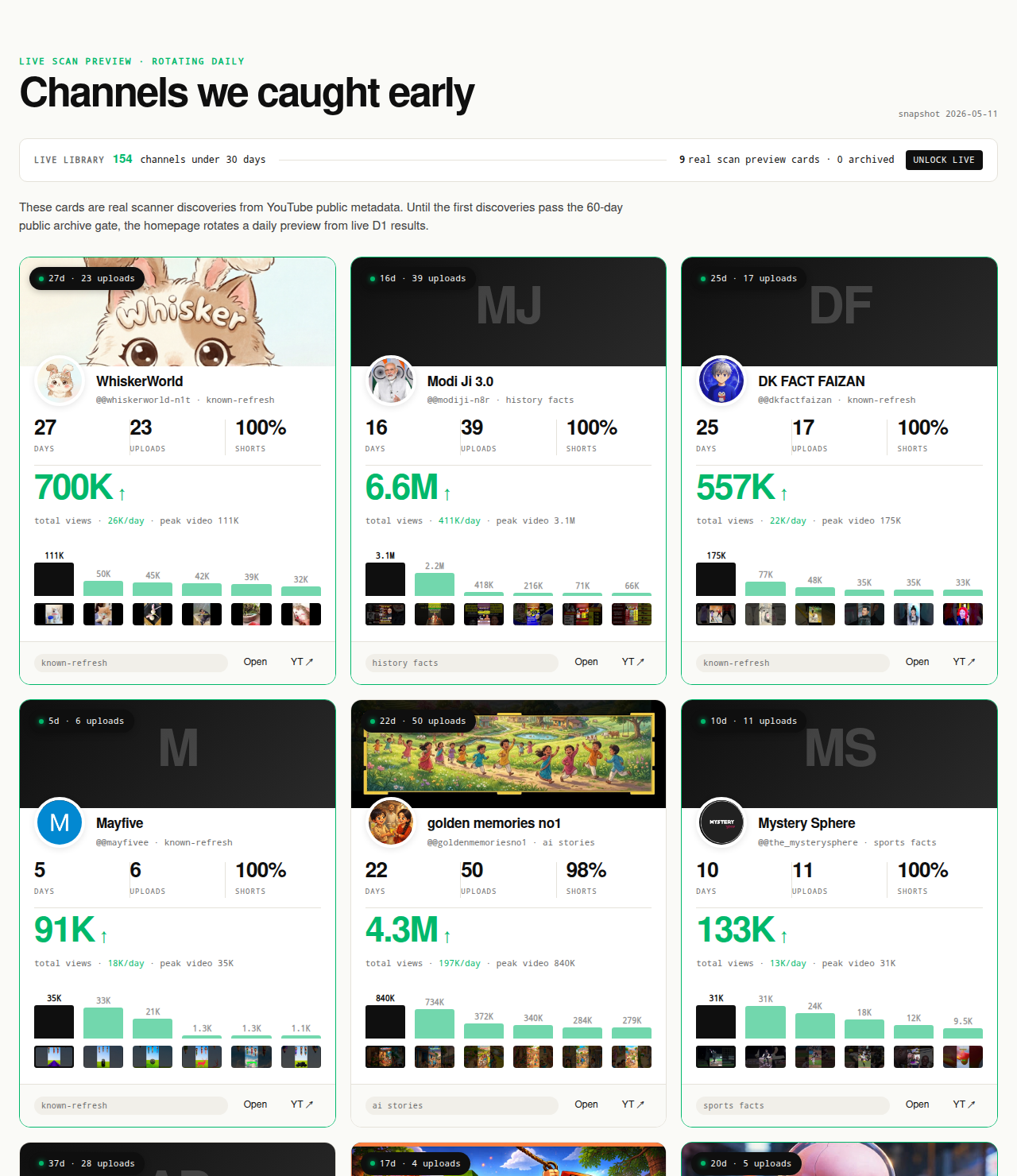
Ai stories by shano
 45d · 36 uploads
YOU & ME
 45d · 25 uploads
Dootoons TV
 45d · 69 uploads
Mr Pawsome
 42d · 64 uploads
sajkcasqq
 38d · 38 uploads
OP Nigma

FactD
 45d · 31 uploads
Cognexa Talks
 39d · 21 uploads
MapLore
Why "best YouTube Shorts niche" is a question public data can partially answer
Every page currently ranking for "best YouTube Shorts niche" treats the word "best" as if it were self-evident, then ranks niches against a private metric the page does not have access to. The Clipshort listicle promises niches "to win at." The TubeBuddy listicle promises "millions of views." The NexLev page promises niches that "grow fast." Packapop and vidIQ rank by some unstated combination of opinion and tool-data. Medium's higher-traffic posts rank by claimed earnings. None of those rankings comes with the underlying data — none of them shows the small channels currently winning inside each niche, with verifiable public metrics a reader can audit on YouTube in one click.
The reason "best" has been treated as self-evident is that the actual question splits into two halves with very different answerability. The first half — "best at producing channel-velocity small channels can replicate" — is partially readable from public Data API v3 metadata. Channel age, view count, first-5 upload views, video duration, Shorts ratio, and publish cadence are all exposed through the channels.list, videos.list, and search.list endpoints (YouTube Data API v3 reference). A researcher can read off which niches currently have small channels clearing the first-5 view floor inside the 45-day breakout window, format-locked at a Shorts ratio of 0.8 or higher. That is the half public data can answer.
The second half — "best at making the creator the most money" — is not readable at all. Per-channel revenue lives behind the YouTube Analytics API and YouTube AdSense, both authenticated and channel-owner-only. The sister pillar on most profitable YouTube niches walks through the structural reason in depth; the short version is that any product claiming to show "highest-RPM Shorts niche" data is extrapolating from non-revenue signals and labeling the extrapolation as fact. The honest version of that ranking would read "we are guessing about a metric we cannot see." Few publishers write the honest version because the dishonest version performs better in search.
This page treats the split as the entire problem to solve. The "best" definition this page uses is the first half: a Shorts niche is "best" in the sense that small channels are currently breaking out inside it under public-data signals at a rate that lets a new entrant credibly replicate. The page reports that breakout density and stops. It does not extrapolate to revenue or competition figures, because the data needed to make those extrapolations honestly is not third-party-readable. The trade-off is between a narrower claim that is verifiable and a broader claim that is not.
What "best" must mean to be falsifiable
A "best Shorts niche" claim is only falsifiable if it points at a public-data signal a reader can audit. Without that signal, the claim is a vibe — agreeable to readers who already believed it, unprovable to readers who didn't. The vibe is what most listicle copy actually sells, but a research artifact has to do better.
The falsifiable definition this page uses: a Shorts niche is "best" inside a given scan window if it has the highest density of small Shorts-first channels currently passing the three hard public-metadata gates in our deterministic methodology — channel age ≤ 45 days, first-5 sum views ≥ 10,000, lifetime views/day ≥ 1,000 — and the score bonus for format clarity weights its members above format-mixed channels in the same cluster. Each component of that definition resolves to a public Data API field, and each is verifiable per channel via outbound YouTube links on every card the live library surfaces.
The unfalsifiable alternatives are worth naming so the difference is explicit. "Best in earnings" requires AdSense access for every channel inside the niche. "Best in spread" requires per-Short distribution data that no public endpoint exposes. "Best for beginners" requires a production-cost-per-upload measurement that depends on the creator's situation rather than the niche. "Lowest competition" requires per-niche channel-count totals YouTube does not publish through the Data API. Each of those claims could be made carefully with caveats, but the claims on this page are limited to ones that survive an outbound-link audit.
The channel-velocity definition is the right primary one for a niche-research artifact because a new entrant's first 45 days will be evaluated by the same recommender that lifted the current breakout channels, against the same format-fit signal those breakouts triggered. If small channels are currently clearing the velocity floor inside a niche, the recommender is currently warming up to new format-audience matches inside it. If small channels are not clearing the floor, the recommender either is not lifting the format or is lifting it only for already-established channels — both bad bets for a new entrant.
The deterministic filter for a working Shorts niche
NicheBreakout flags a channel for the live library when it passes three hard public-metadata gates, then ranks it inside the library with a deterministic score that weights two additional bonuses. The full methodology is published on the methodology page; the version below is the abbreviated readout applied with a Shorts-first lens, since this page is the Shorts-niche cluster on the Shorts pillar.
Channel age
detected within 45 days of channel creationFirst-5 upload views
combined views across the first five public uploads ≥ 10,000Views per day
lifetime channel views ÷ channel age ≥ 1,000Format clarity (bonus)
score weights channels with a clear Shorts-first or long-form-first ratio above mixed-format channelsEarly-traction velocity (bonus)
score boost when channel age ≤ 14 days, first-5 sum ≥ 50,000, or views/day ≥ 5,000
Applied to niches, the filter yields a working definition: a Shorts niche is "working" inside a given scan window if multiple small Shorts-first channels under 45 days old inside the niche are passing all three gates with a Shorts ratio of 0.8 or higher. The niche is "saturating at the template layer" if entrants inside the niche are publishing the same template-driven format but few of them clear the gates. The niche is "decaying" if cleared-gate counts inside the niche are dropping across consecutive scan windows. Each of those reads is a public-data observation, not an editorial judgment.
Average first-five-video views for every populated grade tier inside our discoveries cohort looks like this, with Shorts-first channels typically clearing the 10,000 floor several times over because individual Shorts can clear 50,000 views inside their first 48 hours when the format fits the recommender (grades with no current members are suppressed until they fill in):
The two score bonuses do most of the work that separates "current breakout niche" from "niche the listicle remembers." Format clarity rewards Shorts ratio ≥ 0.8, because a format-mixed channel inside an otherwise working niche teaches the recommender contradicting audience profiles across the Shorts feed and the main Browse feed; the niche's working channels are almost always the format-locked ones. Early-traction velocity catches the channels whose format-audience match is being lifted inside the first 14 days — the fastest-moving entrants inside a niche, which are the cleanest signal that the niche is currently in a velocity event rather than a slow drift.
The filter intentionally produces a smaller, sparser niche list than a brainstorm listicle. A filter that keeps every plausible niche is not a filter; the trade is between a long list of unverified niches and a shorter list of niches with current channel evidence. The shorter list is the durable research artifact.
The Shorts niches with current small-channel breakouts
The list below is the current snapshot of Shorts niches in our scans where small Shorts-first channels under 45 days old are passing the three public-data gates in meaningful density. Read it as an observation about where the recommender is currently lifting new entrants, not as a permanent ranking. The cluster mix shifts week over week as new formats surface and older ones saturate. Across the channels currently inside our live 30-day window — a subset of the broader thousands of-channel scan — the densest Shorts format-leaning niche clusters meeting our sample-size threshold are:
The Shorts-first vs long-form split inside those top clusters looks like this in our dataset:
AI-narrated story niches. Format fingerprint: TTS narration plus AI-generated imagery in a 45-to-90-second vertical container, with recurring story templates (horror anthologies, AI-generated fictional history, AI-generated true-crime-adjacent narratives, faceless mythology retellings). Public-data signal observed: among the densest current Shorts-first clusters in our 2026 scan windows, with first-5 sums in the 50,000-to-500,000 range across multiple under-45-day channels. The AI story channels programmatic page tracks the cluster with the same outbound-link verification as the main library. Saturation note: the parent topic is crowded, and YouTube's 2024 enforcement (YouTube Help: monetization policies and channel guidelines) tightened the editorial bar; current breakouts cluster at the specific-template layer (a recurring horror sub-anthology, a recurring fictional-history setting) rather than the "make AI stories" layer.
Reddit story narration niches. Format fingerprint: TTS or character voicing over r/AmITheAsshole, r/ProRevenge, r/MaliciousCompliance, and adjacent story threads with stock visuals or simple character overlay, typically 60-to-90 seconds vertical. Public-data signal observed: high channel-count concentration inside the under-30-day window, with the working slice cleanly separated from saturated raw-thread-read entrants. The Reddit story channels programmatic page covers the cluster. Saturation note: the format itself is heavily contested; the niches admitting new entrants are the ones where the channel adds character voicing, original commentary, or recurring host editorial selection, not the ones that read raw threads verbatim.
History fact-stack niches. Format fingerprint: three-to-six historical facts stacked inside a 45-to-75-second vertical with cinematic visuals (archival, AI-generated, or hybrid), captioned narration, count-up template. Public-data signal observed: persistent breakout density across multiple monthly scan windows, with channels rotating topics inside the format from medieval kings to ancient empires to lesser-known wars to royal scandals. The history shorts channels programmatic page indexes the cluster. Saturation note: the topic-level long tail is large enough that channels committing to a specific historical sub-niche still break out at meaningful density; format-mixed history channels (vertical plus horizontal on the same channel ID) underperform format-consistent ones in our scans.
Quiz and trivia niches. Format fingerprint: interactive Q&A formats with text overlays, count-down timer, 30-to-60-second vertical containers. Public-data signal observed: lowest production cost per upload of the current top clusters, which translates into higher publish cadence inside the under-45-day window and faster first-5 accumulation. The quiz channels programmatic page tracks the cluster. Saturation note: visual-template saturation is real at the highest-volume end of the cluster; question-bank discipline (difficulty calibration, category selection, recurring framing) is the editorial differentiator that separates the working entrants from the saturated ones.
Scary-story narration niches. Format fingerprint: TTS or human voiceover over atmospheric footage — original, licensed, or AI-generated — typically 60-to-90 seconds vertical, with narrative compression to fit the duration. Public-data signal observed: durable cluster across multiple quarters with topic-level rotation (Reddit nosleep sourcing, original-author originals, public-domain folklore). The scary stories channels programmatic page covers the cluster. Saturation note: copyright collisions on narration of others' creative writing are a recurring monetization risk; channels with explicit licensing or original-author authorization clear longer.
Faceless POV cooking, tier-list, and explainer niches round out the recurring set. POV cooking runs first-person camera over a cutting board, no face, 30-to-75 seconds vertical, with the working entrants committing to a specific cuisine-or-diet sub-niche (one-pan dinners, low-cost meals, regional cuisines, dorm cooking). Tier-list channels use an S-through-F template with on-screen labels and a recurring host-voice or TTS, with the working entrants committing to a recurring ranking domain (anime characters, historical figures, fictional weapons, programming languages); template-only execution saturates inside months. Faceless explainer channels run screen-recorded chart breakdowns or TTS-over-graphs for one specific topical domain (a specific area of finance, science, geography, or historical specialization); generic explainer entries saturate quickly, while specific-topical-domain channels clear the velocity floor faster, particularly in scan windows tied to outside-platform news cycles.
None of these niches is "the best Shorts niche" in any absolute sense. Each is a niche where current public-data signal indicates the recommender is currently lifting new entrants inside a specific format. The dedicated programmatic topic pages linked above each carry the channel evidence inside their cluster; the live library carries the current under-30-day window across all of them.
Why Shorts niche-fit matters more than topic-fit
The Shorts feed is a different ranking surface from Browse and Suggested, with its own watch-through, swipe-away, and impression pool that does not share state with the main feed. YouTube's documentation describes the high-level posture: "The Shorts feed is personalized and ranks each video based on how viewers interact with similar content" (YouTube Help: Shorts overview). The "similar content" part is the format-fingerprint layer the recommender reads at the channel level. A niche is the topical bucket the channel sits inside; the niche-fit signal the recommender actually reads is the channel's format consistency inside that bucket.
This is why niche-fit on Shorts is closer to format-fit-inside-a-niche than to topic-fit-inside-a-niche. A creator who picks "history" as the topic and publishes one vertical fact-stack, one horizontal long-form documentary, one Shorts countdown, and one Reddit-style narrated history piece across four uploads has a consistent topic and a contradicting format profile. The Shorts feed reads the format inconsistency and cools the channel. The same creator picking "vertical history fact-stack Shorts" as the niche-format pair and publishing 10 to 20 uploads inside it teaches the recommender a single audience profile across the early window. The recommender ranks at the format-topic intersection layer, not at the topic layer.
Niche-fit also explains the subscribers-vs-views asymmetry on Shorts. A Shorts-first channel inside a working niche can clear several million Shorts views in 90 days and still have fewer than 1,000 subscribers, because the Shorts feed audience is recommender-served from the swipe feed, not channel-served from subscriptions. The Partner Program eligibility thresholds capture the asymmetry explicitly — 10 million Shorts views in 90 days for the Shorts track, alongside the long-form track of 4,000 watch hours in 12 months (YouTube Help: YouTube Partner Program overview). A new entrant evaluating "is this niche working for small channels" should look at first-5 view sums and views per day, not at subscriber counts, because the subscriber signal in the Shorts feed cohort lags the view signal by months.
What we deliberately don't claim about Shorts niche profitability
NicheBreakout does not publish "highest-RPM Shorts niche" rankings, "Shorts niche earnings" estimates, "best monetization Shorts niche" lists, or "this niche will make you the most money" claims. Those metrics live behind the YouTube Analytics API and YouTube AdSense, both of which authenticate against the channel owner and are not exposed to third parties. The official documentation states the constraint directly: the Analytics API "provides multiple reports that channel owners and content owners can use to retrieve YouTube Analytics data" (YouTube Analytics and Reporting APIs overview). A researcher who does not own the channel cannot read its revenue.
The fields the Analytics API gates are the fields that would be needed to rank Shorts niches by profitability — estimated revenue, estimated ad revenue, CPM, RPM, monetized playbacks, ad impressions. The non-revenue performance fields the Analytics API also gates matter to the profitability conversation — watch time, average view duration, audience retention, click-through rate, traffic source breakdown, audience demographics, subscriber-vs-non-subscriber view share. None of those are third-party-readable. Any product that claims to show competitor RPM by niche, competitor revenue by niche, or competitor watch time by niche is either inferring those metrics from non-Analytics signals and labeling the inference as data, scraping leaked private dashboards, or fabricating the number.
What we do publish, with public-data backing on every claim: which Shorts niches are currently producing small-channel breakouts inside the 45-day early-traction window, what formats those breakouts share, what their first-5 sum views and lifetime views per day look like, and which specific channels are surfacing inside each cluster. Every channel card surfaced outbound-links to YouTube so a reader can verify the public fields directly. The methodology is published on the methodology page in full, without paywall.
The boundary applies to the AI-generated-narrative axis as well. We do not publish synthesized prose attributing causality to private metrics ("this niche pays better because the algorithm rewards X" claims that depend on data we cannot read). Channel cards carry public fields; the methodology page carries the deterministic logic that flags them. A reader who wants a story can write their own from the public fields; a reader who wants verifiable facts gets the facts as they appear in public metadata. The sister most profitable YouTube niches pillar walks through the full public-data-vs-private-data split.
Common mistakes when picking a Shorts niche
Four mistakes recur in creators who pick a Shorts niche from a listicle or AI-tool brainstorm. Chasing a TikTok niche assuming it transfers cleanly. A creator picks a niche-format pair currently working on TikTok — the platforms' recommendation surfaces are different, audio-side trending data drives a different share of TikTok velocity, and the cross-platform sound libraries do not mirror each other. The YouTube Shorts feed does not cross-pollinate audio popularity from TikTok, and Creator Music's catalogue is separate (YouTube Help: Creator Music for Shorts). The corrective is to read which niche-format pairs are currently being lifted by the YouTube Shorts recommender from channel-level Data API metadata, not from TikTok trending feeds.
Ignoring the channel-age signal. A creator studies a 500,000-subscriber Shorts channel inside a niche and copies the current strategy, missing that the mature channel's current strategy is downstream of two years of recommender-trained audience momentum. The corrective is to study channels under 90 days old inside the same niche — the Shorts-first channels currently winning, not the ones that won years ago. The YouTube niche validation checklist operationalizes the channel-age discipline; the sibling how to find trending Shorts page covers the discovery side.
Copying the topic without the format. A creator reads "AI history stories are working" in a listicle and publishes AI history content in a different format than the breakout channels are using — wrong duration, wrong voicing approach, wrong visual template, wrong hook structure. The topic is right and the format is wrong, so the recommender does not match the channel to the same audience pool the breakout channels are matched to. The corrective is to copy the format alongside the topic. The format is the channel-level signal; the topic is the per-video decoration.
Picking a "broad niche" instead of a niche-format pair. A creator commits to "fitness Shorts" or "history Shorts" without committing to a format inside the niche, then publishes 10 Shorts in 10 different formats. The recommender reads 10 contradicting audience profiles and cools the channel. The corrective is to specify the niche at the format-topic-intersection layer — "vertical faceless POV fitness Shorts with text overlays at 45-to-60 seconds" — and run 10 to 20 uploads inside that specification before considering a format change. The sister most profitable YouTube niches pillar covers the related "highest-RPM Shorts niche" trap; the corrective is the same channel-velocity definition this page uses.
Saturated Shorts niches that still admit new entrants
Saturation in the public-data sense is not the same as unworkability. A saturated Shorts niche in our scans is one where most channels publishing the format are not clearing the three velocity gates, but a meaningful minority still is. That minority share is the working slice — the channels adding an editorial differentiator the saturated majority is not. Calling a niche "saturated" and stopping there misses the working slice; calling it "unworkable" is usually wrong.
The Reddit-narration niche is the cleanest illustration. The cluster tightened heavily after 2024, when YouTube's monetization policy moved against mass-produced and reused content (YouTube Help: monetization policies and channel guidelines). Channels that read raw threads verbatim with TTS over stock visuals collapsed in breakout density. The working slice was the channels that added character voicing, recurring host editorial selection, or original commentary. Those entrants still clear the three velocity gates because the editorial differentiator is what the recommender reads as channel-level signal beyond the format itself. The same pattern shows up in AI storytelling (generic stock TTS saturated; recurring narrative templates with custom voicing still admit entrants) and in tier-lists (generic S-tier ranking saturates inside months; specific recurring ranking domains keep producing breakouts).
The corollary is that "saturation" should be read at the format-implementation layer, not the niche-topic layer. A new entrant evaluating a saturated niche should look for the editorial layer the working entrants are adding — character voicing, story selection, recurring domain specialization, host identity — and replicate that layer alongside the format. A "stay out of saturated niches" rule throws out the niches with the most channel-velocity history in our data; the lowest-saturation niches in raw count are usually the ones where the format is not lifting at all. The YouTube niche validation checklist codifies the saturation-vs-editorial-slice read into a workflow.
The clusters currently producing the most breakouts in our scans
The current densest Shorts-first niche clusters skew toward faceless production with template-driven editorial structures, because that production mode sustains the publish cadence the Shorts feed rewards. The cluster mix shifts week over week, and the version below reflects the current observation snapshot — not a permanent ranking. Across the channels inside our live 30-day window, the densest Shorts-leaning niche clusters meeting our sample-size threshold are:
The first cluster on the list is the densest in current scans, and the density is the public-data observation — not a claim about which cluster is "best" in any absolute sense. Density means more small Shorts-first channels are currently passing the three gates inside the cluster than inside other clusters in the same scan window. It does not mean the cluster has the highest expected return per upload, the highest revenue ceiling, or the lowest competition. Density is one observation. It is the observation that maps most cleanly to "is the recommender currently lifting new entrants in this niche," which is the question this page exists to answer.
When the cluster ranking surfaces a single dominant niche above the sample-size threshold, the rest of the top-five list compresses honestly — the placeholder above reports what is in the current snapshot, including the case where one niche is producing most of the current density and the remainder is sparser. The honest framing is more useful than a padded top-five that includes thin-density clusters at the bottom; a thin cluster invites readers to act on a signal closer to noise than to evidence.
FAQ
What's the best YouTube Shorts niche?
Defined honestly, the best YouTube Shorts niche is the one currently producing the most small-channel breakouts in public Data API metadata. That definition rules out every other usage of the word "best" — highest RPM, most viral, easiest to monetize, lowest competition — because each of those alternative definitions requires private data a third party cannot read. Under the public-data definition, the current densest Shorts-first clusters in our scans skew toward AI-narrated storytelling, history fact-stacks, Reddit story narration, quiz and trivia formats, and POV cooking, all running with a Shorts ratio at or above 0.8 and channels under 45 days old clearing the first-5 view floor several times over. The cluster mix shifts week over week; the rest of this page reads off the current snapshot.
What's the most profitable YouTube Shorts niche?
Unknowable from public data. Per-channel revenue, RPM, and CPM live behind the YouTube Analytics API and YouTube AdSense, both of which authenticate against the channel owner and are not exposed to third parties. Anyone publishing a 2026 "highest-paying Shorts niche" ranking is extrapolating from non-revenue signals or repackaging older guesses, because the actual revenue data is private to each channel owner. The sister most profitable YouTube niches pillar walks through the structural reason in depth. What public data can answer is which Shorts niches currently have small channels breaking out — which is the closest defensible proxy for "can a new entrant get traction here right now," and the question this page is built to answer.
What's the easiest Shorts niche for beginners?
There is no single easiest Shorts niche for beginners. The operating constraint that determines beginner difficulty is production cost per upload, not topic difficulty — a Shorts-first channel needs to hit a publish cadence the Shorts feed rewards (daily or every other day for the first 30 uploads) without burning out, and the formats that sustain that cadence at low production cost in our scans are faceless template-driven ones: quiz Shorts with text overlays, history fact-stack Shorts with TTS, faceless tier-list Shorts on a recurring ranking domain. Higher-production formats (POV cooking, character-voiced narrative) work too but require sustained editorial bandwidth. The beginner question collapses into a production-mode decision, not a niche decision.
Are YouTube Shorts niches saturated?
Some are saturated at the template layer; almost none are saturated at the editorial-differentiation layer inside the same format cluster. A saturated niche in our scans means most channels publishing the format are not clearing the three public-data gates — channel age ≤ 45 days, first-5 sum ≥ 10,000, lifetime views/day ≥ 1,000 — even though a meaningful minority still does. The minority share is the working slice. Reddit-narration Shorts saturated heavily after 2024's mass-produced-content enforcement (YouTube Help: monetization policies and channel guidelines), but channels adding character voicing or editorial story selection still break out inside the cluster. Saturation is not the same as unworkability; it raises the editorial bar.
Can I pick more than one Shorts niche?
No, not on the same channel. The Shorts feed evaluates channels on format consistency more aggressively than the main feed does, because the surface throughput is higher and the recommender needs to resolve a stable audience match inside a short observation window. A channel mixing two niche-format pairs across uploads gives the recommender two disjoint audience profiles for the same channel, and the early-traction signal flatlines on both. The corrective is to run two separate channels rather than blending two niches on a single channel ID. Format clarity is one of the two score bonuses in the methodology specifically because the channels we see clearing the velocity floor inside the 45-day window almost always run a single niche-format pair across the early uploads.
What Shorts niche has the lowest competition?
Competition in the listicle sense is not third-party-readable on YouTube, because YouTube does not publish per-niche channel-count totals through the public Data API. What is observable from public metadata is breakout density relative to entry rate inside our scan window — niches where many small channels are publishing but few are clearing the three public-data gates are saturated at the template layer, and niches where small-channel entrants frequently clear the gates are admitting new entrants. The denser clusters covered in this page are not the lowest-competition clusters in raw channel count; they are the clusters where the format-audience match is currently warm enough that new entrants who execute the format consistently still break out. Lowest raw competition usually means the format is not lifting at all.
How do I find a niche for my Shorts channel?
Read the format from small Shorts-first channels currently inside the 45-day breakout window (channel age ≤ 45 days, first-5 sum ≥ 50,000, Shorts ratio ≥ 0.8), then pick a topic inside that format you can credibly publish on the publish cadence the Shorts feed rewards. A working Shorts format generalizes across topics for months — TTS history fact-stacks have been a continuously producing cluster for more than 18 months in our scans, with topics rotating from medieval kings to ancient empires to royal scandals — so the durable research artifact is the format, not the trending topic. The parent YouTube Shorts trends pillar covers the velocity-over-topic framing in full; the sibling YouTube Shorts ideas page covers the idea-level companion question.
What about "most viral" Shorts niches?
Virality is not third-party-readable on YouTube. The view-count headline numbers attached to "most viral Shorts niche" listicles cannot be sourced to a public dataset, because no public dataset exposes per-niche view distributions across the entire Shorts catalogue. The closest defensible public-data observation is small-channel breakout density inside a niche, which is what this page reports. "Most viral niche" copy is usually inferred from a few large-channel case studies and projected onto the niche as a whole; the projection skips the channel-age gate and ignores that the large channel's current strategy is downstream of momentum a new entrant cannot reproduce. The corrective is to read current small-channel evidence inside the 45-day window, not large-channel case studies from prior years.
Methodology / About this analysis
NicheBreakout's research relies entirely on YouTube Data API v3 public fields: channel age, subscriber count, video count, view count, video metadata, video publish dates, video duration, and recent video performance. The Shorts-first niche observations on this page are derived from the same scan that powers the main live library — no separate dataset, no authenticated Analytics access, no inferred audio-side data, no AI-generated narratives describing why specific channels or niches work. Shorts-first labeling uses the Shorts ratio computed from video duration; the cutoff is 0.8.
Original-research artifacts in this article: the falsifiable-definition framing for "best Shorts niche" in the opening sections, the saturation-vs-editorial-differentiation split, the niche-fit-over-topic-fit argument grounded in the Shorts-feed surface mechanics, the deterministic flagging methodology, the current Shorts niche-cluster snapshot, and the revealed channel cards above the fold. The niche cluster list reflects what we have scanned, not the entirety of Shorts YouTube. Author: Nicholas Major (Founder, NicheBreakout · Software engineer since 2011). Article last revised 2026-09-21.
Live scan freshness:
Related research
- YouTube Shorts trends: parent pillar covering the four-category Shorts-trend taxonomy and the Shorts-feed surface split.
- YouTube Shorts ideas: sibling cluster page covering the idea-level question — format-cluster anchored ideas with current channel evidence.
- YouTube Shorts niche finder: sibling cluster page covering the tool framing for Shorts niche discovery.
- YouTube Shorts ideas without showing face: sibling cluster page covering the faceless-specific idea catalogue.
- How to find trending Shorts: sibling cluster page covering the discovery-process side.
- Faceless YouTube niches: cross-pillar covering the production-mode angle that dominates Shorts-first niche choice.
- YouTube niche finder: cross-pillar covering niche research across Shorts-first and long-form-first channels.
- YouTube channel research: cross-pillar covering the broader channel-discovery category.
- YouTube outlier finder: cross-pillar covering the breakout-discovery framing applied to any channel type.
- Most profitable YouTube niches: companion pillar covering the public-data-vs-private-data split on the profitability question.
- How to do YouTube niche research: full process guide downstream of the niche-finder pillar.
- AI story channels: programmatic topic page tracking the AI-storytelling Shorts cluster.
- Reddit story channels: programmatic topic page tracking the Reddit-narration Shorts cluster.
- History shorts channels: programmatic topic page tracking the history-shorts cluster.
- Quiz channels: programmatic topic page tracking the quiz/trivia Shorts cluster.
- Scary stories channels: programmatic topic page tracking the scary-story narration cluster.
The Friday digest sends three current breakout channels every week — Shorts-first and long-form-first both — with format fingerprints and outbound YouTube links. Free, present-tense. The live library refreshes daily and surfaces channels currently inside the 30-day window. See pricing for the current tier; subscribe to the digest free.
End of cluster
Find the Shorts niches currently producing breakouts
Every channel card outbound-links to YouTube so you can audit the public metadata yourself. No "best niche" verdicts, no RPM claims, no virality guarantees — public Data API only. The live under-30-day library is the paid workflow; the Friday digest is free.