
/ Cluster · YouTube Shorts vs Google Trends
YouTube Shorts vs Google Trends: what each surface actually shows, and what it doesn't
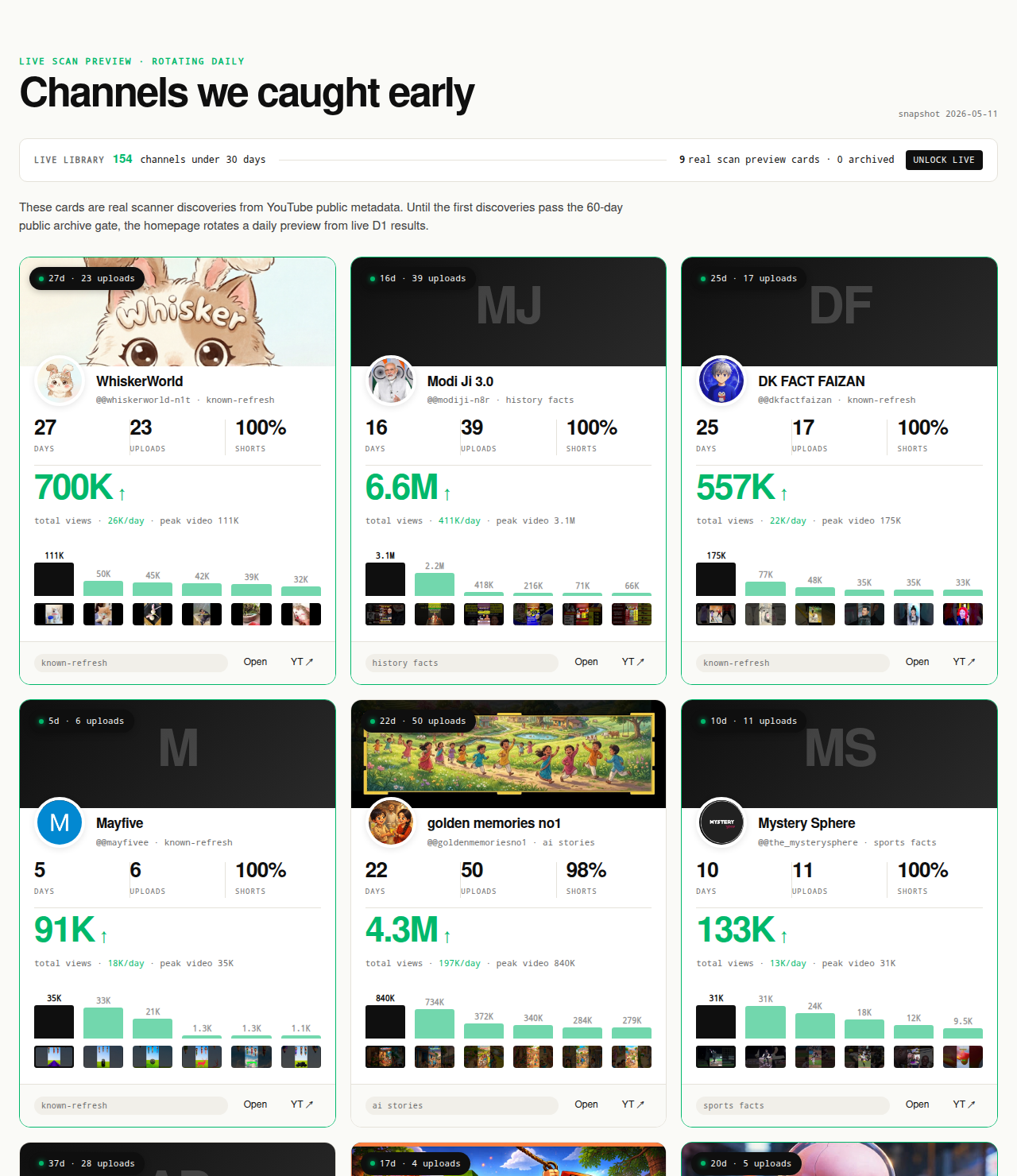
Most readers searching "google trends youtube shorts" expect Google Trends to surface a YouTube Shorts trending feed — and it doesn't. Google Trends has a YouTube Search data source that reports relative interest in queries typed into YouTube's search box, which is genuinely useful for topic-level research, but the Shorts feed is a separate ranking surface with no public trending list at all. This page explains what Google Trends actually shows for YouTube, what it cannot show for the Shorts feed specifically, and which public-data signals do answer the Shorts-feed question — built on thousands of channels scanned to date using public YouTube metadata only.

Ai stories by shano
 45d · 36 uploads
YOU & ME
 45d · 25 uploads
Dootoons TV
 45d · 69 uploads
Mr Pawsome
 42d · 64 uploads
sajkcasqq
 38d · 38 uploads
OP Nigma

FactD
 45d · 31 uploads
Cognexa Talks
 39d · 21 uploads
MapLore
What Google Trends actually shows for YouTube
Google Trends measures relative search-query interest over time, scaled to 100 at the peak inside the chosen window, broken down by region and sub-window. The tool exposes several data sources via a dropdown at the top of the explore page (trends.google.com): Web Search, Image Search, News Search, Google Shopping, and YouTube Search. The YouTube Search source is the relevant one for any YouTube research question — it reports the relative volume of queries typed into YouTube's search box, scoped to the time window and geography the researcher selects.
What the YouTube Search source is good at: comparing relative interest between two topics, surfacing rising query terms inside a topic ("Related queries" → "Rising"), identifying seasonality (does this topic spike every December, every Memorial Day, every January 1), and comparing geographic distribution (which country is searching this most). All of those answers are useful for a creator deciding whether a topic has search-side demand at all and where the demand is concentrated. They are honest answers within the tool's scope.
The methodology footnotes matter for interpretation. Google Trends data is normalized — the raw query counts are not exposed, only relative scores scaled inside the chosen window (Google Trends Help: data normalization). The data is sampled rather than exhaustive. Very low-volume queries are filtered to zero rather than reported, so a niche query may show as a flat line not because nobody searches it but because the volume is below the sampling threshold. A topic at "50" in one window may have less absolute search volume than the same topic at "20" in another window if the peak that scaled the second window was much larger. The score is comparative, not cardinal.
None of those caveats break the tool. Used inside its scope — relative search-query interest on the YouTube Search property — Google Trends is a defensible input for topic-side niche research. The mismatch happens when readers treat YouTube Search interest as a Shorts feed signal, which is what the next section unpacks.
What Google Trends does NOT show for Shorts
Google Trends has no Shorts feed data source. The YouTube property inside Google Trends measures queries typed into YouTube's search box, full stop — it does not partition Shorts results from long-form results, does not report which Shorts viewers are swiping through inside the Shorts feed, does not expose per-channel velocity inside Shorts, and does not produce a Shorts-only trending list. None of those signals exist as Google Trends outputs, because the Shorts feed is a different surface from YouTube Search and Google Trends only reads search.
The structural gap is consequential. YouTube documents the Shorts feed as a personalized swipe surface that ranks each Short based on how viewers interact with similar content (YouTube Help: Shorts overview), with ranking inputs including per-view watch-through, swipe-away rate, and re-watches inside a separate impression pool that does not share state with the main feed. The signals that determine what trends inside the Shorts feed (watch-through, swipe-away, format-fit at the channel layer) are different from the signals that determine what trends in YouTube Search (query frequency, query co-occurrence, search-volume seasonality). A topic spiking in YouTube Search does not automatically rank inside the Shorts feed, and vice versa.
What Google Trends specifically does not surface for Shorts research, item by item: no Shorts-feed-specific trending list (no equivalent to "what is hot on the swipe feed right now"); no per-channel velocity (Google Trends does not even know which channel publishes a topic — it knows the query string only); no swipe-away rate (a Shorts-feed-specific signal entirely absent from the data); no Shorts vs long-form partition on the YouTube Search source (queries are not filtered by which surface the user ended up on); no Shorts-format fingerprinting (the data does not distinguish "TTS history fact-stack format" from "Reddit narration format" from anything else — those are channel-level production patterns, not search queries); and no recommender-lift indicator (Google Trends has no read on whether the YouTube Shorts recommender is currently surfacing more of one cluster than another).
The honest framing is that Google Trends is not failing at the Shorts feed question — it is answering a different question. The tool was built for search-query analysis and works well for it. Shorts feed research needs a different data source because the Shorts surface is a different object. The next section names the two questions explicitly so the reader can pick the right tool for the one they are actually asking.
The two questions that get conflated
The "google trends youtube shorts" SERP collapses two distinct questions onto one query string, and readers usually mean one or the other without knowing which one Google Trends actually answers.
Question A — YouTube Search trends. "Are people typing this query into YouTube's search box more or less than they were last quarter?" Topic-level, search-side, demand-confirmation. Google Trends with the YouTube Search source selected answers this cleanly. Useful for deciding whether a topic has rising search-side demand, what region the demand concentrates in, what seasonality the topic follows, what related queries are rising alongside the head term. The output is a number-over-time chart and a related-queries table; the actionable interpretation is "search interest is rising / flat / decaying for this topic."
Question B — Shorts feed trends. "Which production format is the recommender currently lifting on the Shorts swipe feed, and which small Shorts-first channels are getting the lift?" Format-level, surface-specific, channel-velocity. Google Trends does not answer this question because the Shorts feed is not a Google Trends data source. The readable answer comes from channel-level public Data API metadata filtered to Shorts-first channels under 45 days old with abnormal view velocity. The output is a list of channels and the format pattern they share; the actionable interpretation is "the recommender is currently lifting this production format at the small-channel layer."
The questions interact at the edges. A topic rising in YouTube Search (Question A) sometimes precedes a Shorts cluster acceleration if the topic is broad enough to drive both surfaces — a new game release, a news event with mass appeal, a seasonal moment. The mapping is noisy and lagged, but it exists. A format-cluster acceleration on the Shorts feed (Question B) does not consistently show up in YouTube Search because the Shorts feed audience is swipe-served rather than search-served — viewers find Shorts by swiping, not by searching. Treating Question A as a proxy for Question B is therefore weak in one direction and broken in the other.
The clean workflow uses both tools for their respective questions. Google Trends to confirm topic-level search demand and seasonality before committing to a topic inside a chosen format; channel-velocity discovery to validate the format itself is currently being lifted on the Shorts surface. Either alone leaves a research gap. The "how to use them together" section below operationalizes the combined workflow.
When Google Trends IS useful for Shorts research
Three Shorts-research questions where Google Trends is genuinely the right tool, with caveats. Each maps to a Google Trends output the YouTube Search source produces cleanly.
Topic-level search demand. Before committing to a topic inside a chosen Shorts format, confirm that search-side interest in the topic exists and is rising rather than decaying. Set the data source to YouTube Search, the time window to 12 months, and the geography to the target region. A flat or declining curve is a yellow flag — the format may still work on the Shorts feed via swipe-served discovery, but the search-side reinforcement is weak and the long tail of the topic will be thin. A rising curve is a green light for the topic-side of the decision. The interpretation is not "this topic will trend on Shorts" — it is "this topic has search-side demand the channel can also tap."
Seasonality detection. Set the time window to 5 years and look at the YouTube Search curve for the topic. If the curve has a predictable annual peak (Christmas decoration topics in November-December, tax-prep topics in March-April, fantasy-sports topics in August-September), the topic is seasonal and a Shorts channel built around it will see predictable view-velocity swings. The channel either commits to the seasonality (matching upload cadence to the seasonal window) or rejects the topic in favor of an evergreen alternative. Seasonality is a Google Trends strength because the underlying search behavior repeats on a calendar cycle the data is well-suited to surface.
Geographic comparison. Compare relative search interest in the topic across countries or regions. A topic concentrated in one country tells the creator the Shorts channel will be audience-concentrated there, which interacts with the channel's language choice, cultural-reference choice, and monetization expectations. A topic broadly distributed across English-speaking regions has a different audience-distribution profile. Google Trends surfaces this directly via the geographic breakdown on the YouTube Search source.
The shared shape of all three: Google Trends answers topic-side research questions for any YouTube channel, Shorts-first or long-form. None of the three is a Shorts-feed-specific question; they are topic-side questions that apply to any production format, and the Shorts-first specificity comes from the format choice the researcher already made independently. That separation is the right one — pick the format from channel-velocity data, pick the topic with help from Google Trends, run uploads.
When Google Trends is NOT useful for Shorts research
Three Shorts-research questions where Google Trends is structurally the wrong tool. Each maps to a signal the YouTube Search source cannot produce because the signal lives on a different surface.
Anything Shorts-feed-specific. "What is trending on the Shorts feed today" is not a question Google Trends can answer, because Google Trends does not have a Shorts feed data source. The YouTube Search source measures search-box queries, not swipe-feed activity. A reader using Google Trends to find "what to make a Short about right now" is reading the wrong surface — even if the topic is rising in search, the Shorts feed may not be lifting that topic at all, and a topic the Shorts feed is lifting hard may show as flat in YouTube Search because the audience is swipe-served rather than search-served.
Channel-level signal. Google Trends does not know which channel publishes which video. It knows query strings, click destinations in aggregate, and search-volume curves — it does not know that a specific 25-day-old Shorts channel is accumulating 50,000 views per day inside a history fact-stack format. The reader who wants "which small Shorts channels are breaking out right now" is asking a channel-level question, and channel-level data only exists in the YouTube Data API plus the channel-velocity filters applied on top of it. Google Trends is silent on this entire layer.
Format-clarity signal. Format is a channel-level production-pattern attribute (duration distribution, Shorts ratio, title patterns, thumbnail style, upload cadence), not a search query. Google Trends measures queries, so format-clarity is invisible to it. The reader who wants to know "is the recommender currently lifting TTS history fact-stack Shorts more than character-voiced Reddit narration Shorts" is asking a format-level question; the answer requires channel-level Data API filtering with a format-classification layer, neither of which Google Trends provides.
The pattern across all three: Google Trends is a search-query tool, and questions that do not reduce to search queries are not Google Trends questions. The four-category Shorts-trend taxonomy — audio-side trends, swipe-away patterns, channel-velocity trends, format-cluster trends — covered on the parent YouTube Shorts trends pillar names the categories Google Trends does not reach. The "deterministic public-data signal" section below shows the signal that does.
The deterministic public-data signal for Shorts trends
The signal that answers the Shorts-feed question Google Trends cannot answer is channel velocity inside known Shorts-first format clusters. NicheBreakout applies three hard gates plus two scoring bonuses to small Shorts-first channels and ranks the survivors as the current trend instances; the format pattern shared across them is the durable trending signal. The full version lives on the methodology page; the abbreviated readout is below.
Channel age
detected within 45 days of channel creationFirst-5 upload views
combined views across the first five public uploads ≥ 10,000Views per day
lifetime channel views ÷ channel age ≥ 1,000Format clarity (bonus)
score weights channels with a clear Shorts-first or long-form-first ratio above mixed-format channelsEarly-traction velocity (bonus)
score boost when channel age ≤ 14 days, first-5 sum ≥ 50,000, or views/day ≥ 5,000
Each gate maps to a failure mode Google Trends cannot detect. Channel age ≤ 45 days isolates the current velocity wave from historical sediment — Google Trends data does not partition by channel age at all, so a topic curve mixes a 5-year-old channel's traffic with a 30-day-old channel's traffic and reports the average. First-5 sum views ≥ 10,000 is the recommender-lift signal for new entrants — invisible to Google Trends, which has no read on per-video view counts. Views per day ≥ 1,000 is the velocity floor — also invisible to Google Trends. The two bonuses (format clarity and early-traction velocity) operate on the Shorts ratio and the per-channel velocity curve, neither of which is a Google Trends data source.
Average first-five-video views for every populated grade tier inside our discoveries cohort:
The output of the filter is a list of small Shorts-first channels currently being lifted by the recommender. The format pattern across the surviving channels (production mode, duration distribution, hook structure, thumbnail style, title formatting) is the durable trending signal. Specific channels rotate as the cluster ages; the format carries for months. The current densest cluster snapshot, derived from this filter:
The Shorts-first vs long-form split inside the top clusters looks like this in our dataset:
The list of dedicated programmatic topic pages — AI story channels, Reddit story channels, history shorts channels, quiz channels, faceless storytelling channels — each carries the channel-evidence trail for one cluster with outbound YouTube links so the public metadata is one click from verification.
What we deliberately don't claim about trending data
NicheBreakout does not claim a proprietary "trending feed" that outperforms Google Trends on search-query accuracy. Google Trends does not have a Shorts feed surface, and this page is not arguing that NicheBreakout's channel-velocity data is a better Google Trends — it argues NicheBreakout answers a different question. The two tools are complementary, not competitive on the same axis.
The specific things this page does not claim. No proprietary trending-sounds feed. YouTube does not expose trending-sounds data through the public Data API v3 (YouTube Data API v3 reference), and Creator Music availability is gated behind Creator Studio rather than a third-party endpoint. We do not infer it from TikTok scrapes and we do not republish trending-sounds lists. No claim to outperform Google Trends on search-data accuracy. Google Trends is built on Google's own search query stream and is the authoritative source for relative YouTube Search interest; nothing we do reads that data. No prediction of which format will trend next. The filter surfaces what is currently being lifted, not what will be lifted in three months — predictions about future cluster-level trend direction are unfalsifiable from public data, and the page declines to make them.
What is readable from public YouTube Data API fields: channel age, subscriber count (rounded to three significant figures per the API documentation), total view count, video count, video metadata, video publish dates, individual video view counts, and video duration. Shorts ratio is computable from duration plus video count; format pattern is inferable from title patterns, duration distribution, and thumbnail style; velocity is view count divided by channel age. Every claim in the deterministic-signal section is defensible from one of those fields.
What is not readable: swipe-away rate, per-Short impression count, Shorts feed ranking position, RPM-by-format, traffic source breakdown, audio-track-level usage data, watch-through time, audience retention by second, or anything that requires authenticated YouTube Analytics access. None of those signals ship in the live library, the Friday digest, or the future matured public archive, and none would survive the outbound-link verification rule that governs every channel card on the site. The boundary is the same one that lets a reader click any card and replicate the calculation on YouTube directly.
Common mistakes when using Google Trends for Shorts research
Six mistakes recur in readers using Google Trends as a Shorts research input. Each one maps to a misread of what the tool actually measures.
Picking topics by search volume without checking channel-velocity inside the cluster. A topic with rising search interest in YouTube Search is a green light at the topic layer only. If no small Shorts channels are currently breaking out inside that topic-cluster, the format-fit signal at the Shorts surface is missing and a new entrant has no recommender wave to ride. The corrective is to layer channel-velocity discovery on top of the Google Trends signal — confirm the topic has rising search demand AND confirm the Shorts recommender is currently lifting small channels in the cluster. Either alone is half the research.
Using year-over-year comparisons for topics that did not exist as Shorts last year. Shorts as a format was meaningfully different two years ago, three years ago, five years ago — the surface itself has evolved (the 3-minute upper bound, for instance, only launched in October 2024). A 5-year Google Trends comparison on a topic captures search-query interest, which has its own dynamics independent of whether the topic was viable as a Short in any prior year. Read the year-over-year curve as a topic-demand curve, not a Shorts-viability curve, and shorten the window to 12-24 months when the Shorts-specific decision is what matters.
Treating "Rising" related queries as Shorts trends. The "Rising" panel inside Google Trends surfaces queries with the largest relative growth in the chosen window — useful for topic-side ideation, but the rising queries are search-box queries, not Shorts-feed format clusters. A rising query may map to a Shorts opportunity, or it may map to a long-form opportunity, or it may map to neither because the audience searches for the topic but watches it on a different surface. Cross-reference rising queries against channel-velocity data before committing.
Mistaking score-of-50 for "average" demand. Google Trends scores are relative inside the chosen window, not cardinal. A topic scoring 50 inside a window scaled by a single news-event peak may have less absolute search volume than the same topic scoring 20 inside a flatter window. Compare topics inside the same Google Trends query (multi-line on one chart) rather than reading individual scores as absolute volume.
Reading the geographic breakdown without checking language fit. A topic concentrated in India by Google Trends geographic distribution is a real demand signal, but the Shorts channel built around it has to make a language choice (Hindi vs English vs regional language) that affects production cost and monetization. Geographic demand is one input; language fit is another; production reality is a third. Google Trends only gives you the first.
Ignoring the YouTube Search vs Web Search distinction. Google Trends' default data source is Web Search across Google's main search engine. The YouTube Search data source is a separate selection — different curves, different rising queries, sometimes different geographic distributions. A reader who runs the query on Web Search by default and treats the output as "YouTube demand" is reading the wrong surface. The corrective is one click: change the data source to YouTube Search before drawing any YouTube-specific conclusion.
How to use Google Trends and NicheBreakout together
The combined workflow uses each tool for its question, then layers the outputs into a single niche decision. Two passes: a topic-side pass via Google Trends, a format-side and channel-velocity pass via NicheBreakout, and a reconciliation step that combines the two.
Topic-side pass — Google Trends. Pick the candidate topic. Open trends.google.com, set the data source to YouTube Search, the geography to the target region, and the time window to 12 months. Read three things off the chart: is the curve rising, flat, or decaying (topic-demand direction); is there a seasonal pattern visible inside the window (seasonality); and what queries appear in the "Rising" related-queries panel (adjacent ideation). The output is a topic-demand verdict — rising / flat / decaying — plus a list of related rising queries the channel could absorb as long-tail upload topics.
Format-side pass — NicheBreakout. Pick the candidate Shorts format (TTS history fact-stack, character-voiced Reddit narration, faceless quiz overlay, AI-imagery horror anthology, faceless POV cooking, scary-story narration). Open the live library, apply the Shorts-first filter (Shorts ratio ≥ 0.8) and the channel-age filter (≤ 45 days), and scan for channels matching the candidate format. The output is a list of small Shorts-first channels currently being lifted by the recommender inside that format cluster; the count and view-velocity distribution is the format-fit verdict.
Reconciliation. A topic rising in YouTube Search inside a format the recommender is currently lifting is the strongest combined signal — both inputs are green. A topic rising in YouTube Search inside a format with thin channel-velocity output is a yellow flag — the topic has demand but the Shorts surface is not lifting that production format right now; consider a long-form channel instead. A topic flat in YouTube Search inside a format with strong channel-velocity output is a different kind of yellow flag — the recommender is lifting the format on the swipe feed but search-side demand for the topic is weak, which limits the long-tail upside and may indicate a swipe-served-only audience. A topic flat in YouTube Search inside a format with thin channel-velocity output is a red flag — neither surface is supporting the decision; pick a different topic or a different format.
The reconciliation step is where the comparison actually pays off. Single-tool decisions overweight one signal; combined decisions weigh both. The reconciliation is also where the parent YouTube Shorts trends pillar, the sibling how to find trending Shorts process guide, the best YouTube Shorts niches listicle, and the YouTube Shorts niche finder tool framing fit — each is a different vantage point on the same underlying channel-velocity data the format-side pass operates on, with the topic-side pass anchored on Google Trends throughout. The methodology page documents the deterministic kernel; the YouTube niche validation checklist compresses the workflow into a deterministic checklist.
FAQ
Does Google Trends show YouTube Shorts trends?
Partially, and only at the search-query layer — not the Shorts-feed layer. Google Trends has a YouTube Search data source (selectable from the search-property dropdown at trends.google.com) that reports relative interest in queries typed into YouTube's search box. It does not report what is currently spiking inside the Shorts swipe feed, which channel is breaking out, what format the recommender is lifting, or whether a topic that is rising in YouTube Search is also rising on the Shorts surface. The two surfaces use different ranking inputs, and Google Trends only reads the search side.
How do I see what's trending on YouTube Shorts?
There is no first-party Shorts-feed trending list. YouTube's Trending tab and YouTube Charts surface a broad-audience mix of long-form and Shorts videos, ranked across each country with bias toward established channels (YouTube Help: How YouTube ranks trending videos), but it is not a Shorts-feed-specific surface. The closest readable signal from public Data API metadata is channel velocity inside known Shorts-first format clusters — small Shorts-first channels (Shorts ratio ≥ 0.8, channel age ≤ 45 days) currently accumulating abnormal view counts. The format those channels share is the durable trending signal; the parent YouTube Shorts trends pillar covers the framing in depth.
Can I use Google Trends for YouTube niche research?
Yes, with a clear scope. Google Trends is useful for topic-level questions — is search interest in this topic rising, is it seasonal, which region is searching it most, what queries are rising alongside the head term. Those answers feed niche selection at the topic layer. Google Trends does not answer format-fit questions (which Shorts production format the recommender is currently lifting at the small-channel layer), channel-velocity questions (which sub-30-day channels are breaking out), or surface-specific questions (is this trend on the Shorts feed or on Browse). For those, channel-level public-data filters are the right tool. The YouTube niche finder pillar covers the channel-velocity side; Google Trends covers the search-demand side. Both inputs improve a niche decision; neither replaces the other.
What's the difference between Google Trends and YouTube Trending?
Google Trends measures search-query interest over time — the relative volume of searches typed into Google, YouTube, Google Images, Google News, and Google Shopping, broken down by region and time window. YouTube Trending is a first-party YouTube surface that ranks currently popular videos using watch signals plus topicality (YouTube Help: How YouTube ranks trending videos). Different inputs, different outputs. Google Trends tells you that searches for a topic are rising; YouTube Trending tells you which specific videos are watching popular right now. Neither is a Shorts-feed-specific surface, and the Shorts feed itself has no equivalent public trending list.
Is Google Trends accurate for YouTube?
It is accurate for what it measures — relative search interest in queries typed into YouTube's search box, scaled to 100 for the peak inside the chosen window. The accuracy caveats are structural rather than methodological. The data is relative, not absolute (no raw query counts), it is sampled (not every search is counted), and very low-volume queries are filtered to zero rather than reported (Google Trends Help: data normalization). Within those limits the YouTube Search data source is a reasonable proxy for topic-level interest on YouTube as a whole. It is not a proxy for Shorts feed activity, recommendation lift, or per-channel velocity.
What's better than Google Trends for Shorts?
The question is wrong-shaped — they answer different questions. Google Trends answers the topic-demand question (is search interest rising for this idea); for the Shorts-feed-specific question (what production format the recommender is currently lifting at the small-channel layer) the answer is channel-velocity data filtered to Shorts-first channels under 45 days old, which is what NicheBreakout surfaces from public YouTube Data API metadata. The right workflow uses both: Google Trends to confirm topic-level seasonality and search demand, channel-velocity discovery to confirm format-fit and current recommender lift. Picking one over the other usually means asking the wrong question of the chosen tool.
Can I see Shorts-specific trending data anywhere?
Not as a first-party public surface. YouTube does not expose a Shorts-feed trending endpoint through the Data API v3 (YouTube Data API v3 reference), and the Trending tab is not Shorts-only. Third-party tools that publish "trending YouTube Shorts" lists are inferring from one of: scraped TikTok lists republished under a YouTube label, view-count snapshots of recent Shorts (a video-level signal, not a feed-level one), or channel-level breakout detection (the approach NicheBreakout takes). Channel-level breakout detection is the only category that operates on actual YouTube data with a defensible methodology; the other two infer from non-API sources or weak proxies.
How fresh is NicheBreakout's data compared to Google Trends?
Google Trends updates near-real-time for daily search interest and offers minute-level granularity for the last 24 hours. NicheBreakout scans daily and the live library surfaces channels currently inside the 30-day window — channel age, upload count, views, views per day, Shorts ratio. The two datasets are on different update cadences because they measure different things: search-query interest moves minute-to-minute on news events, while channel-velocity signal accumulates over days as the recommender learns the format-audience fit. Every channel card on NicheBreakout outbound-links to YouTube so a reader can verify the current public metadata at the source.
Methodology / About this analysis
NicheBreakout's research relies entirely on YouTube Data API v3 public fields: channel age, subscriber count, video count, view count, video metadata, video publish dates, video duration, and recent video performance. The Google-Trends-vs-Shorts comparison on this page is sourced from Google's public Google Trends product (the YouTube Search data source) plus Google's published normalization documentation, and YouTube's public Help Center documentation for the Shorts feed, the Trending tab, and the Data API. Nothing on this page relies on authenticated Analytics access, scraped third-party data, audio-side inference, or AI-generated narratives describing why specific channels or clusters work. Shorts-first labeling uses the Shorts ratio computed from video duration; the cutoff is 0.8.
Original-research artifacts in this article: the two-question separation (YouTube Search trends vs Shorts feed trends), the explicit list of Shorts-research questions Google Trends is and is not the right tool for, the six common-mistake pattern list, the combined Google-Trends + NicheBreakout reconciliation workflow, the deterministic public-data signal as the Shorts-feed-side answer, and the revealed channel cards above the fold. The observations reflect what we have scanned and published, not all of Shorts YouTube. Author: Nicholas Major (Founder, NicheBreakout · Software engineer since 2011). Article last revised 2026-09-21.
Live scan freshness:
Related research
- YouTube Shorts trends: parent pillar covering the four-category Shorts-trend taxonomy and the Shorts-feed surface split.
- YouTube Shorts ideas: sibling cluster covering the idea-side question once a trend has been identified.
- YouTube Shorts niche finder: sibling cluster covering the tool framing for Shorts niche discovery.
- Best YouTube Shorts niches: sibling cluster covering the niche-level question on the Shorts surface.
- How to find trending Shorts: sibling cluster covering the four-method procedural workflow for surfacing trending Shorts from public data.
- YouTube Shorts ideas without showing face: sibling cluster covering the faceless × Shorts intersection.
- Faceless YouTube niches: cross-pillar covering the production-mode angle that dominates Shorts-first production.
- YouTube niche finder: cross-pillar covering niche research across Shorts-first and long-form-first channels.
- YouTube channel research: cross-pillar covering the broader channel-discovery category.
- YouTube outlier finder: cross-pillar covering the breakout-discovery framing applied to any channel type.
- Most profitable YouTube niches: companion cluster covering the profitability-vs-niche-velocity split.
- AI story channels: programmatic topic page tracking the AI-storytelling Shorts cluster.
- Reddit story channels: programmatic topic page tracking the Reddit-narration Shorts cluster.
- History shorts channels: programmatic topic page tracking the history-shorts cluster.
- Quiz channels: programmatic topic page tracking the quiz/trivia Shorts cluster.
- Faceless storytelling channels: programmatic topic page tracking the broader faceless storytelling cluster.
The Friday digest sends three current breakout channels every week — Shorts-first and long-form-first both — with format fingerprints and outbound YouTube links. Free, present-tense. The live library refreshes daily and surfaces channels currently inside the 30-day window. See pricing for the current tier; subscribe to the digest free.
End of cluster
Use Google Trends for topic demand, channel-velocity for format fit
Google Trends answers the YouTube Search question. NicheBreakout answers the Shorts-feed question. Every channel card outbound-links to YouTube so you can audit the public metadata yourself. The live under-30-day library is the paid workflow; the Friday digest is free.