
/ Cluster · YouTube Shorts niche finder
YouTube Shorts niche finder: what a Shorts-scoped niche finder should actually do (and what most tools get wrong)
A "YouTube Shorts niche finder" should be a niche-finder applied to the Shorts feed surface — channels filtered by Shorts ratio, ranked by Shorts-feed-relevant velocity signals, scoped to the channel-age window where the recommender is still actively learning the format. Most products marketed under this label are general YouTube niche-finders with a "Shorts" badge slapped on; they index the same channel population and surface the same long-form-first results. NicheBreakout's framing is narrower: apply the deterministic channel-velocity filter inside the Shorts-first cohort specifically, then read the format. Built on thousands of channels scanned to date using public YouTube Data API v3 metadata only.

Ai stories by shano
 45d · 36 uploads
YOU & ME
 45d · 25 uploads
Dootoons TV
 45d · 69 uploads
Mr Pawsome
 42d · 64 uploads
sajkcasqq
 38d · 38 uploads
OP Nigma

FactD
 45d · 31 uploads
Cognexa Talks
 39d · 21 uploads
MapLore
What "YouTube Shorts niche finder" actually means
A YouTube Shorts niche finder is a niche-finder applied to the Shorts feed surface — not a general YouTube niche-finder with a "Shorts" label dropped on top. The distinction matters because the Shorts feed is a separate ranking surface from Browse and Suggested (the parent YouTube Shorts trends pillar covers the surface split in full), and a niche that works on Browse is not automatically a niche that works on Shorts. A tool that reads keyword volume across all of YouTube and surfaces "AI storytelling" as a niche is answering a different question than a tool that filters for Shorts-first channels accumulating recommender lift inside the Shorts feed specifically.
The lateral YouTube niche finder pillar covers niche-finder logic across both surface types. This page is the Shorts-feed-specific subset: same methodology, narrower cohort. The Shorts-first cohort in our data is channels with a Shorts ratio (videos under 60 seconds divided by total videos) of 0.8 or higher — channels the recommender is unambiguously evaluating on the Shorts surface, not on Browse. Format-mixed channels (Shorts ratio 0.3 to 0.7) are evaluated on both surfaces simultaneously, accumulate ambiguous early-traction signal, and rarely break out cleanly. A Shorts niche finder that ignores the Shorts ratio is mostly returning long-form-first channels that publish an occasional Short; those channels are not Shorts research artifacts.
The narrow definition this page commits to: a YouTube Shorts niche finder is a research tool that filters public YouTube Data API metadata to surface Shorts-first channels (ratio ≥ 0.8) under 45 days old with abnormal first-five-video velocity, then reads the format those channels share as the niche signal. Anything broader is a general niche-finder. Anything narrower is a per-video-virality predictor, which public metadata cannot support.
Why the Shorts feed needs its own niche-finder logic
The Shorts feed evaluates channels on different inputs than Browse, ranks on different signals, and saturates audience matches on a different timeline. A niche-finder built for Browse will systematically miss Shorts-first breakouts and over-surface long-form-first channels, because the inputs a Browse-tuned filter privileges (subscriber count, long-form watch hours, search-relevance signals) are weak or absent on the Shorts surface. The Help Center documents the posture: "The Shorts feed is personalized and ranks each video based on how viewers interact with similar content" (YouTube Help: Shorts overview). Shorts-feed ranking reads per-view watch-through inside the first seconds, swipe-away rate, and re-watch behavior — none of which correlate with the signals a general niche-finder typically uses.
Three Shorts-feed properties force separate logic. The recommender-served split: a Shorts-first channel can clear several million views with under 1,000 subscribers because the Shorts feed serves the channel to viewers who don't follow it, so a general niche-finder filtering on subscribers misses those channels entirely. The format-fingerprint sensitivity: the Shorts feed evaluates channels on tight format consistency more aggressively than Browse does, because swipe-feed throughput is higher and the recommender needs a clean signal to match audiences fast. The cadence sensitivity: Shorts-first channels publishing daily or every-other-day accumulate the format-fit signal the recommender needs, while the same cadence is over-publishing on Browse.
The implication for niche-finder design: the right filters for Shorts are Shorts ratio ≥ 0.8, channel age ≤ 45 days (with heavier weighting toward ≤ 14 days), first-five-video sum ≥ 10,000 (most working Shorts-first channels clear by 10x), and views per day ≥ 1,000 (frequently 5,000+ for breakouts). Drop the Shorts ratio filter and the surface results converge with a general niche-finder. Keep it and the cohort separates cleanly. The lateral how to find trending Shorts guide covers per-Short discovery downstream; the parent YouTube Shorts trends pillar covers the trend taxonomy upstream.
The deterministic filter for a working Shorts niche
NicheBreakout applies the same three hard public-metadata gates and two score bonuses to the Shorts-first cohort as to long-form-first channels; the absolute numbers a working Shorts channel produces are higher across most of the gates, and the format-clarity bonus carries more weight. The full methodology is published on the methodology page. The Shorts-first readout looks like this:
Channel age
detected within 45 days of channel creationFirst-5 upload views
combined views across the first five public uploads ≥ 10,000 (Shorts-first channels typically clear this floor by 5x–50x)Views per day
lifetime channel views ÷ channel age ≥ 1,000Format clarity (bonus)
score weights channels with a Shorts ratio ≥ 0.8 above format-mixed channels — the heaviest single bonus on this surfaceEarly-traction velocity (bonus)
score boost when channel age ≤ 14 days, first-5 sum ≥ 50,000, or views/day ≥ 5,000 — fires more often on Shorts-first channels
The three gates read differently on the Shorts surface. Channel age ≤ 45 days is the same upper bound, but Shorts-first breakouts cluster earlier — channels often clear breakout thresholds inside the first 14 days when the format fits, because the Shorts feed evaluates and lifts faster than Browse. The early-traction velocity bonus (channel age ≤ 14 days) fires more often on Shorts-first channels for this reason. First-5 sum views ≥ 10,000 is the same floor, but a working Shorts-first channel typically clears it by an order of magnitude — Shorts breakouts commonly post first-5 sums in the 100,000 to 500,000 range, because individual Shorts can clear 50,000 views inside their first 48 hours when the recommender lifts the format. A Shorts-first channel scraping the 10,000 floor is a borderline case; a long-form-first channel at the same floor is on a normal trajectory. Views per day ≥ 1,000 is the same gate, frequently exceeded by 10x or 50x on Shorts-first breakouts.
The format-clarity bonus is the bonus that does the most work on the Shorts surface. A channel with a Shorts ratio ≥ 0.8 is unambiguously Shorts-first and gets the format-clarity weight applied; the recommender is reading a consistent format fingerprint and matching audiences on it. Format-mixed channels (Shorts ratio 0.3 to 0.7) accumulate traction more slowly because the recommender is evaluating them on both the Shorts feed and Browse and learning contradicting audience profiles from each surface. On long-form-first niches the format bonus is useful; on Shorts-first niches it is close to load-bearing. Early-traction velocity bonuses catch the fastest-moving Shorts-first channels — the ones whose format is unambiguously being lifted inside the first two weeks.
Average first-five-video views for every populated grade tier inside our discoveries cohort looks like this (grades with no current members are suppressed until they fill in):
The exact score formula, grade thresholds, and edge cases live on the methodology page. The YouTube niche validation checklist operationalizes this filter into a step-by-step workflow.
How to use a Shorts-specific niche-finder workflow
The Shorts-specific workflow is four steps in order. Step 1: filter to the Shorts-first cohort. Set the Shorts ratio gate at 0.8 or higher, which drops format-mixed and long-form-first channels and isolates channels the recommender is reading as Shorts-only. Inside that cohort, apply the same three hard gates from the methodology: channel age ≤ 45 days, first-5 sum ≥ 10,000, views per day ≥ 1,000. Most Shorts-first channels clear the floor by a wide margin or fail it entirely — there is little middle ground, because the Shorts feed lifts fast or stays cold.
Step 2: read the format the surviving channels are running, not the topic. Open three or four of the top-ranked Shorts-first channels and look at the upload pattern. Is it TTS narration over stock footage? AI imagery plus voiceover? Vertical Reddit narration with character overlays? A 45-to-75-second history fact-stack? A quiz template with countdown overlays? The format is the durable signal — a working Shorts format runs for months across rotating topics. The topic is disposable — a hot topic inside the format saturates inside weeks. Naming the niche by format is the useful research artifact; naming it by topic is recommendation by vibe.
Step 3: confirm the format cluster has more than one current breakout. A single channel breaking out is signal that the format is replicable; three or four small channels currently breaking out in the same format inside the 45-day window is signal that the recommender is actively lifting the format. The cluster, not the single channel, is the niche. The best YouTube Shorts niches sibling page indexes the most-populated format clusters in our current scans.
Step 4: pick a topic to run inside the format. Once the format is identified and the cluster confirmed, topic selection is the lighter decision — the format generalizes, so the exact topic is mostly about personal interest and production efficiency. The YouTube Shorts ideas page covers topic-level brainstorming downstream of format selection; YouTube Shorts ideas without showing face narrows further for faceless-only operators. The format-first workflow rejects the inverted order — picking a topic and then improvising a format is the most common Shorts-research error. The workflow also rejects "trending sounds" as the entry point; sound is a per-video decoration, not a niche (the parent Shorts trends pillar covers that critique in full).
The Shorts-first niches currently surfacing the most breakouts
The Shorts-first cohort in our scans clusters into a handful of formats that keep producing small-channel breakouts inside the 45-day window. The list below reads as observation, not ranking — there is no "best" Shorts niche, only formats the recommender is currently lifting at the small-channel layer. Across the channels currently inside our live 30-day window with Shorts ratio ≥ 0.8 — a subset of the broader thousands of-channel scan — the densest format-leaning niche clusters meeting our sample-size threshold are:
The Shorts-first vs long-form split inside those top clusters:
AI story Shorts are the highest-volume Shorts-first cluster in our 2026 scans. The format runs TTS narration plus AI-generated imagery in a 45-to-90-second vertical container, with recurring story templates (horror anthologies, AI-generated fictional history, narrative true-crime-adjacent stories). The AI story channels programmatic page indexes the cluster. The format works on the Shorts feed because watch-through is high inside a tight vertical container and the AI imagery layer lets a single operator scale story output without face-on-camera production overhead.
Reddit story Shorts run TTS over r/AmITheAsshole, r/ProRevenge, r/MaliciousCompliance, and adjacent story threads with stock visuals or character overlays. The Reddit story channels page tracks the cluster. The format has a built-in first-second hook (the title question) and a payoff inside 60 seconds. Current breakouts typically add character voicing or editorial selection, since YouTube's 2024 mass-production enforcement (YouTube Help: monetization policies and channel guidelines) targeted lazy implementations.
History fact-stack Shorts stack three to six historical facts inside a 45-to-75-second vertical with cinematic visuals, captioned narration, and a count-up template. The history shorts channels page indexes the cluster. The format compounds across the long tail of historical topics. Quiz and trivia Shorts run interactive Q&A formats with text overlays and countdown timers. The quiz channels page tracks the cluster. Production cost is the lowest of the four — visuals are template-driven and the editorial work is question selection.
Other Shorts-first clusters surface periodically without dedicated programmatic pages: POV cooking Shorts (first-person camera over a cutting board, no face), tier-list Shorts (S-tier through F-tier inside a 60-second template), satisfying process Shorts (manufacturing, restoration, cleaning), and travel-fact Shorts (locations stacked with on-screen captions). The faceless YouTube niches sister pillar covers the production-mode angle that overlaps most of these formats.
Differences from a generic niche finder
A Shorts niche finder shares the methodology spine of a general niche finder — same three public-metadata gates, same two score bonuses — but three weights shift materially on the Shorts surface. First, the Shorts ratio threshold is load-bearing. A general niche-finder treats Shorts ratio as one input among many or ignores it; on Shorts, applying the 0.8 cutoff is the difference between a tool that returns Shorts-first channels and one that returns long-form-first channels that happen to publish occasional Shorts. The Shorts feed evaluates channels on format fingerprint aggressively, so the Shorts ratio is also the variable with the largest measurable effect on early-traction outcomes.
Second, the first-5 sum threshold is absolutely higher in practice. The 10,000 minimum is the same across both cohorts, but a working Shorts-first channel typically clears it by an order of magnitude. A long-form-first channel at 12,000 first-5 sum views is on a normal trajectory; a Shorts-first channel at the same number is borderline. The qualitative read should weight Shorts-first results against a higher implicit floor — call it 50,000 first-5 sum as the practical signal threshold — even though the hard gate stays at 10,000 for cohort consistency.
Third, channel age weight is heavier. A 30-day-old long-form-first channel without breakout traction is still inside its normal early window. A 30-day-old Shorts-first channel without breakout traction has already underperformed, because the Shorts feed evaluates and saturates faster. The early-traction velocity bonus (≤ 14 days, first-5 sum ≥ 50,000, views/day ≥ 5,000) fires more often on Shorts-first, and the absence of it inside the first 30 days is a stronger negative signal on Shorts than on long-form.
One rule worth naming: subscriber count is even less useful on Shorts than on long-form. The Shorts feed serves channels to viewers who don't follow them, so a Shorts-first channel can clear 5 million views with 800 subscribers. The right rank input on the Shorts surface is view velocity (views per day, first-5 sum, recent-30-day view rate), not subscriber-derived signal. The lateral YouTube niche finder pillar covers the general-case methodology; this page is the Shorts-specific specialization. Same methodology spine, narrower cohort.
What we deliberately don't claim about Shorts niche profitability
NicheBreakout doesn't claim a Shorts niche is profitable, will be profitable, or has a specific RPM. Those claims require monetization data — RPM, CPM, audience demographics, traffic-source revenue split — that lives behind the YouTube Analytics API and is not third-party accessible. The Shorts ad revenue pool pays creators based on each creator's share of total Shorts views from monetizing viewers, and individual channel RPM is a function of viewer geography, ad inventory, and content category, none of which is exposed publicly. Anyone selling "$X RPM for this Shorts niche" data is either guessing, extrapolating from a small private sample, or marketing.
What this page does claim, and is defensible from public Data API v3 fields, is that a Shorts-first niche has small-channel breakouts currently happening. That signal answers "is the recommender currently lifting Shorts-first channels in this format" and does not answer "will the creator make money." The two questions are independent: a format the recommender lifts can be commercially weak (low-CPM categories, geography-limited audiences), and a commercially strong category can have a cold recommender right now. The audit-ready claim is breakout activity; the commercial claim is out of scope.
Other claims this page declines: no per-Short watch-through prediction, no swipe-away rate, no audio-side trending data, no "this Short will go viral" forecasting, no AI-generated narrative explaining why specific channels work. The Shorts Partner Program eligibility threshold (10 million Shorts views in 90 days, per the YouTube Partner Program overview) is observable from public view count, but the dollar payout downstream of crossing it is not. The structural boundary is the same as the parent pillar: public Data API metadata only, every channel verifiable on YouTube directly, no AI narrative.
Common mistakes when using a Shorts niche finder
Five mistakes recur. Treating Shorts views as a subscriber-growth signal. The Shorts feed serves recommender-matched viewers, not channel-page visitors, so a Shorts-first channel clearing 5 million views with 800 subscribers is normal. Creators expecting subscriber growth proportional to views are misreading the surface. Set Shorts goals on view velocity and Partner Program eligibility, not on subscriber count.
Ignoring the Shorts ratio in the format-clarity bonus. A result set without a Shorts ratio filter mostly contains long-form-first channels with occasional Shorts, and copying their format will not produce Shorts-feed lift. The recommender is reading the format fingerprint that hard, so the research has to as well — filter on Shorts ratio ≥ 0.8 before reading anything else.
Picking a topic before picking a format. "Cooking" is not a Shorts niche. "POV first-person 45-second cooking Shorts with no face" is a Shorts niche. The format carries; the topic rotates. Creators who pick a topic from a trending-topic list and then improvise a format teach the recommender an unstable profile and the early-traction signal stays cold.
Trusting keyword-volume tools for Shorts niche selection. Keyword volume reads search demand on YouTube as a whole, which has weak correlation with what the Shorts feed lifts. A 50,000-search keyword can be a flat Shorts niche if no small Shorts-first channels are breaking out in it; a 200-search keyword can be a working one if the cohort is. Read channel-evidence signal first; treat keyword volume as a downstream input for video optimization.
Copying mature Shorts channels instead of mid-breakout small ones. A 500,000-subscriber Shorts channel's current strategy is downstream of two years of trained audience momentum. A new entrant copying that strategy is learning from the destination, not the path. Study Shorts-first channels under 45 days old inside the same format — the channels currently winning, not the channels that won. The up-and-coming YouTube channels page indexes the same cohort framing for channel discovery generally.
Tool comparison: what NicheBreakout does vs. other Shorts niche tools
The tool category splits into three product types, and the difference is which signal the tool reads. Keyword-signal tools — vidIQ, TubeBuddy, NexLev's keyword surfaces — read search-engine demand, autocomplete, tag overlap, and competition scoring. They answer "what topic has search volume on YouTube." Useful for video-level optimization inside an already-picked niche, especially for long-form. For Shorts niche selection it is the wrong input, because the Shorts feed ranks on watch-through and swipe-away inside its own impression pool, not on search demand.
Channel-evidence tools — NicheBreakout, OutlierKit, TubeLab — read public channel-level data and surface channels with abnormal early traction. OutlierKit's framing is closest; they use view-to-subscriber ratio as the primary signal. TubeLab adds profitability framing on top of channel data, which is the part that cannot be defended from public data. NicheBreakout's differentiators inside this group: the 45-day channel-age filter, the first-five-video signal as the velocity input, and the Shorts ratio cutoff as a hard filter — most channel-evidence tools surface mixed-format channels and require the user to filter manually.
Channel directory tools — ChannelCrawler is the canonical one — let a researcher search a large channel database by keyword, subscriber range, country, or topic tag. They are search infrastructure, not niche-finders. Useful for confirming a channel exists or for surfacing channels by category, less useful for "which Shorts formats are currently breaking out" because they don't rank by early-traction signal at all.
The honest framing for a creator picking a Shorts niche: keyword-signal tools answer the wrong question for niche selection but the right question for video-level optimization. Channel-directory tools are infrastructure. Channel-evidence tools answer the niche-selection question directly, and the Shorts ratio filter is the variable that separates a Shorts-scoped tool from a generic one. NicheBreakout's published filter is reproducible from public Data API metadata; nothing in the methodology requires NicheBreakout specifically to be the executor. Most operators end up using a channel-evidence tool to pick the niche and a keyword tool for video-level optimization inside it.
FAQ
What is a YouTube Shorts niche finder?
A YouTube Shorts niche finder is a research tool scoped to finding content niches that work inside the YouTube Shorts feed specifically, not across YouTube as a whole. The useful version of the tool reads public Data API metadata — channel age, Shorts ratio, first-five-video view counts, upload cadence — and surfaces small Shorts-first channels currently accumulating recommender lift. The category overlaps with general YouTube niche finders, but the Shorts feed is its own ranking surface with its own thresholds, so applying a general niche-finder to it without a Shorts ratio filter mostly returns long-form channels that are not Shorts-relevant.
Is there a free YouTube Shorts niche finder?
Yes. The Friday digest reveals three current breakout channels every week for free — Shorts-first and long-form-first both — with outbound YouTube links so the public metadata is verifiable in one click. NicheBreakout's live 30-day library is the paid workflow surface; a matured public archive of 60+ day discoveries opens as a second free surface in summer 2026 as the first Shorts-first cohort ages out of the live window. Other tools market free Shorts niche tiers (TubeLab, ChannelCrawler, OutlierKit have free tiers with different filter shapes), but the framing on this page is channel-evidence, not keyword volume.
How do you find Shorts niches?
Filter the channel population to Shorts-first (Shorts ratio ≥ 0.8), young (channel age ≤ 45 days), and accumulating abnormal view velocity (first-5 sum ≥ 10,000, views/day ≥ 1,000). Then read the format the surviving channels are running — TTS-over-stock history, AI story narration, Reddit narration, quiz, POV cooking — and treat the format as the niche, not the topic. A specific topic inside the format will saturate inside weeks; the format itself runs for months. Trying to find Shorts niches by reading trending-topic lists is the most common workflow error, because trending topics are downstream of trending formats and decay faster.
What's the best Shorts niche finder tool?
There is no single best tool, because "Shorts niche finder" splits into two product categories: keyword-signal tools (vidIQ, TubeBuddy, NexLev) and channel-evidence tools (NicheBreakout, OutlierKit, TubeLab). Keyword-signal tools tell a researcher what people are searching; channel-evidence tools tell a researcher which small Shorts-first channels are currently winning at a format. Both are useful at different decision layers. Most operators end up using both — keyword tools for video-level optimization, channel tools for niche-level evidence. The honest answer is that the right tool depends on whether the open question is "what topic should I cover" or "is this niche currently working at the small-channel layer."
Can vidIQ find Shorts niches?
vidIQ surfaces keyword volume, tag suggestions, and competition scoring, which is useful for video-level optimization inside a niche the creator has already picked. It is not a Shorts-specific niche finder in the channel-evidence sense — it doesn't filter for Shorts-first channels by Shorts ratio, doesn't rank by first-five-video velocity, and doesn't isolate channels under 45 days old. The product category is adjacent, not substitute. A creator running a Shorts-first channel benefits from both: vidIQ for keyword-level work on individual Shorts, a channel-evidence tool for confirming the niche has small-channel breakout activity to begin with.
How is finding a Shorts niche different from finding a long-form niche?
Three differences matter. First, the Shorts ratio threshold matters more — a long-form niche finder doesn't need it, but on the Shorts surface a channel publishing 60% Shorts and 40% long-form is recommender-ambiguous and the early-traction signal stays cold. Second, the first-5 sum a working Shorts-first channel produces is absolutely higher — Shorts-first breakouts commonly clear 100,000 to 500,000 first-5 sum views, where a working long-form-first channel clears 10,000 to 50,000. Third, channel age weight is heavier on Shorts — the Shorts feed evaluates and saturates audience matches faster, so a 30-day-old Shorts-first channel without abnormal velocity has already underperformed, while a 30-day-old long-form-first channel can still be on a normal trajectory.
How accurate are Shorts niche finders?
Accuracy depends on the signal the tool reads. Keyword-volume tools project from search-engine data, which has weak correlation with what the Shorts feed actually lifts — the Shorts surface ranks on watch-through and swipe-away rate inside its own impression pool, not on search demand. Channel-evidence tools that read public Data API metadata are more accurate at answering "are small channels currently winning at this format," because every claim is verifiable against the channel's public stats. Neither type can predict revenue, because RPM and CPM live behind the YouTube Analytics API and are not third-party-accessible. The accurate framing for any Shorts niche finder is "public evidence the format is currently working," not "this niche will be profitable."
Can a Shorts niche finder predict which Shorts will go viral?
No. Per-video virality depends on the hook, thumbnail-equivalent first frame, the audio choice, and the recommender's per-impression watch-through reading, most of which are not observable from public metadata and none of which are predictable in advance. A Shorts niche finder answers a different question: which Shorts-first channels are currently accumulating recommender lift at the channel level. Channel-level lift is the precondition for per-video lift, but it doesn't determine which specific Short inside the channel will be the breakout video.
Methodology / About this analysis
NicheBreakout's research relies entirely on YouTube Data API v3 public fields: channel age, subscriber count, video count, view count, video metadata, video publish dates, video duration, and recent video performance. The Shorts-first cluster observations on this page are derived from the same scan that powers the main live library, filtered by Shorts ratio ≥ 0.8 — no separate dataset, no authenticated Analytics access, no inferred audio-side data, no AI-generated narrative describing why specific channels work. The Shorts ratio is computed from public video duration metadata using a 60-second cutoff.
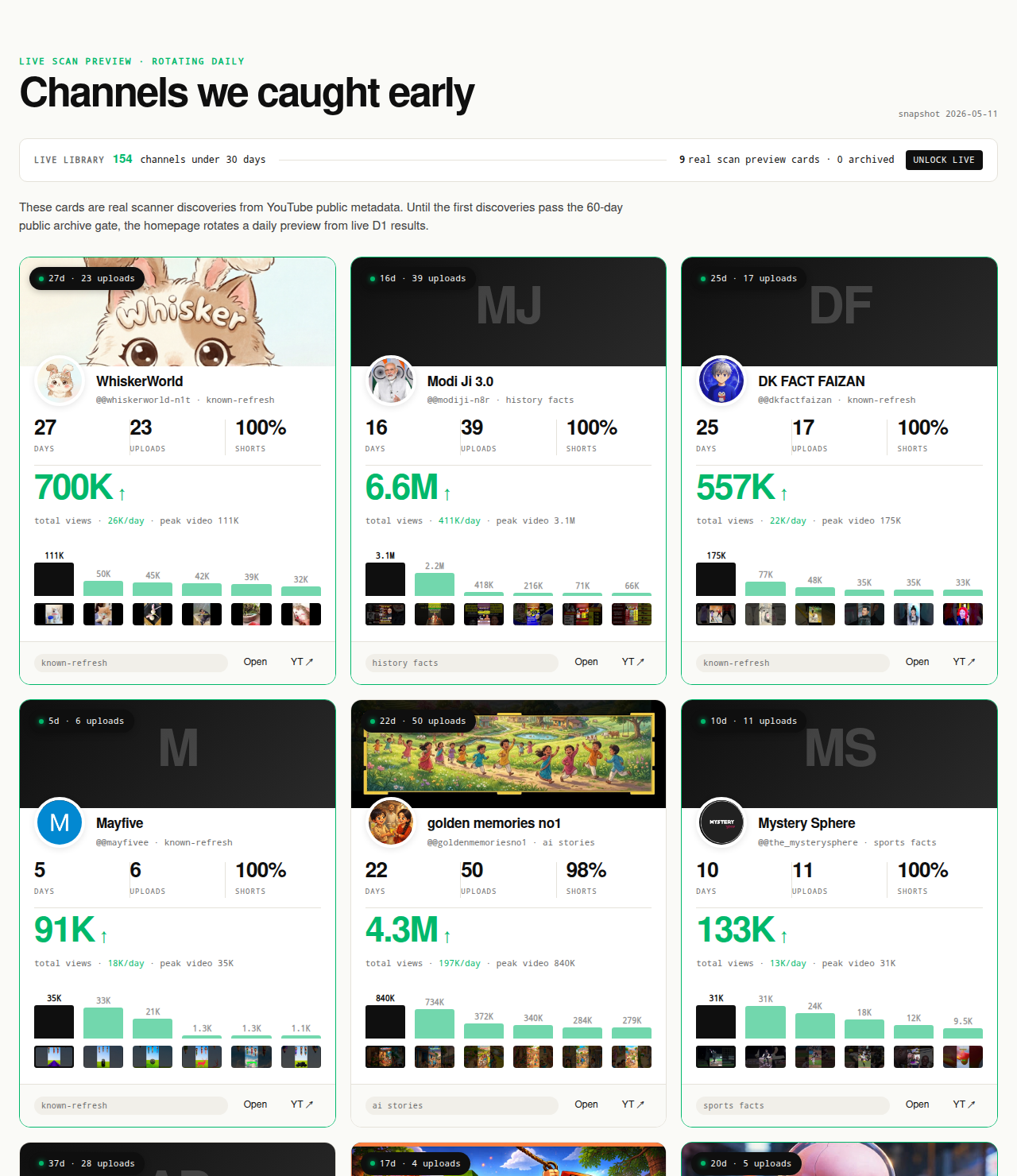
Original-research artifacts in this article: the Shorts-feed-vs-Browse niche-finder distinction in the opening section, the four-step Shorts-specific workflow, the three weight-shift differences from a general niche-finder, the live Shorts-first niche-cluster snapshot, and the revealed channel cards above the fold. Format clusters discussed reflect what we've scanned, not all of Shorts YouTube. Author: Nicholas Major (Founder, NicheBreakout · Software engineer since 2011). Article last revised 2026-09-21.
Live scan freshness:
Related research
- YouTube Shorts trends: the parent pillar covering the trend taxonomy, surface split, and channel-velocity framing that this page applies to niche-finding.
- YouTube niche finder: the lateral pillar covering the general-case methodology across Shorts-first and long-form-first channels.
- YouTube Shorts ideas: topic-level brainstorming downstream of format selection.
- Best YouTube Shorts niches: sibling cluster page indexing the most-populated format clusters.
- YouTube Shorts ideas without showing face: faceless-only narrowing of the Shorts ideas surface.
- How to find trending Shorts: per-Short discovery workflow downstream of channel-level filtering.
- Faceless YouTube niches: production-mode angle that overlaps most Shorts-first formats.
- YouTube channel research: broader channel-discovery category.
- YouTube outlier finder: breakout-discovery framing applied to any channel type.
- Most profitable YouTube niches: companion listicle backed by examples from the live cohort.
- How to do YouTube niche research: the full process guide downstream of the niche-finder pillars.
- AI story channels, Reddit story channels, history shorts channels, quiz channels, faceless storytelling channels: programmatic topic pages tracking specific Shorts-first format clusters.
The Friday digest sends three current breakout channels every week — Shorts-first and long-form-first both — with format fingerprints and outbound YouTube links. Free, present-tense. The live library refreshes daily and surfaces channels currently inside the 30-day window. See pricing for the current tier; subscribe to the digest free.
End of cluster
Find the Shorts format the recommender is lifting today
Every channel card outbound-links to YouTube so you can audit the public metadata yourself. The live under-30-day library is the paid workflow; the Friday digest is free.