
/ Cluster · Small YouTube channels blowing up
Small YouTube channels blowing up: the public-data signature of an actual inflection
"Blowing up" is a hype phrase, but a defensible reading exists if you write one. Most small channels the open web describes as "blowing up" had one viral upload; the channel itself never crossed the inflection. The version of the phrase this page operates under is narrower: a small channel is blowing up when the channel-level public-data signature has shifted — first-5 sum views climbing, lifetime views per day jumping against the prior baseline, and the per-upload distribution staying distributed enough that the lift is not concentrated in a single video. This page distinguishes "blew up once" from "blowing up" and shows the public-data signature of the second case. Research base: thousands of channels scanned to date — public YouTube Data API v3 metadata only.

Ai stories by shano
 45d · 36 uploads
YOU & ME
 45d · 25 uploads
Dootoons TV
 45d · 69 uploads
Mr Pawsome
 42d · 64 uploads
sajkcasqq
 38d · 38 uploads
OP Nigma

FactD
 45d · 31 uploads
Cognexa Talks
 39d · 21 uploads
MapLore
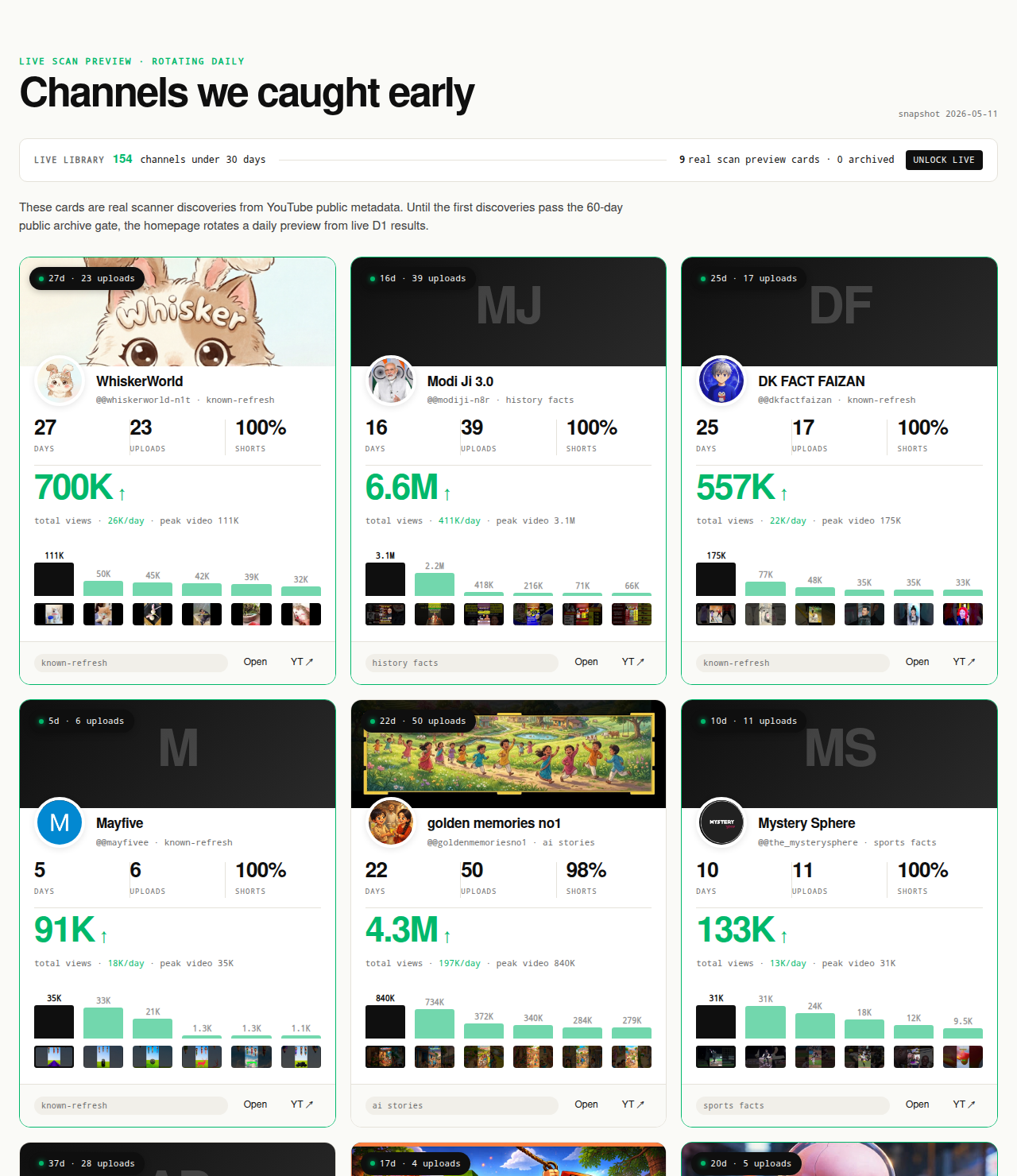
What "blowing up" actually means for a small YouTube channel
"Blowing up" is a phrase that does not survive close inspection unless someone writes it down. In open-web writing it gets applied to viral one-hits, channels that crossed a subscriber-count threshold, channels riding a trending topic, and channels whose week-over-week view counts ticked up by some unspecified amount. None of those are the same object. The version this page operates under is concrete: a small YouTube channel is blowing up when its channel-level public-data signature has crossed an inflection across multiple uploads, not when one upload went viral.
The inflection is readable from four public Data API v3 fields. Channel age places the channel inside the small-channel window — under 45 days from creation. First-5 upload views sums the first five public uploads and has to clear a low-thousands floor (10,000) for the content vehicle to be readable as working. Lifetime views per day measures age-adjusted velocity and has to clear a 1,000 floor for the inflection to register against the cohort. Per-upload distribution measures concentration — whether the channel's view total comes from one viral upload or from a distributed pattern across several. The fourth check is the one that separates "blew up once" from "blowing up."
"Blowing up" is also present-tense — the channel is in motion, the metrics are currently lifting, the inflection has not yet settled into either continued scaling or regression. A channel that blew up six months ago is no longer blowing up; it is either a channel that scaled or a channel that regressed. The phrase only applies to channels currently inside the inflection window, which is why real-time scanning is the only sourcing model that delivers "blowing up" research at the layer where it is useful.
The framing disciplines what evidence the page owes. An "actually blowing up right now" claim comes with the channel's age in days, upload count at detection, first-5 sum views, lifetime views per day, the cohort-comparison multiple, and a per-upload distribution that demonstrates the inflection is not concentrated in a single video. Every blowing-up label NicheBreakout publishes is paired with those fields, and every channel card outbound-links to YouTube so a reader can verify them.
Blew up once vs. blowing up
The single most common research mistake on this topic is conflating one viral upload with a channel-level inflection. They look similar from the outside — one channel and one large number — but they are different objects, and a researcher who acts on the first as if it were the second usually ends up studying noise. The diagnostic that separates them is concentration: what share of the channel's total views comes from the single highest-view upload.
Blew up once describes a channel whose total views are concentrated inside one upload. Imagine a 30-day-old channel with twelve uploads, 920,000 total views, and a single upload accounting for 880,000 of those views. The other eleven uploads share 40,000 across them. The concentration ratio is roughly 96%. The channel had a viral event — one upload caught the recommender on the right surface at the right moment. The other uploads did not benefit meaningfully from the spike. The channel is not blowing up; it has one viral video on it.
Blowing up describes a channel whose total views are distributed across multiple uploads. Imagine a 30-day-old channel with twelve uploads, 920,000 total views, where the highest-view upload accounts for 180,000 and the next several uploads cleared 60,000 to 110,000 each. The concentration ratio is roughly 20%. The recommender is lifting the channel's format consistently, not one specific video. The next upload will probably land in a similar neighborhood because the lift is format-driven, not video-driven.
The diagnostic is easy to run manually: divide the highest single-upload view count by the channel's total view count. Above roughly 60% is one viral video on a quiet channel. Under roughly 30% is a distributed inflection. Between is ambiguous and worth a second scan a week later — a 40%-concentration channel whose other uploads also clear the cohort median is closer to blowing up than to one-viral-video, but the read is noisier.
NicheBreakout's first-5 sum gate is a softer version of the same check. Requiring the first five uploads to sum to 10,000 views makes it harder for a channel with one viral video and four low-performers to pass — the gate is sensitive to whether the early-window distribution is balanced enough that the recommender is reading the channel's format, not one specific upload.
The deterministic filter for a small channel actually blowing up
NicheBreakout's flagging methodology operationalizes the blowing-up label as a hard-gate filter plus a deterministic score. A channel enters the live library when it passes three hard public-metadata gates, then ranks inside the library on a score that weights two bonuses. The full methodology is published on the methodology page; the abbreviated readout follows.
Channel age
detected within 45 days of channel creationFirst-5 upload views
combined views across the first five public uploads ≥ 10,000Views per day
lifetime channel views ÷ channel age ≥ 1,000Format clarity (bonus)
score weights channels with a clear Shorts-first or long-form-first ratio above mixed-format channelsEarly-traction velocity (bonus)
score boost when channel age ≤ 14 days, first-5 sum ≥ 50,000, or views/day ≥ 5,000
The three hard gates each isolate a different piece of the inflection signature. Channel age ≤ 45 days restricts the candidate pool to channels whose traction is recommender-driven rather than audience-driven. First-5 sum views ≥ 10,000 separates channels with a working content vehicle from channels with one lucky video — five uploads sharing 10,000 views is the smallest sample size that survives single-video flukes. Views per day ≥ 1,000 is the cleanest velocity-based check available from public metadata; it represents the channel's age-adjusted view count and maps directly to the cohort-median comparison.
The two score bonuses sharpen the ranking. Format-clarity bonus weights channels with an unambiguous Shorts-first or long-form-first format because the cohort comparison is more meaningful for format-consistent channels — a mixed-format channel is evaluated against two different medians and shows up weakly in both. Early-traction velocity bonus rewards channels at the extreme end of the inflection distribution: age ≤ 14 days, first-5 sum ≥ 50,000, or views/day ≥ 5,000.
Average first-five-video views for every populated grade tier inside our discoveries cohort looks like this (grades with no current members are suppressed until they fill in):
The score formula, grade thresholds, and edge cases — channels gaming the format-clarity signal by deleting non-conforming uploads, channels whose first-5 sum is dominated by a single viral video, channels with hidden subscriber counts — live on the methodology page. The how to find small YouTube channels companion guide walks through how to apply these signals manually.
The public-data signature of an inflection
Read the signature in a specific order, because each field constrains the meaning of the next. The order is: first-5 sum, views/day acceleration, upload cadence, format clarity, concentration ratio. Researchers who start with the most recent viral upload or with subscriber count usually misread the signature, because the inflection lives in the channel-level distribution, not in any single upload.
First-5 sum jump. Sum view counts on the first five public uploads. An inflection requires the sum to clear 10,000, and the cleaner the distribution the better. Five uploads sharing 50,000 evenly is a different signal than one at 48,000 and four at 500. The first-5 window is the period during which the channel's format-audience match is being established under the recommender; a working match produces a distributed first-5 sum.
Views/day acceleration. Divide aggregate channel view count by channel age. The result is lifetime views per day, the closest public-data proxy for recommender-driven lift. An inflection requires the channel to clear 1,000 views per day. A 3,400-views-per-day channel is an inflection against a 400-views-per-day cohort and unremarkable against an 8,000-views-per-day cohort.
Sustained upload cadence. Count uploads against age. A channel that crossed the thresholds three weeks in and then stopped publishing is no longer blowing up — the recommender needs new uploads to keep lifting the channel. Sustained cadence after the inflection started is the cleanest read that the operator is actively running the channel. Extremely high cadence (more than two uploads per day on a young channel) sometimes triggers YouTube's mass-production heuristics and is worth treating as a flag.
Format clarity holding. Compute the Shorts ratio or read the duration distribution from videos.list. A channel inside an inflection is usually 80%+ Shorts or 80%+ long-form, not a mix. The recommender treats the Shorts feed and the Browse/Suggested surfaces as separately ranked surfaces inside YouTube's own product (YouTube Official Blog: Shorts and long-form on YouTube), and a format-consistent channel teaches the recommender a cleaner audience profile. A channel that ran 90% Shorts during its first two weeks and is now publishing a mix of Shorts and long-form is mid-pivot; the inflection read becomes ambiguous.
Concentration ratio. Divide the highest single-upload view count by the channel's total. Under 30% is a distributed inflection. Over 60% is one viral upload on a quiet channel. The concentration check is the strictest version of the blew-up-once-vs-blowing-up diagnostic and is the field that most often disqualifies channels the open web has labeled as "blowing up."
A worked-shape example, kept generic: a channel created 26 days ago, 14 Shorts uploads under 50 seconds, AI-storytelling cluster. Aggregate views 380,000. View velocity 14,600 per day. First-5 sum 22,000, evenly distributed. Shorts ratio 1.0. Highest single-upload view count 78,000; concentration ratio 20.5%. Cadence every two days. This signature clears all three gates with room to spare, earns both bonuses, and passes the concentration check. Every number is verifiable from the channel's own YouTube page in under two minutes.
Why most "small channels blowing up" content focuses on the wrong signal
Open the open-web SERP for "small youtube channels blowing up" and the dominant content falls into three failure modes. None gives a researcher a clean read on what an actually-blowing-up channel looks like in public metrics.
The first is the viral-video listicle that picks ten channels whose latest upload broke a million views and presents them as blowing up — without checking whether the rest of each channel's uploads also broke baseline. A channel whose latest upload broke a million views and whose previous fifteen uploads each cleared 12,000 is a quiet channel that ran one viral upload. The recommender lifted a specific video; the channel itself did not cross an inflection. The "blowing up" label here is doing rhetorical work the channel-level public data does not support.
The second is the creator-growth-tips article that lists fifteen things small creators should do to "blow up" without naming any specific channel. Without a named channel, the article has no falsifiability mechanism — the advice is not pinned to evidence in the way a named channel pinned to public fields is.
The third is more subtle. Some content names specific channels and includes subscriber-count screenshots, but reads the inflection off subscriber count rather than view velocity. Subscriber count is rounded to three significant figures in the public Data API and is a lagging indicator — by the time a small channel's subscriber count has visibly jumped, the underlying view-velocity inflection happened weeks earlier. A 21-day-old channel with 4,000 subscribers and 14,600 views per day is in the middle of an inflection; a 21-day-old channel with 8,000 subscribers and 400 views per day is past whatever inflection it had. Subscriber-led listicles routinely flip those readings.
The corrective: read inflection off view velocity, first-5 sum, and concentration ratio — the public-data fields that capture the channel-level signal — rather than off any single video's view count or any subscriber-count screenshot.
What we deliberately don't claim about inflection moments
NicheBreakout does not publish a causal explanation of why any specific small channel is blowing up, AI-generated or otherwise. The blowing-up label is a public-metrics observation; the question of why a specific channel's format-audience match resonated depends on signals that are not third-party-readable. The official YouTube Data API v3 reference (YouTube Data API v3 reference) is the canonical list of what is exposed publicly. Watch time, audience retention curves, click-through rate, swipe-away rate, traffic-source breakdowns, and per-video impression counts are outside that list — they live behind the YouTube Analytics API, which Google reserves for channel owners and authenticated content partners (YouTube Data API: channels.list). Any "blowing up" content claiming to explain the recommender's reasoning is either reading authenticated owner data or making the explanation up.
The product-side discipline that follows is to stay descriptive rather than causal. Channel cards carry public fields; the methodology page carries the deterministic logic. Neither surface attempts a narrative explaining what is going on inside the channel that produced the public signature.
We also do not predict which small channels will blow up before the public-data signature shows it. NicheBreakout's scan flags channels when they cross the thresholds, which is the point at which the observation becomes defensible. The window between "the channel has not yet crossed the thresholds" and "the channel has crossed the thresholds" is the window the product does not claim to cover. The lag between threshold-crossing and listing is measured in hours, not weeks.
The third boundary is revenue. NicheBreakout does not publish per-channel revenue, RPM, CPM, or monetization claims. Revenue data lives behind the YouTube Analytics API and YouTube AdSense, both authenticated channel-owner-only. The most profitable YouTube niches sister page covers the structural reason. The blowing-up label is about traction, not monetization.
Common mistakes when reading blow-up signals
Six mistakes recur when researchers or creators try to use blow-up signals for niche decisions.
Treating one viral video as the channel signal. A 4M-view upload on a small channel is a viral event, not a channel-level inflection. The concentration ratio is the diagnostic — under 30% is distributed inflection, over 60% is one viral video. Read the channel-level distribution, not the highest-view upload in isolation.
Ignoring channel age. The blow-up label means something different on a 14-day-old channel than on a 14-month-old channel. The older channel has a year of accumulated audience momentum; the new channel has the recommender doing the lifting. A reader who copies the older channel's current strategy is studying a system whose performance depends on inputs they do not have. The YouTube niche validation checklist operationalizes the age-cohort discipline into a workflow.
Copying the topic of the one viral video instead of the channel's format. When a small channel's latest upload breaks a million views, the obvious mistake is to publish on the same topic. Topics saturate in weeks; the recommender has already started rotating the topic out by the time a new entrant publishes their version. The format (production mode, length, cadence, visual template, hook style) generalizes across topics for months and is the variable a new entrant can replicate. The faceless YouTube niches sister pillar covers the format-vs-topic distinction in production-mode detail.
Treating subscriber count as the inflection signal. Subscriber count is rounded to three significant figures in the public Data API and is a lagging indicator. A 21-day-old channel with 4,000 subscribers and 14,600 views per day is in the middle of an inflection; a 21-day-old channel with 8,000 subscribers and 400 views per day is past it. Weight view velocity and first-5 sum above subscriber count.
Confusing trending-topic spikes with channel-level inflections. A small channel publishing on a trending topic may see a one-upload spike that has nothing to do with the channel's underlying format-audience match. The next upload — on a non-trending topic in the same format — usually reveals whether the lift was format-driven or topic-driven. Weight channels with several uploads of consistent performance over channels with one trending-topic upload.
Skipping the cohort comparison. A channel-level metric in isolation is not an inflection signal; it becomes one only relative to a peer cohort of similar-age, similar-format channels. A 5,000-views-per-day channel is an inflection if the cluster median is 500 and unremarkable if the cluster median is 12,000. Bucket by format cluster before computing the inflection multiple — the bucketing NicheBreakout's methodology does internally.
The clusters currently producing the most blowing-up small channels in our scans
Blowing-up channels in our 2026 scans cluster into a handful of format-topic intersections that keep producing inflections inside the 45-day window. Across the channels currently inside our live 30-day window — a subset of the broader thousands of-channel scan — the densest niche clusters meeting our sample-size threshold are:
The Shorts-first vs long-form split inside those top clusters looks like this in our dataset:
Format clustering is the right unit of analysis for inflection detection because cohort medians are most meaningful inside a format cluster. A TTS-narration history-shorts channel compared against other TTS-narration history-shorts channels produces a clean inflection multiple; the same channel compared against all history channels produces a noisy comparison dominated by format-fit variance.
Separately from the live snapshot, NicheBreakout maintains dedicated programmatic topic pages for five recurring format clusters that produce channel-level inflections repeatedly:
- AI story channels: TTS narration plus AI imagery, recurring story templates, Shorts-first publishing.
- Reddit story channels: TTS reading r/AmITheAsshole, r/ProRevenge, r/MaliciousCompliance threads with stock visuals.
- History shorts channels: fact-stacking with cinematic visuals, vertical and horizontal variants.
- Faceless storytelling channels: broader narrative format spanning fiction and non-fiction.
- Quiz channels: interactive Q&A format, often Shorts-first with text overlays.
The parent YouTube outlier finder pillar covers the cross-cluster methodology, and the faceless YouTube niches sister pillar covers the production-mode angle most inflection-producing clusters fall under.
Why catching a small channel before the blow-up matters more than after
The research gap between catching a small channel during the blow-up window and catching it after collapses fast. A 30-day-old channel currently inside its inflection is a fundamentally different research object than the same channel at nine months old with 400,000 subscribers.
Inside the blow-up window, the channel is an experiment whose results the recommender is publishing in real time. The format has either been picked up by the algorithm at the small-channel layer or it has not, and the public-data signature shows which. A new entrant can read off the format (production mode, length, cadence, visual style, hook) and apply it to a different topic inside the same cluster, because the inflection signal lives in format-fit rather than in the audience the channel has accumulated.
By the time the same channel reaches 400,000 subscribers, the lift is partly downstream of the subscriber base — subscribers who get notified on every upload, watch most uploads regardless of topic, and drive early-window watch time the recommender reads as positive signal. A new entrant studying the channel at 9 months is studying a system whose performance partly depends on inputs they do not have. The format read is still informative but is mixed with audience-momentum read in a way that is hard to disentangle.
The window typically lasts 30-to-90 days from first upload, after which subscriber accumulation begins to dominate the lift. A researcher who catches the channel inside that window has clean format data; a researcher who catches it three months later has format data contaminated by audience-momentum data.
The implication for sourcing: any blow-up surface whose lead time exceeds the blow-up window itself is structurally late. Annual "channels that blew up this year" listicles cannot deliver channels at the layer where they are most informative — by the time the listicle ranks, the channels inside it have already exited the window. Real-time scanning is the only sourcing model that delivers blowing-up channels at the useful layer, which is why NicheBreakout's live library updates daily and the Friday digest surfaces three current small-channel inflections per week rather than a once-a-year recap. The matured public archive, when it opens in summer 2026, will preserve the detection-time public fields of channels flagged during their blow-up window so the read remains the read at the moment of detection.
FAQ
What does it mean when a small YouTube channel blows up?
When a small YouTube channel blows up, the channel's public-metadata performance has crossed an inflection: lifetime views per day jumped sharply against the prior baseline, first-5 sum views cleared a low-thousands floor and kept climbing across the next several uploads, and the cohort-comparison multiple moved several notches above the same-age, same-format peer median. NicheBreakout's working definition is concrete: channel age under 45 days, first-five-upload sum views ≥ 10,000, lifetime views per day ≥ 1,000, and a per-upload distribution distributed enough that no single video accounts for the majority of channel views. The phrase "blowing up" is descriptive of what the public metrics are doing right now, not predictive of where the channel will be six months from now.
How do small YouTube channels blow up?
From the outside the public-data signature looks similar on most channels that blow up: a young channel publishes into a format the recommender is currently lifting, the first few uploads clear an unusual view-count floor, the next uploads land in the same neighborhood instead of regressing toward zero, and the cohort comparison places the channel several multiples above the peer median. The mechanics inside the channel — which thumbnail style, which hook, which AI tool — are private to the operator and not third-party-readable. The methodology page covers the full set of public-data fields the inflection is readable from.
Can I see which small YouTube channels are blowing up right now?
The live 30-day window inside NicheBreakout's library — channels under 30 days old that have cleared the three hard gates — is the paid workflow surface. The Friday digest is free and surfaces three current small-channel inflections every week with format fingerprints and outbound YouTube links so the public metadata is verifiable in one click. The matured public archive opens as a second free surface in summer 2026 once the first detected cohort ages past the 60-day post-detection mark, with both detection-time and current-state public fields preserved.
What's the difference between viral and blowing up?
Viral describes a single upload reaching a large absolute view count — a one-event observation about one video. Blowing up describes the channel as a whole pulling abnormal traction across multiple uploads inside its first 45 days. A viral video on a mature channel does not make the channel blow up. The concentration test is the cleanest diagnostic: if one upload accounts for 70%+ of channel views, the channel had a viral event and is otherwise unremarkable; if no single upload accounts for more than 25-to-30%, the channel has a real inflection. The parent YouTube outlier finder pillar covers the full disambiguation.
Why do some small channels blow up and others don't?
From the public-data side the question is partially unanswerable. The variables that determine whether a given small channel crosses the inflection are mostly downstream of inputs the YouTube Data API does not expose: the operator's posting cadence, the title and thumbnail experiments, the recommender's current weighting of the format, audience saturation inside the topic, copyright or policy events, the operator's willingness to keep publishing through the first few low-performing uploads. What the public data does support is the after-the-fact observation: channels that blow up tend to be format-consistent, publish on a cadence the recommender can read, and run inside format-topic intersections where peer-cohort channels are also being lifted.
Can I copy a blowing-up channel?
Copy the format, not the topic. Format is the variable the recommender reads at the channel level — production mode (faceless vs face-on-camera), video length distribution, publish cadence, visual template, hook style. Topic rotates inside a working format. A new entrant publishing the exact same topic into the same format usually saturates faster than one running a sibling topic inside the same format. The faceless YouTube niches sister pillar covers the format-vs-topic split in production-mode detail.
How long does it take a small channel to blow up?
In our scans the inflection usually shows up between the third and the twentieth upload, on channels less than 45 days old. The lower end — channels crossing the thresholds inside their first week with three or four uploads — usually correlates with the early-traction velocity bonus (age ≤ 14 days, first-5 sum ≥ 50,000, or views/day ≥ 5,000). The higher end — channels crossing the thresholds around their thirtieth day with a dozen-plus uploads — usually correlates with format-clarity. Past 45 days the public-data signature becomes harder to read cleanly because subscriber accumulation starts contributing to the lift.
Are small channels that blow up worth subscribing to long-term?
Depends on what you want. If the goal is to watch formats and topics the recommender is currently lifting at the small-channel layer, subscribing to channels inside their blow-up window is a high-signal way to fill your feed with content the system itself is treating as fresh. If the goal is to find a creator you will keep watching for years, the blow-up label gives you no information about that — a meaningful share of channels that blow up regress to the cohort median or stop publishing within six months. Treat subscriptions to blowing-up channels as a research tool, not a long-term creator commitment.
Methodology / About this analysis
NicheBreakout's research relies entirely on YouTube Data API v3 public fields: channel age, subscriber count (rounded to three significant figures), video count, view count, video metadata, publish dates, duration, and per-video performance. The small-channel inflection observations on this page are derived from the same scan that powers the main live library — no separate dataset, no authenticated YouTube Analytics API access, no inferred private metrics, no AI-generated narratives explaining why specific channels are blowing up. Cohort medians are computed inside format clusters so the inflection multiple stays apples-to-apples.
Original-research artifacts: the blew-up-once vs blowing-up disambiguation, the concentration-ratio diagnostic, the deterministic flagging methodology, the five-step public-data signature read, the structural critique of subscriber-count-led blow-up listicles, and the revealed channel cards above the fold. Author: Nicholas Major (Founder, NicheBreakout · Software engineer since 2011). Article last revised 2026-09-21.
Live scan freshness:
Related research
- YouTube outlier finder: the parent pillar covering channel-level vs video-level outlier detection and the statistical case behind the inflection label.
- Breakout YouTube channels: sibling cluster page covering the product-language framing of the same object and the matured-archive publishing rule.
- Up-and-coming YouTube channels: sibling cluster page covering the rhetorical framing of channels currently inside their breakout window.
- New YouTube channels growing fast: sibling cluster page (when built) covering the freshness-and-sustained-velocity framing on the same object.
- YouTube channels before they blow up: sibling cluster page (when built) covering the speculative-listicle framing.
- How to find small YouTube channels: the manual-workflow version of channel-level inflection detection for researchers building a private workflow.
- YouTube channel research: sister pillar covering the broader channel-discovery category that inflection detection sits inside.
- YouTube niche finder: sister pillar covering niche research across breakout-channel discovery and the broader niche-finder category.
- Faceless YouTube niches: sister pillar covering the production-mode angle that dominates most inflection-producing clusters.
- YouTube Shorts trends: sister pillar covering the Shorts-first publishing angle that dominates the small-channel inflection layer.
- Most profitable YouTube niches: companion pillar covering the public-data-vs-private-data boundary on revenue and monetization claims.
- AI story channels: programmatic topic page tracking the AI-storytelling inflection cluster.
- Reddit story channels: programmatic topic page tracking the Reddit-narration inflection cluster.
- History shorts channels: programmatic topic page tracking the history-shorts inflection cluster.
- Faceless storytelling channels: programmatic topic page tracking the broader storytelling cluster.
- Quiz channels: programmatic topic page tracking the quiz/trivia cluster.
The Friday digest sends three current small-channel inflections every week with format fingerprints and outbound YouTube links — free, present-tense. The live library refreshes daily and surfaces channels currently inside the 30-day window. See pricing for the current tier; subscribe to the digest free.
End of cluster page
Find the small YouTube channels blowing up today
Every channel card outbound-links to YouTube so you can audit the public metadata yourself. The live under-30-day library is the paid workflow; the Friday digest is free.