
/ Cluster · Breakout YouTube channels
Breakout YouTube channels: how to read the public-data signature before the channel is obvious
A breakout YouTube channel is a channel whose public-metadata performance significantly exceeds the baseline for its size, age, or genre cohort — measurable from public Data API v3 fields, observable before the channel becomes obvious to the broader market. "Breakout" is the term NicheBreakout uses for this object because it is more accurate than "viral" (which describes one video) and more useful than "trending" (which describes one moment). This page defines the term, shows how to read a breakout channel's public-data signature deterministically, and stays inside what public metadata can support. Research base: thousands of channels scanned to date — no private metrics, no AI-generated explanations of why specific channels broke out.

Ai stories by shano
 45d · 36 uploads
YOU & ME
 45d · 25 uploads
Dootoons TV
 45d · 69 uploads
Mr Pawsome
 42d · 64 uploads
sajkcasqq
 38d · 38 uploads
OP Nigma

FactD
 45d · 31 uploads
Cognexa Talks
 39d · 21 uploads
MapLore
What "breakout YouTube channel" actually means
A breakout YouTube channel is a channel whose public-metadata performance significantly exceeds the baseline for its size, age, or genre cohort. The word "significantly" is doing measurable work in that sentence — it does not mean "a lot" in a colloquial sense, it means by a multiple large enough that the channel is unlikely to be inside the same distribution as its peers. The word "cohort" is doing the other half — without a defined peer group, "exceeds the baseline" has no anchor. A 21-day-old channel publishing TTS-narration history shorts compared against TTS-narration history shorts channels of similar age produces a meaningful multiple. The same channel compared against all of YouTube produces a number that means little.
NicheBreakout uses "breakout" as the operating term because the alternatives are either too narrow or too vague. "Viral" describes a single video that hit a large absolute view count, usually outside the channel's normal audience — a one-event observation, not a channel-level trajectory. "Trending" describes whatever is currently popular at the surface level, with no inherent claim about the channel's age, size, or peer comparison. "Outlier" is statistically clean but generic; an outlier can be a video, a channel, or a one-day spike depending on the distribution being measured. "Breakout" specifically refers to a channel as a whole outpacing its peer cohort across multiple uploads inside a young-channel window — which is the object that is actually useful for niche research and the object the product is built to find.
The framing matters because it determines what evidence the page owes the reader. A "viral video" claim should come with one video's view count. A "trending topic" claim should come with a current popularity ranking. A "breakout channel" claim, in the way this page uses the term, comes with channel age, upload count at detection, aggregate view count, lifetime views per day, and the peer-cohort comparison that placed the channel above its cohort median. Every breakout label NicheBreakout publishes is paired with those public fields, and every channel card outbound-links to YouTube so a reader can verify the fields directly.
The label is descriptive, not predictive. A channel flagged as a breakout today is one whose public metrics currently outpace its peer cohort under the recommender. Whether the same channel will keep breaking out next month depends on signals public data cannot read. The breakout label is a present-tense observation of public metrics, not a forecast.
Breakout vs viral vs trending vs outlier
Four words get used interchangeably in YouTube-research content and they mean four different things. Disambiguating them matters because each one carries a different research question and a different evidence standard.
Viral describes absolute view-count magnitude on a single piece of content. A 5M-view video is viral regardless of whether the channel that published it normally clears 50,000 or 5M; the term is absolute, not relative. Viral events are usually single videos and usually do not repeat at the same scale — the next upload from a channel that hit a viral 5M-view video typically lands closer to the channel's existing baseline. Viral evidence is one number: the absolute view count.
Trending describes whatever is currently popular at a particular surface (the Shorts feed, the trending tab, a country-level top list) at a particular moment. The label says nothing about the channel's age, size, or sustainability — a fifteen-year-old channel and a fifteen-day-old channel can both be on a trending surface for an afternoon. Trending evidence is a current surface position, which means it has roughly the shelf life of the surface itself.
Outlier is the statistical generalization. An outlier is an observation that sits far enough from the median or mean of a distribution that it is unlikely to have come from the same generating process as the rest. On YouTube the distribution depends on what you measure: video views inside a channel, channel views per day inside a peer cohort, first-five-video sums across newly created channels. Outlier evidence is a multiple against a defined baseline — the harder part is choosing the baseline. The parent YouTube outlier finder pillar covers the video-outlier vs channel-outlier distinction in depth.
Breakout, as this page uses the term, is the specific subset of channel-level outlier that applies inside a young-channel window. A breakout channel is a channel under a defined age threshold (NicheBreakout uses 45 days) whose aggregate metrics (views per day, first-5 sum, age-adjusted view count) sit far above the median of its same-age, same-format peer cohort. Breakout evidence is the full cohort comparison plus the channel's age, upload count, and aggregate views — the channel-as-a-whole, multi-upload, peer-relative version of outlier.
The four labels map onto different research conclusions. "Viral" is one-event evidence and risks generalizing from a single sample. "Trending" is surface-state evidence and risks confusing an afternoon's ranking with a structural pattern. "Outlier" is the right statistical word, but unqualified it does not say which distribution. "Breakout" specifically points at the upstream object that matters for niche research — small channels outpacing their cohort before any single video carries them — which is the signal a new entrant can read meaningfully.
Why "breakout" is the useful frame for niche research
Niche research asks a specific question: given a format-topic intersection, is the recommender currently lifting new entrants who run that format, or has the intersection saturated? The question is answered at the channel level, not the video level. A single viral video on a mature channel does not tell you whether the recommender is lifting new entrants — the mature channel's audience momentum is doing the work, and that momentum is not replicable for a new creator. A trending topic at the surface level says even less; topics rotate weekly and the surface position lasts hours. The question that matters is which small channels are currently breaking out inside the format, which is exactly the object the breakout label points at.
The channel-level framing also fits how a new creator's first 45 days will be evaluated. A new channel does not have a subscriber base lifting it; the recommender is doing the audience-finding work. The signal that the recommender is currently warm for a format-topic intersection is what other small channels in the same intersection are achieving in public metrics — channel age, first-5 sum, views per day, Shorts ratio. If a 21-day-old peer channel publishing the same format clears 60,000 first-5 views and 4,000 views per day, the recommender is currently lifting that format. The new entrant's first 45 days will be evaluated by the same recommender against the same format-fit signal.
The video-level framing misses the upstream condition. A creator who reads ten outlier videos inside ten mature channels can extract format experiments from those channels (which thumbnails beat the channel's baseline, which titles broke out), but the read does not tell them whether the format itself is currently breaking out at the small-channel layer. The mature channel's outlier video is internally informative for the channel's operator and externally noisy for the niche researcher, because the mature channel's existing audience is part of the lift. The breakout-channel framing isolates the part of the lift that is replicable by reading channels small enough that the recommender, not the audience, is doing the work.
The channel-level framing also disciplines the time horizon. A breakout label inside a 45-day window is a near-real-time observation — the same scan that flagged the channel can be re-run a week later to see whether the channel is still inside the window and still outpacing its cohort. The label does not ask the reader to trust a forecast; it asks them to check the public metrics, which are verifiable on YouTube in one click. The parent YouTube outlier finder pillar covers the statistical case for channel-level over video-level detection in more depth.
The deterministic filter that flags a breakout channel
NicheBreakout's flagging methodology operationalizes the breakout label as a hard-gate filter plus a deterministic score. A channel enters the live library when it passes three hard public-metadata gates, then ranks inside the library on a score that weights two bonuses. Read the gates as the binary breakout criteria (in or out of the candidate set) and the score as the ordering inside the set. The full methodology is published on the methodology page; the abbreviated readout follows.
Channel age
detected within 45 days of channel creationFirst-5 upload views
combined views across the first five public uploads ≥ 10,000Views per day
lifetime channel views ÷ channel age ≥ 1,000Format clarity (bonus)
score weights channels with a clear Shorts-first or long-form-first ratio above mixed-format channelsEarly-traction velocity (bonus)
score boost when channel age ≤ 14 days, first-5 sum ≥ 50,000, or views/day ≥ 5,000
The three hard gates each isolate a different piece of the breakout signature. Channel age ≤ 45 days restricts the candidate pool to channels whose traction is recommender-driven rather than audience-driven; channels past that window have started to accumulate a subscriber base, which makes the cohort comparison noisier. First-5 sum views ≥ 10,000 separates channels with a working content vehicle from channels with one lucky video — five uploads sharing 10,000 views is the smallest sample size that survives single-video flukes while staying readable inside a working channel's first month. Views per day ≥ 1,000 is the cleanest velocity-based check available from public metadata; it represents the channel's age-adjusted view count and is the variable that most directly maps to the cohort-median comparison.
The two score bonuses sharpen the breakout ranking inside the qualified set. Format-clarity bonus weights channels with an unambiguous Shorts-first or long-form-first format above format-mixed channels because the cohort comparison is more meaningful for format-consistent channels — a mixed-format channel is being evaluated against two different cohort medians and shows up weakly in both. Early-traction velocity bonus rewards channels at the extreme end of the breakout distribution: age ≤ 14 days, first-5 sum ≥ 50,000, or views/day ≥ 5,000 each indicate the channel is outpacing its peer cohort by an unusually large multiple. These are the channels worth surfacing first because the breakout strength is unambiguous.
Average first-five-video views for every populated grade tier inside our discoveries cohort looks like this (grades with no current members are suppressed until they fill in):
The score formula, grade thresholds, and edge cases — channels gaming the format-clarity signal by deleting non-conforming uploads, channels whose first-5 sum is dominated by a single viral video, channels with hidden subscriber counts — live on the methodology page. The companion how to find small YouTube channels guide walks through how to apply the signals manually for researchers building a private workflow without the paid library.
How to read a breakout channel's public-data signature
Read the channel's public Data API v3 fields in a specific order, because the order constrains what each later field can mean. The order is: channel age, then first-5 upload views, then view velocity, then format clarity, then upload cadence. Each field narrows the interpretation of the next one. Reading the fields in a different order — starting with subscriber count, for example, or starting with the most recent viral upload — usually produces a misleading read.
Step one: channel age. The channel's creation date is the anchor. A breakout interpretation requires the channel to be young enough that recommender-driven lift, not audience momentum, is doing the work. NicheBreakout's threshold is 45 days; researchers running the manual version can be slightly looser (60 to 90 days) at the cost of noisier cohort comparison. Anything older than 90 days is outside the breakout window — whatever the channel is achieving may be impressive, but it is no longer cleanly readable as recommender lift.
Step two: first-5 upload views. Sum the view counts on the first five public uploads. The first-5 sum is the cleanest signal that the content vehicle itself is working, as distinct from one viral upload accidentally landing. A breakout signature requires the sum to clear 10,000 — and the closer the five uploads are to each other (say, three uploads above 1,500 views) the cleaner the signal, because consistency across uploads is what the recommender reads at the channel level. A 50,000-first-5-sum where 48,000 came from one upload and the other four cleared 500 each is a different signal (one viral video, not a breakout) than 50,000 distributed evenly.
Step three: view velocity. Divide aggregate channel view count by channel age in days. The result is lifetime views per day, the closest public-data proxy for the recommender-driven lift that watch-time and impressions would measure if they were third-party-readable. A breakout signature requires the channel to clear 1,000 views per day. The number to compare against is the peer cohort's median (same age, same format), not an absolute threshold — a 1,500-views-per-day channel is impressive against a 200-views-per-day cohort and unremarkable against a 5,000-views-per-day cohort.
Step four: format clarity. Compute the Shorts ratio (number of videos under 60 seconds divided by total video count) or read the duration distribution directly from videos.list. A breakout-strength channel is usually format-consistent: 80%+ Shorts or 80%+ long-form, not a mix. The reason is that the recommender treats the Shorts feed and the Browse/Suggested surfaces as separately ranked surfaces inside YouTube's own product (YouTube Official Blog: Shorts and long-form on YouTube), and a format-consistent channel teaches the recommender a cleaner audience profile. A 50/50 mixed-format channel breaking out at the same view velocity is rarer and usually has a specific reason.
Step five: upload cadence. Count uploads against channel age. A 21-day-old channel with 25 uploads is publishing roughly daily; with five uploads, every four days. Cadence interacts with the earlier signals — high cadence with low per-video performance can still clear the gates by accumulating views, but the cleanest breakout signatures have both healthy cadence and healthy per-video performance. Extremely high cadence (more than two uploads per day on a young channel) sometimes triggers YouTube's mass-production heuristics.
A worked-shape example, kept generic: a channel created 26 days ago, 14 Shorts uploads under 50 seconds, AI-storytelling cluster. Aggregate views 380,000. View velocity 14,600/day. First-5 sum 22,000, evenly distributed. Shorts ratio 1.0. Cadence every two days. This signature clears all three gates with room to spare, earns the format-clarity bonus, and earns the early-traction velocity bonus. The peer-cohort comparison places the channel several multiples above its cluster median, and every number is verifiable from the channel's own YouTube page in under two minutes.
The matured archive: what makes a "matured" breakout publishable
NicheBreakout's product surface splits into three layers by channel age: the live 30-day window (paid), the under-60-day post-detection window (paid + not yet matured for the public archive), and the matured archive (60+ days post-detection, free, named in full). The split is a freshness-gate, not a redaction — every named channel surfaced on the public archive surface is real and outbound-links to YouTube. The 60-day post-detection threshold is the line between "live workflow value" and "publishable evidence."
The line exists because the breakout label is most useful when fresh and most defensible when checked. A channel inside the 30-day window is current breakout-research evidence — the kind of data the paid library exists to surface. The same channel at 60+ days post-detection has either continued breaking out (in which case the matured archive entry includes both the detection-time and current-state metrics), regressed to the cohort median (in which case the matured archive entry still includes the detection-time public metrics, with current state shown for transparency), or been deleted or restricted (in which case the entry notes the channel state). All three outcomes are publishable; the archive is honest about which outcome each channel produced.
The matured-archive surface opens as a second free surface in summer 2026 once the first cohort ages past the 60-day post-detection mark. Today's free surface is the Friday digest — three current breakouts every week with format fingerprints and outbound YouTube links. Both surfaces share the same evidence standard: every channel named outbound-links to YouTube for verification, and no card synthesizes a narrative about why the channel broke out beyond the public-data observation that it did.
The publishability boundary also avoids a specific failure mode of breakout-research content elsewhere on the web: lists of "channels that broke out two years ago" that present the channels' current state as if it were the detection-time state. NicheBreakout's matured archive shows both — detection-time public metrics and current-state public metrics — so a reader can see the trajectory from breakout to current state and judge for themselves whether the format is still readable.
The matured archive is not a "best channels of all time" list. It is the archival surface for channels NicheBreakout flagged as breakouts in real time under the deterministic methodology, retained with their detection-time public fields preserved. The retrospective value is in being able to point at a channel and say: here is what was public about this channel on the day NicheBreakout flagged it, here is what is public about the channel today, and here is the methodology that connected the two. The companion YouTube channel research sister pillar covers the broader channel-discovery category these archived entries fit inside.
What we deliberately don't claim about breakout channels
NicheBreakout does not publish a causal explanation of why any specific channel broke out, AI-generated or otherwise. The breakout label is a public-metrics observation; the question of why a specific channel's format-audience match resonated at this moment depends on signals that are not third-party-readable — audience retention curves, click-through rate on impressions, traffic-source breakdown, swipe-away rate, watch-time on Shorts. The official YouTube Data API v3 reference (YouTube Data API v3 reference) is the canonical list of what is exposed publicly; anything outside that list, including every signal that would actually answer "why," is not third-party-accessible.
The product-side discipline that follows from the boundary is to stay descriptive rather than causal. Channel cards carry public fields (channel age, view count, upload count, first-5 sum, views per day, Shorts ratio); the methodology page carries the deterministic logic that flags channels. Neither surface attempts to explain what is going on inside the channel that produced the public signature. A reader who wants a causal narrative can write their own from the public fields and from watching the channel's actual uploads; a reader who wants verifiable facts gets the facts as they appear in public metadata. The two reads are different products and deliberately so.
We also do not predict future breakouts before the public-data signature shows them. Predictive claims about which channels will break out — "we use AI to identify channels before they hit the breakout threshold" or similar — require either non-public signals or fabricated confidence in extrapolation from public ones. NicheBreakout's scan flags channels when they cross the public-data thresholds, which is the point at which the observation becomes defensible. The window between "the channel has not yet crossed the thresholds" and "the channel has crossed the thresholds" is the window the product does not claim to cover.
The third boundary is revenue. NicheBreakout does not publish per-channel revenue, RPM, CPM, or monetization claims for any channel surfaced — the same as every other NicheBreakout surface. The most profitable YouTube niches sister page covers the structural reason: revenue data lives behind the YouTube Analytics API and YouTube AdSense, both authenticated channel-owner-only. The breakout label is about traction, not monetization, and the page deliberately stops at traction.
Common mistakes when chasing breakout signals
Five mistakes recur in researchers and creators who try to use breakout signals for niche or format decisions. Chasing single-video virality and calling it a breakout. A 5M-view video on a young channel is a viral event; the same channel's full public-metadata signature (first-5 sum, views per day, upload cadence) may or may not support the breakout label. The mistake is reading one upload as the channel-level signal. Read the channel-level distribution: five uploads sharing 50,000 evenly is a breakout signature; one upload with 48,000 and four with 500 each is a viral event on an otherwise non-breaking channel.
Treating subscriber count as the breakout signal. Subscriber count is a lagging indicator and is rounded to three significant figures in the public API, which makes small-channel reads imprecise. A 21-day-old channel with 4,000 subscribers and 14,600 views per day is a breakout under the velocity signal; a 21-day-old channel with 8,000 subscribers and 400 views per day is not, despite the higher subscriber number. Weight view velocity and first-5 sum above subscriber count.
Copying the topic instead of the format. A breakout channel publishing into a specific topic invites the obvious mistake — publish on the same topic. Topics saturate in weeks; formats generalize across topics for months. The replicable variable for a new entrant is the format (production mode, video length, publish cadence, visual template, hook style), not the topic. A new entrant running a sibling topic inside the same format usually outperforms an entrant running the exact same topic, because the recommender reads format consistency at the channel level and rotates topics inside it. The faceless YouTube niches sister pillar covers the format-vs-topic distinction in detail.
Skipping the cohort comparison. A channel-level metric in isolation is not a breakout signal; it becomes a breakout signal only relative to a peer cohort of similar-age, similar-format channels. A 5,000-views-per-day channel is a breakout if the cohort median is 500 and unremarkable if the cohort median is 12,000. Without a cohort baseline, "above-median" is just the upper half of the distribution. Bucket by format cluster (Shorts-first vs long-form, faceless vs face-on-camera, primary niche tag) before computing the breakout multiple — the bucketing NicheBreakout's flagging methodology does internally.
Treating mature channels' current strategies as breakout evidence. A large channel's current upload strategy is downstream of years of recommender-trained audience momentum the new entrant does not have. The corrective is to study channels at the same age as the channel you are building — 30-day-old channels for a 30-day-old plan, not 30-month-old ones. The how to do YouTube niche research guide operationalizes the age-cohort discipline into a workflow.
The clusters currently producing the most breakouts
Across the channels currently inside our live 30-day window — a subset of the broader thousands of-channel scan — the densest niche clusters meeting our sample-size threshold are:
The Shorts-first vs long-form split inside those top clusters looks like this in our dataset:
Read the list as a current observation of where the recommender is lifting new entrants, not as a "best niches" ranking. Cluster mix shifts week over week as new format-topic intersections surface and older ones saturate. The clusters with the most channels passing the three gates inside the current scan window are the clusters where the breakout signal is currently warm at the small-channel layer.
Separately from the live cluster snapshot above, NicheBreakout maintains dedicated programmatic topic pages for five recurring format clusters that produce channel-level breakouts repeatedly in our scans:
- AI story channels: TTS narration plus AI imagery, recurring story templates, Shorts-first publishing.
- Reddit story channels: TTS reading r/AmITheAsshole, r/ProRevenge, r/MaliciousCompliance threads with stock visuals.
- History shorts channels: fact-stacking with cinematic visuals, vertical and horizontal variants.
- Faceless storytelling channels: broader narrative format spanning fiction and non-fiction.
- Quiz channels: interactive Q&A format, often Shorts-first with text overlays.
If the goal is to read breakout density inside a specific format cluster rather than across the live cohort, those five programmatic pages are the entry points. The parent YouTube outlier finder pillar covers the cross-cluster methodology, and the YouTube niche finder pillar covers the broader niche-research category these clusters fit inside.
FAQ
What's a breakout YouTube channel?
A breakout YouTube channel is a channel whose public-metadata performance significantly exceeds the baseline for its size, age, or genre cohort. Specifically — and the specificity matters — NicheBreakout flags a channel as a breakout when it clears three public Data API v3 gates: channel age ≤ 45 days from creation, first-five-upload sum views ≥ 10,000, and lifetime views per day ≥ 1,000. The label is descriptive of what is currently happening in public metrics, not predictive of where the channel will be in twelve months. Most flagged channels do not stay outliers forever; the value of the label is that it identifies which channels are currently outpacing their peer cohort under the recommender, before any single video goes viral.
How do you find breakout YouTube channels?
By running a deterministic filter over public Data API v3 metadata at scan-time, not by hunting. The four readable inputs are channel age (from the channel's creation date), aggregate view count, video count, and per-video performance. From those, the derived signals are lifetime views per day, first-five-video sum views, upload cadence, and Shorts ratio. A channel that passes the three hard gates lands in the candidate set; the score then ranks it inside the set with format-clarity and early-traction-velocity bonuses. The full methodology is on the methodology page. The how to find small YouTube channels guide walks through the manual version for researchers building a private workflow.
What makes a channel "breakout" instead of just "new"?
A new channel is one with a recent creation date. A breakout channel is a new channel that is also outpacing its peer cohort under the recommender — channels of similar age and format. The cohort comparison is what creates the breakout signal. A 21-day-old channel publishing into a format whose peer cohort averages 2,000 views per day is unremarkable at 1,500 views per day. The same channel at 30,000 views per day is a breakout. New is a calendar fact; breakout is a relative-performance observation against same-age, same-format peers.
Can you predict which channels will break out?
No, and we deliberately do not. The product is observational, not predictive. Public-data signals tell you which channels are currently outpacing their peer cohort — that is a present-tense fact about what the recommender is doing right now. Whether the channel will continue breaking out next month, plateau, or regress to the cohort median is downstream of decisions and signals NicheBreakout cannot read (the operator's posting cadence going forward, the recommender's surface mix, audience saturation inside the format, copyright or policy events). Anyone offering a tool that promises to predict breakouts before the public-data signature shows them is selling something that public-data inputs cannot support.
Are breakout YouTube channels worth copying?
Copy the format, not the topic. Format is the variable the recommender reads at the channel level — production mode (faceless vs face-on-camera), video length distribution, publish cadence, visual template, hook style. Topic is the variable that rotates inside a working format. A breakout channel publishing TTS-narration history shorts is signal that the format-audience match is currently warm; a new entrant publishing the same exact topic into the same format usually saturates faster than one running a sibling topic inside the same format. The faceless YouTube niches sister pillar covers the format-vs-topic distinction in production-mode detail.
How fresh are NicheBreakout's breakouts?
The live library refreshes daily and surfaces channels currently inside the 30-day window — present-tense breakouts. The Friday digest sends three current channel-level breakouts every week for free, each outbound-linking to YouTube so the public metadata is verifiable in one click. The matured public archive opens as a second free surface in summer 2026 once the first detected cohort ages past the 60-day post-detection mark; that archive will list named channels with their detection-time and current-state public fields. Live channels in the under-30-day window are the paid workflow surface today.
What's the difference between breakout and viral?
Viral describes a single video that hit a large absolute view count, usually outside the channel's normal audience. Breakout describes the channel as a whole outpacing its peer cohort across multiple uploads. Viral is a one-event observation; breakout is a multi-upload trajectory. A viral video on a mature channel does not make the channel a breakout — most viral videos on mature channels are downstream of the channel's existing audience momentum. A breakout channel, by contrast, is producing above-cohort traction without an audience moat to lean on, which is the signal a new entrant can read meaningfully. The parent YouTube outlier finder pillar covers the breakout-vs-outlier-vs-viral distinction in full.
Is there a free way to find breakout YouTube channels?
Yes, two routes. The Friday digest is free and surfaces three current breakouts every week with format fingerprints and outbound YouTube links. Separately, the manual version of the workflow is free for anyone willing to run it themselves: filter YouTube search to recently uploaded videos, click into the channels behind interesting uploads, check the channel's creation date and aggregate view count, divide view count by age in days, and screen for the three gates above. The manual route is slow without a tool — most candidates will fail one of the three gates — and the cohort-comparison step requires a peer-format reference distribution, which is the part hardest to assemble by hand. NicheBreakout's paid library automates the screen across the full scan window.
Methodology / About this analysis
NicheBreakout's research relies entirely on YouTube Data API v3 public fields: channel age (from creation date), subscriber count (rounded to three significant figures), video count, view count, video metadata, video publish dates, video duration, and recent video performance. The breakout-channel observations on this page are derived from the same scan that powers the main live library — no separate dataset, no authenticated YouTube Analytics API access, no inferred private metrics, no AI-generated narratives explaining why specific channels broke out. Cohort medians are computed inside format clusters (Shorts-first vs long-form, faceless production mode vs face-on-camera, primary niche tag) so the breakout multiple stays apples-to-apples.
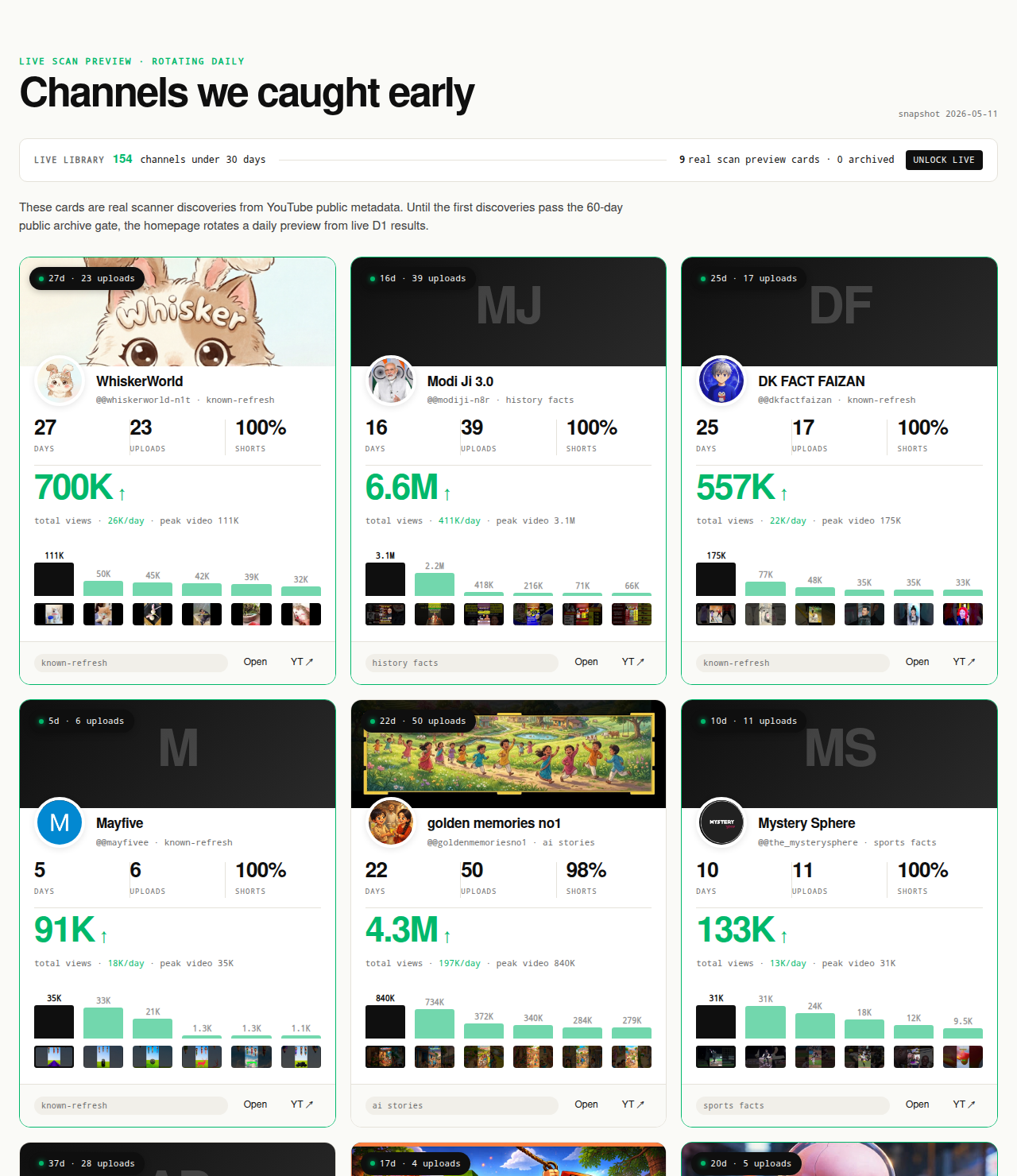
Original-research artifacts in this article: the breakout-vs-viral-vs-trending-vs-outlier disambiguation, the channel-level-over-video-level argument for niche research, the deterministic flagging methodology, the five-step public-data signature read, the matured-archive publishing rule, and the revealed channel cards above the fold. The breakout-producing format clusters discussed reflect what we have scanned, not the entirety of YouTube. Author: Nicholas Major (Founder, NicheBreakout · Software engineer since 2011). Article last revised 2026-09-21.
Live scan freshness:
Related research
- YouTube outlier finder: the parent pillar covering channel-level vs video-level outlier detection and the statistical case behind the breakout label.
- YouTube niche finder: sister pillar covering niche research across breakout-channel discovery and the broader niche-finder category.
- YouTube channel research: sister pillar covering the broader channel-discovery category that channel-level breakout detection sits inside.
- Faceless YouTube niches: sister pillar covering the production-mode angle that dominates most breakout-producing clusters.
- YouTube Shorts trends: sister pillar covering the Shorts-first publishing angle and the breakout-Shorts intersection.
- Most profitable YouTube niches: companion pillar covering the public-data-vs-private-data boundary on revenue and monetization claims.
- How to do YouTube niche research: the full process guide downstream of the niche-finder pillar.
- How to find small YouTube channels: the manual-workflow version of channel-level breakout detection for researchers building a private workflow.
- New YouTube channels growing fast: sibling cluster page (when built) covering the fast-growth angle on breakout discovery.
- Up and coming YouTube channels: sibling cluster page (when built) covering the prospective-channel framing.
- Small YouTube channels blowing up: sibling cluster page (when built) covering the small-channel-momentum framing.
- AI story channels: programmatic topic page tracking the AI-storytelling breakout cluster.
- Reddit story channels: programmatic topic page tracking the Reddit-narration breakout cluster.
- History shorts channels: programmatic topic page tracking the history-shorts breakout cluster.
- Faceless storytelling channels: programmatic topic page tracking the broader storytelling cluster.
- Quiz channels: programmatic topic page tracking the quiz/trivia cluster.
The Friday digest sends three current breakout YouTube channels every week with format fingerprints and outbound YouTube links — free, present-tense. The live library refreshes daily and surfaces channels currently inside the 30-day window. See pricing for the current tier; subscribe to the digest free.
End of cluster page
Find the breakout YouTube channels worth studying today
Every channel card outbound-links to YouTube so you can audit the public metadata yourself. The live under-30-day library is the paid workflow; the Friday digest is free.